
Catalogue Photography as a Cold Start: Toward Deployable Carbide Burr Recognition
Abilash Philip Madavath, Chandra Yuvesh Aubeeluck, Augustin Raju, Nicolas Pyschny, Felix Hackelöer, Florian Zwanzig · N/A · 2026
Framework
N/A
License
N/A
Stars
N/A
Summary
Verifying that manufactured batches of milling tools or carbide rotary burrs conform to production order sheets remains a largely manual and error-prone quality assurance task. Automating this process with computer vision faces a critical cold-start constraint since no labelled imagery is availab...
Abstract Summary
Key Points
- Verifying that manufactured batches of milling tools or carbide rotary burrs conform to productio...
- Automating this process with computer vision faces a critical cold-start constraint since no labe...
- We investigate how far catalogue supervision can support an industrial recognition pipeline under...
- Our findings reveal three key insights
- First, off-the-shelf frozen feature extractors do not reliably separate the two task attributes, ...
Catalogue Photography as a Cold Start: Toward Deployable Carbide Burr Recognition
|Authors: Abilash Philip Madavath, Chandra Yuvesh Aubeeluck, Augustin Raju, Nicolas Pyschny, Felix Hackelöer, Florian Zwanzig
|Venue: arXiv preprint | Year: 2026
|arXiv: 2609.03995v1
Abstract
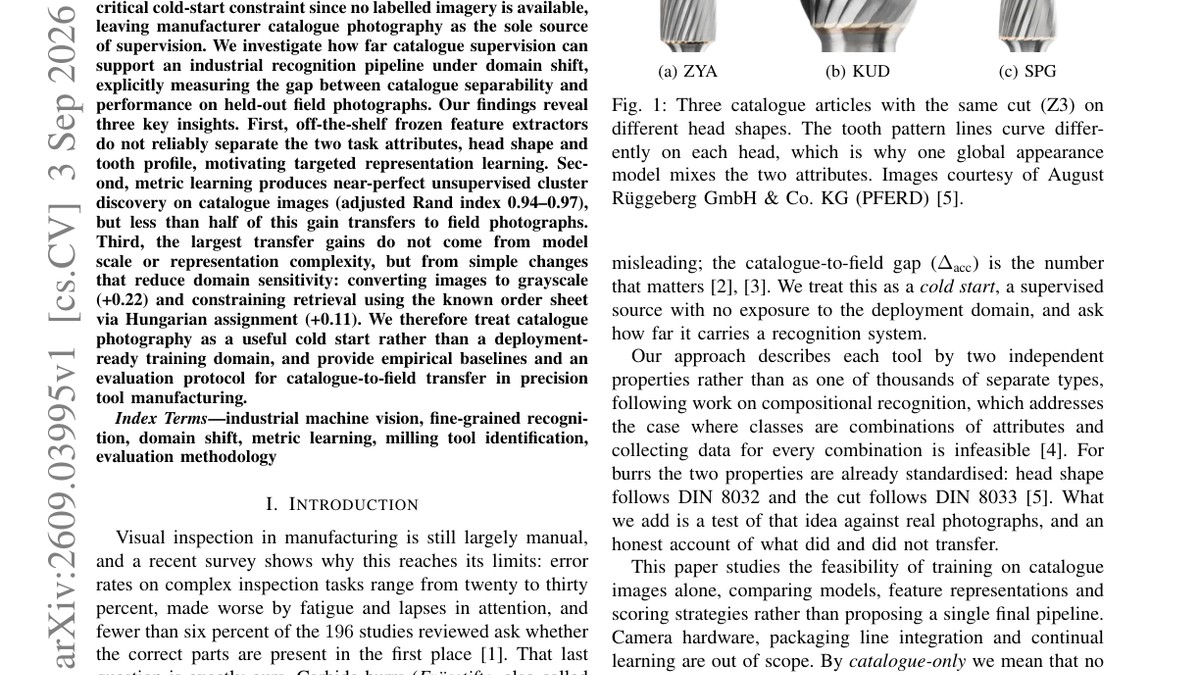
Verifying that manufactured batches of milling tools or carbide rotary burrs conform to production order sheets remains a largely manual and error-prone quality assurance task. Automating this process with computer vision faces a critical cold-start constraint since no labelled imagery is available, leaving manufacturer catalogue photography as the sole source of supervision. We investigate how far catalogue supervision can support an industrial recognition pipeline under domain shift, explicitly measuring the gap between catalogue separability and performance on held-out field photographs. Our findings reveal three key insights. First, off-the-shelf frozen feature extractors do not reliably separate the two task attributes, head shape and tooth profile, motivating targeted representation learning. Second, metric learning produces near-perfect unsupervised cluster discovery on catalogue images (adjusted Rand index 0.94—0.97), but less than half of this gain transfers to field photographs. Third, the largest transfer gains do not come from model scale or representation complexity, but from simple changes that reduce domain sensitivity: converting images to grayscale (+0.22) and constraining retrieval using the known order sheet via Hungarian assignment (+0.11). We therefore treat catalogue photography as a useful cold start rather than a deployment-ready training domain, and provide empirical baselines and an evaluation protocol for catalogue-to-field transfer in precision tool manufacturing.
Key Contributions
- Verifying that manufactured batches of milling tools or carbide rotary burrs conform to productio…
- Automating this process with computer vision faces a critical cold-start constraint since no labe…
- We investigate how far catalogue supervision can support an industrial recognition pipeline under…
- Our findings reveal three key insights
- First, off-the-shelf frozen feature extractors do not reliably separate the two task attributes, …
Topics
- vision
- reinforcement-learning
- benchmark
Code & Data
No code repository linked in paper metadata.
BibTeX
@article{Madavath2026_260903995v1,
  title     = {Catalogue Photography as a Cold Start: Toward Deployable Carbide Burr Recognition},
  author    = {Abilash Philip Madavath and Chandra Yuvesh Aubeeluck and Augustin Raju and Nicolas Pyschny and Felix Hackelöer and Florian Zwanzig},
  year      = {2026},
  eprint    = {2609.03995v1},
  archivePrefix = {arXiv},
  primaryClass  = {cs.CV},
  url       = {https://arxiv.org/abs/2609.03995v1}
}
Related Papers
Assessing Physical Frailty and Fall-Risk Indicators with Social Robots: An in situ Evaluation with Older Adults
Aniol Civit, Antonio Andriella, Alba Martínez et al. · arXiv preprint · Jul 2026
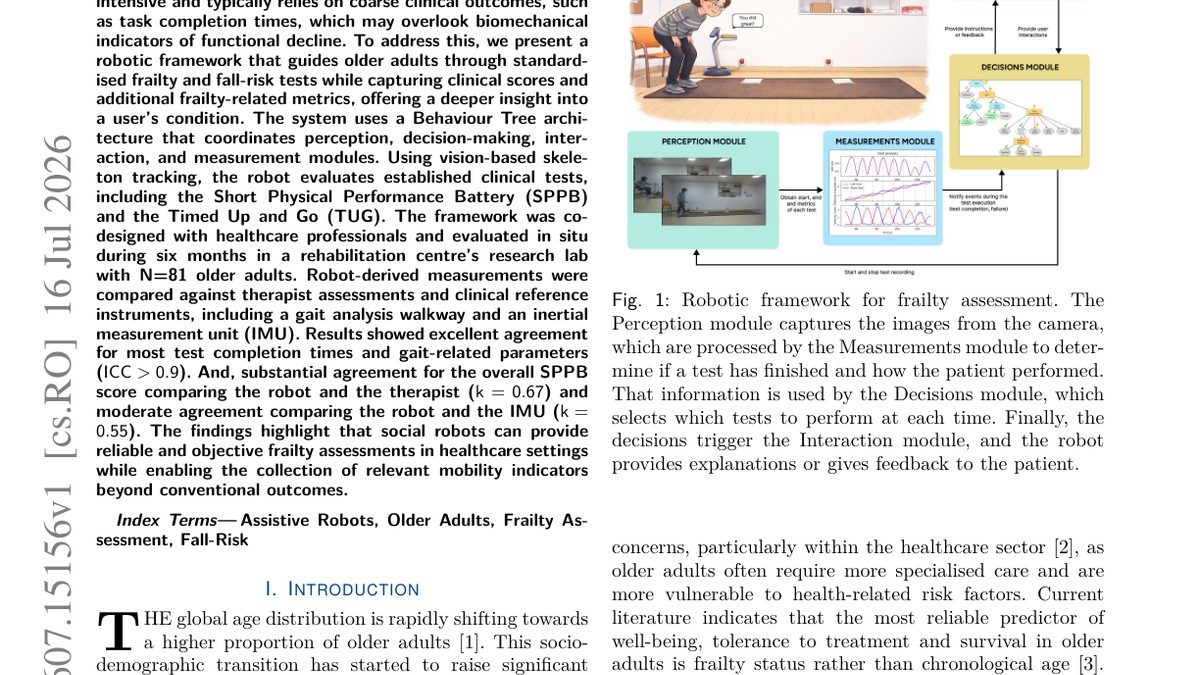
Frailty assessments are crucial to evaluate the risk of adverse events and the health and social care needs of older adults, yet their administration remains resource-intensive and typically relies on coarse clinical outcomes, such as task completion times, which may overlook biomechanical indica...

Beyond Episodic Evaluation: Memory Architectural Bottlenecks in Sequential Embodied Question Answering
Zikui Cai, Kaushal Janga, Tan Dat Dao et al. · arXiv preprint · Jul 2026
Embodied question answering (EQA) is traditionally evaluated under an episodic formulation, where agents solve each task independently and reset internal state between episodes. However, real-world robots operate continuously and must accumulate, retain, and selectively reuse information acquired...

CrossDepth: Geometry-Constrained Attention for Generalizable Multi-View Surround Depth Estimation
Samer Abualhanud, Max Mehltretter · arXiv preprint · Sep 2026
Reliable 3D understanding of the surrounding environment is a core requirement for autonomous driving. Multi-view surround camera rigs provide broad scene coverage, but the spatially adjacent images typically overlap only minimally. Consequently, the depth of most pixels must be inferred from mon...
DECOWAM: Decoupled Whole-Body World-Action Model for Legged Mobile Manipulation
Siyuan Ma, Boshi Zhang, Yutian Zhang et al. · arXiv preprint · Aug 2026
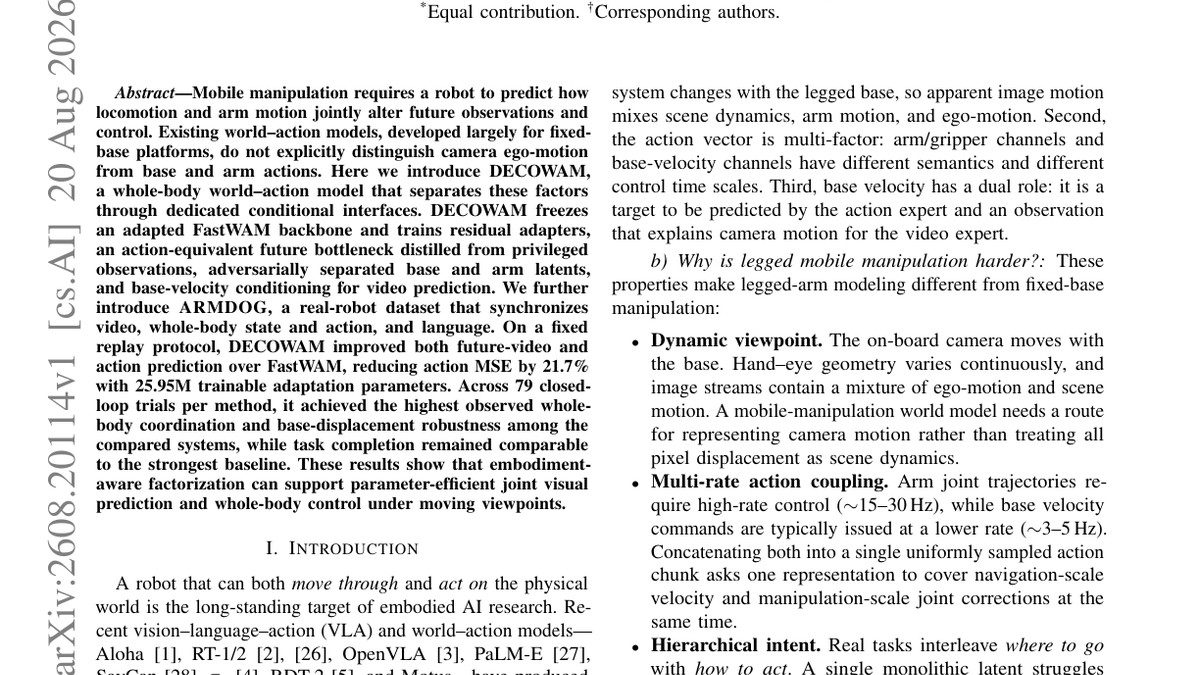
Mobile manipulation requires a robot to predict how locomotion and arm motion jointly alter future observations and control. Existing world-action models, developed largely for fixed-base platforms, do not explicitly distinguish camera ego-motion from base and arm actions. Here we introduce DECOW...