
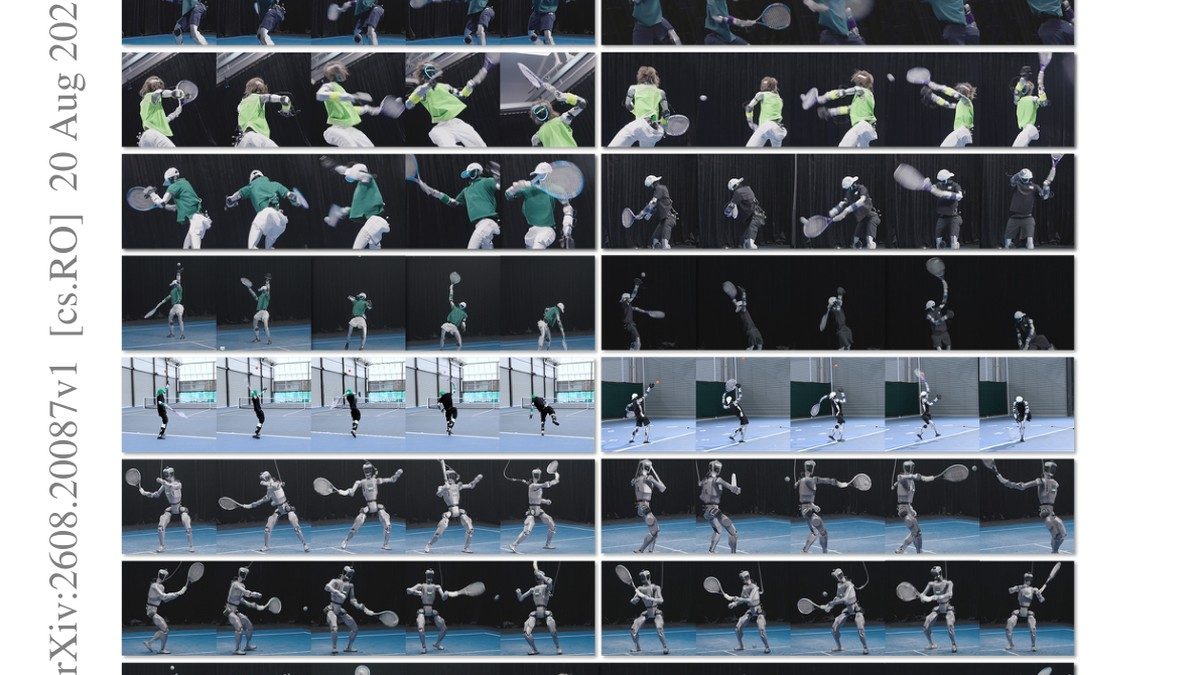
Towards Professional Tennis Styles for Humanoid Robots with Adaptive Motion Planning and Tracking
Tao Huang, Ruofei Liu, Xuchen Tang, Xinyin Zhang, Junli Ren, Huayi Wang, Feiyu Jia, Yukai Qi, Kangning Yin, Weishuai Zeng, Lipeng Chen, Xi Li, Ting Wu, Kailin Li, Ruoli Dai, Jingbo Wang, Lei Han, Jiangmiao Pang · N/A · 2026
Framework
N/A
License
N/A
Stars
N/A
Summary
Humanoid robots have recently demonstrated promising capabilities in real-world ball sports. However, achieving professional motion styles while maintaining strong task performance remains challenging. In this work, we propose AdaPT, an Adaptive Motion Planning and Tracking framework that learns ...
Abstract Summary
Key Points
- Humanoid robots have recently demonstrated promising capabilities in real-world ball sports
- However, achieving professional motion styles while maintaining strong task performance remains c...
- In this work, we propose AdaPT, an Adaptive Motion Planning and Tracking framework that learns pr...
- This hierarchical design is motivated by the key insight that the planner generates stylistic kin...
- Despite its effectiveness in simulation, a substantial sim-to-real gap emerges: tracking performa...
Towards Professional Tennis Styles for Humanoid Robots with Adaptive Motion Planning and Tracking
|Authors: Tao Huang, Ruofei Liu, Xuchen Tang, Xinyin Zhang, Junli Ren, Huayi Wang, Feiyu Jia, Yukai Qi, Kangning Yin, Weishuai Zeng, Lipeng Chen, Xi Li, Ting Wu, Kailin Li, Ruoli Dai, Jingbo Wang, Lei Han, Jiangmiao Pang
|Venue: arXiv preprint | Year: 2026
|arXiv: 2608.20087v1
Abstract
Humanoid robots have recently demonstrated promising capabilities in real-world ball sports. However, achieving professional motion styles while maintaining strong task performance remains challenging. In this work, we propose AdaPT, an Adaptive Motion Planning and Tracking framework that learns professional tennis serving and rally styles directly from broadcast videos. This hierarchical design is motivated by the key insight that the planner generates stylistic kinematic motions, while the tracker executes them with minimal interference with planning. Despite its effectiveness in simulation, a substantial sim-to-real gap emerges: tracking performance inevitably degrades on real robots, and this degradation is partially overlooked by autoregressive planning and further compounded by noisy perception. To address these issues, our adaptation mechanism improves tracking robustness by learning to track randomized execution speeds, while conditioning the planner on a learned motion-speed adapter to mitigate compounding errors. Real-world experiments on the Unitree G1 demonstrate the effectiveness of our adaptation mechanism in bridging the sim-to-real gap. We further deploy AdaPT policies on the full-size Dobot Atom humanoid robot (1.7m) and demonstrate in-the-wild serving without motion capture. Beyond these results, our real-world experiments reveal both algorithmic and engineering insights for future humanoid ball-sports systems. Videos and code are available on our \href{https://humanoidtennis.github.io/AdaPT/}{project website}.
Key Contributions
- Humanoid robots have recently demonstrated promising capabilities in real-world ball sports
- However, achieving professional motion styles while maintaining strong task performance remains c…
- In this work, we propose AdaPT, an Adaptive Motion Planning and Tracking framework that learns pr…
- This hierarchical design is motivated by the key insight that the planner generates stylistic kin…
- Despite its effectiveness in simulation, a substantial sim-to-real gap emerges: tracking performa…
Topics
- vision
- reinforcement-learning
- sim-to-real
- planning
Code & Data
- GitHub repository: https://github.com/noitom-robotics/AdaPT
BibTeX
@article{Huang2026_260820087v1,
  title     = {Towards Professional Tennis Styles for Humanoid Robots with Adaptive Motion Planning and Tracking},
  author    = {Tao Huang and Ruofei Liu and Xuchen Tang and Xinyin Zhang and Junli Ren and Huayi Wang and Feiyu Jia and Yukai Qi and Kangning Yin and Weishuai Zeng and Lipeng Chen and Xi Li and Ting Wu and Kailin Li and Ruoli Dai and Jingbo Wang and Lei Han and Jiangmiao Pang},
  year      = {2026},
  eprint    = {2608.20087v1},
  archivePrefix = {arXiv},
  primaryClass  = {cs.RO},
  url       = {https://arxiv.org/abs/2608.20087v1}
}
Related Papers
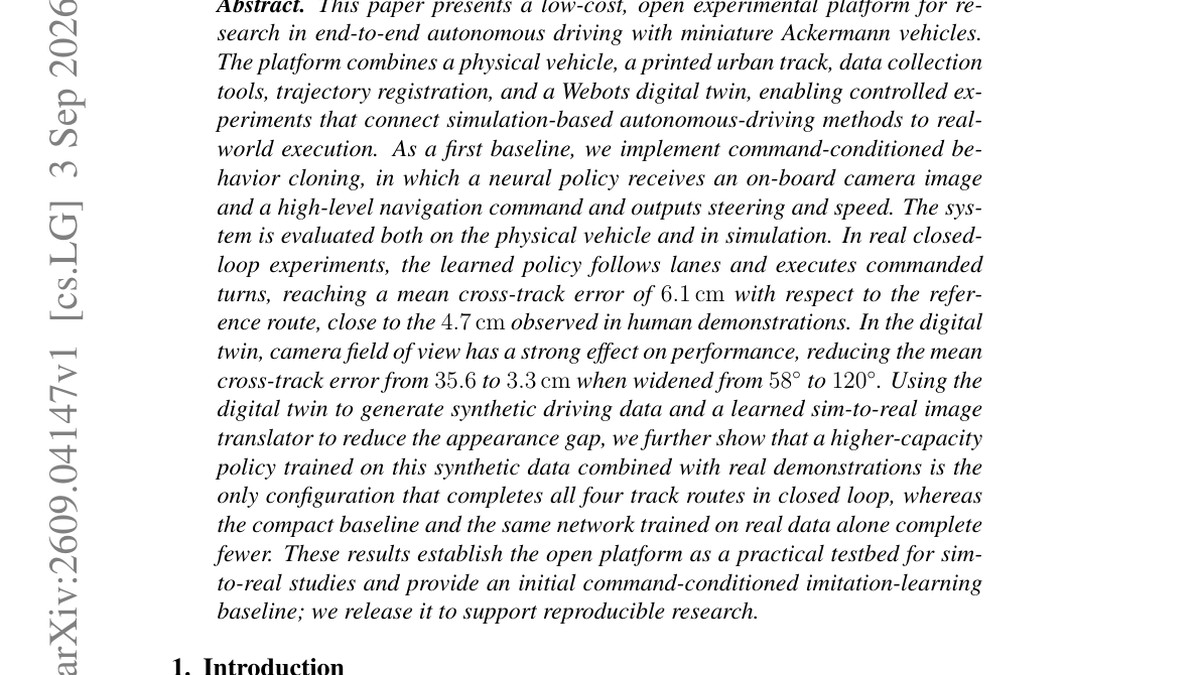
A Low-Cost, Open Platform for End-to-End Autonomous Driving on a Miniature Ackermann Vehicle
Gustavo Claudio Karl Couto, Eric Aislan Antonelo, Gabriel George Zipperer · arXiv preprint · Sep 2026
This paper presents a low-cost, open experimental platform for research in end-to-end autonomous driving with miniature Ackermann vehicles. The platform combines a physical vehicle, a printed urban track, data collection tools, trajectory registration, and a Webots digital twin, enabling controll...
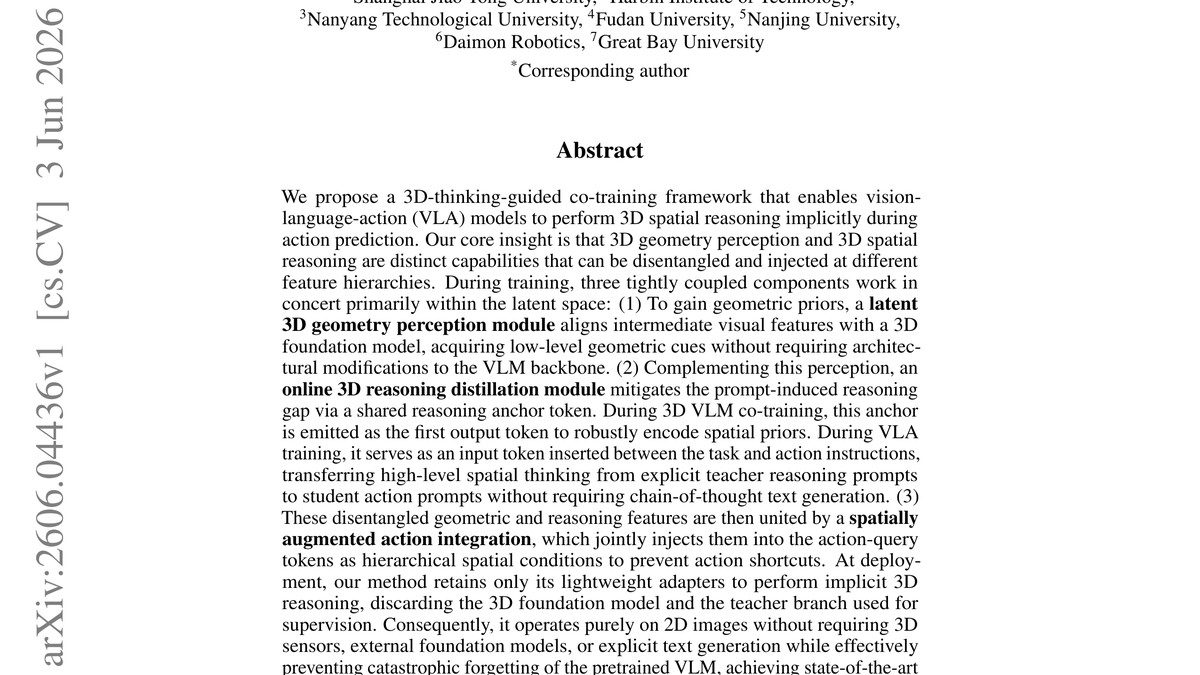
3DThinkVLA: Endowing Vision-Language-Action Models with Latent 3D Priors via 3D-Thinking-Guided Co-training
Jiaxin Shi, Xidong Zhang, Fucai Zhu et al. · arXiv preprint · Jun 2026
We propose a 3D-thinking-guided co-training framework that enables vision-language-action (VLA) models to perform 3D spatial reasoning implicitly during action prediction. Our core insight is that 3D geometry perception and 3D spatial reasoning are distinct capabilities that can be disentangled and ...
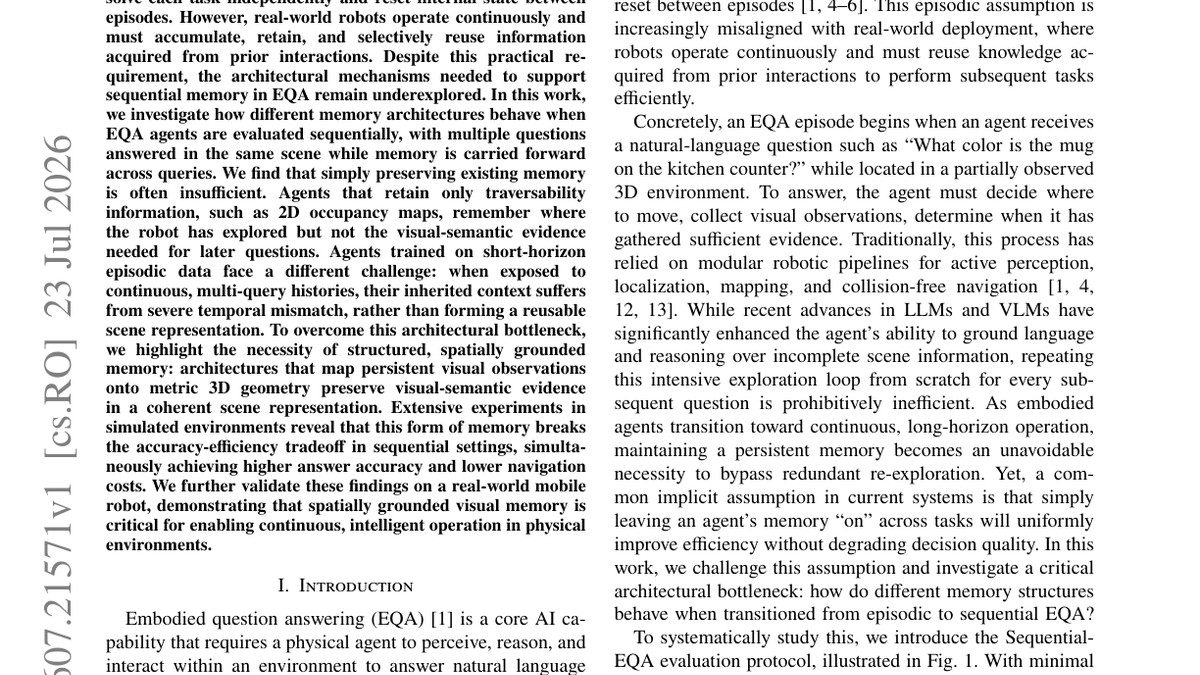
Beyond Episodic Evaluation: Memory Architectural Bottlenecks in Sequential Embodied Question Answering
Zikui Cai, Kaushal Janga, Tan Dat Dao et al. · arXiv preprint · Jul 2026
Embodied question answering (EQA) is traditionally evaluated under an episodic formulation, where agents solve each task independently and reset internal state between episodes. However, real-world robots operate continuously and must accumulate, retain, and selectively reuse information acquired...
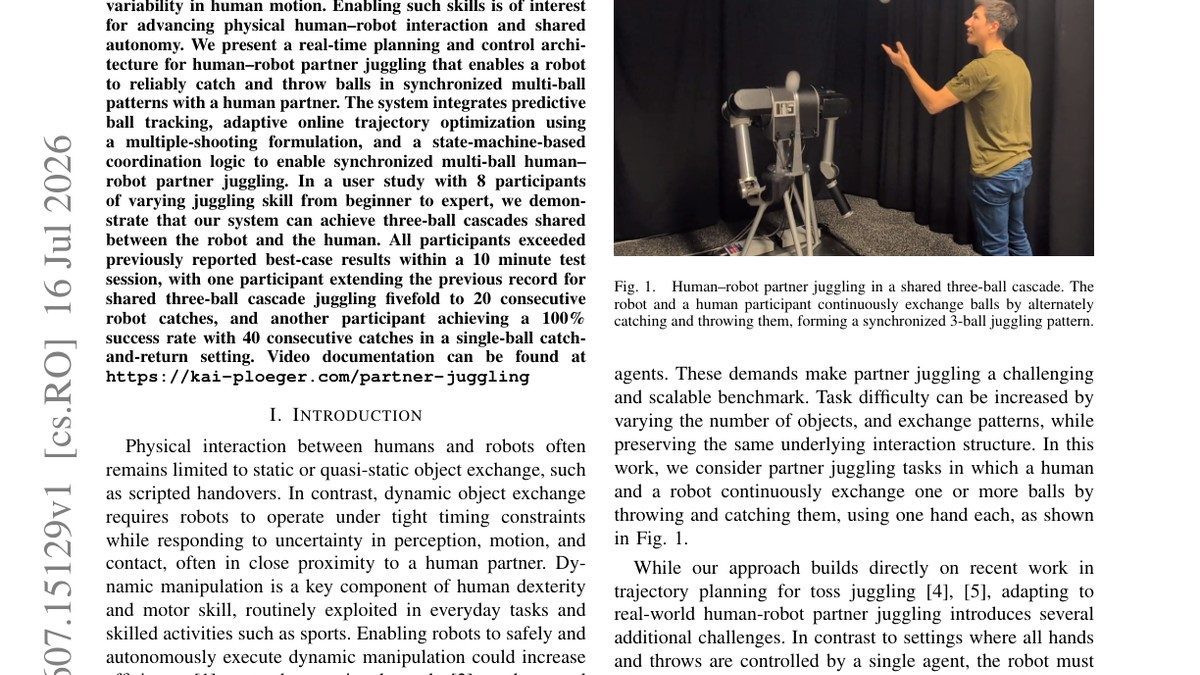
Catch, Throw, Repeat: Planning for Human-Robot Partner Juggling
Jonathan Rainer Lippert, Kai Ploeger, Abir Chowdhury et al. · arXiv preprint · Jul 2026
Dynamic object exchange between humans and robots remains a challenging problem due to uncertainty in perception, timing, and contact-rich interaction. Human-robot juggling represents a particularly demanding instance of this problem, requiring precise real-time coordination, predictive motion pl...