
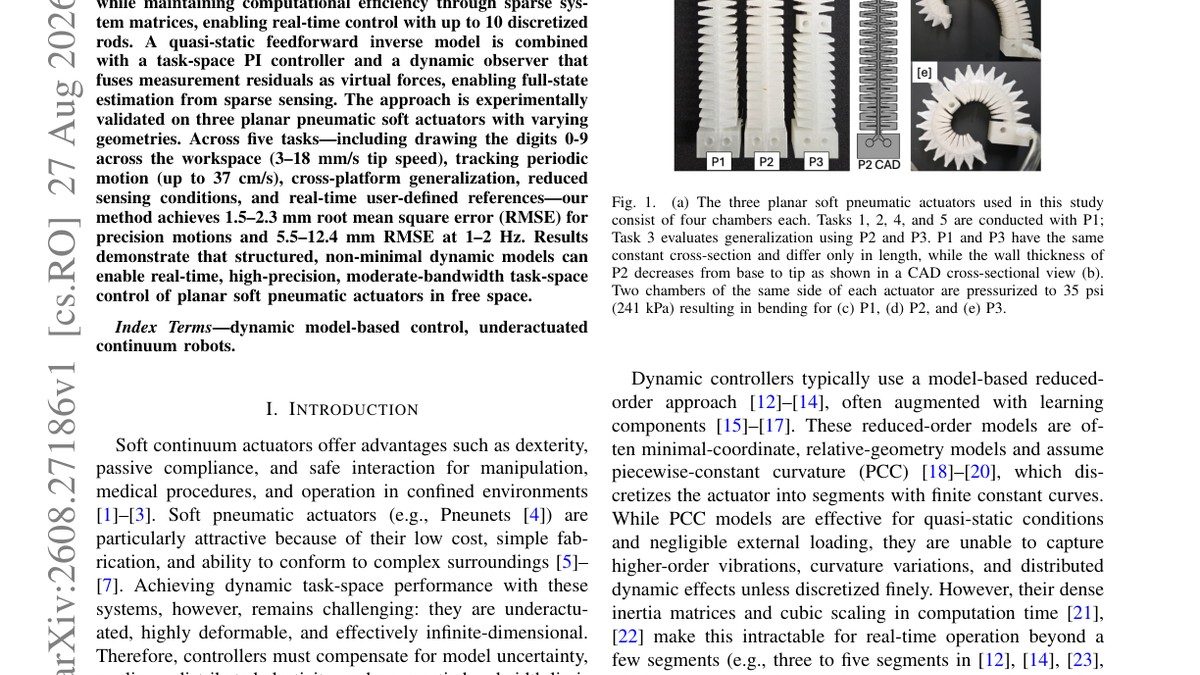
Task-space model-based control of pneumatic soft actuators
Nithin S. Kumar, Joshua Gaston, D. Caleb Rucker, Eric J. Barth · N/A · 2026
Framework
N/A
License
N/A
Stars
N/A
Summary
Soft actuators enable dexterous and compliant interaction, but closed-loop task-space control remains challenging due to strong nonlinearities, distributed deformation, and uncertainty in their dynamics. This paper presents a real-time dynamic-model-based task-space feedback and estimation framew...
Abstract Summary
Key Points
- Soft actuators enable dexterous and compliant interaction, but closed-loop task-space control rem...
- This paper presents a real-time dynamic-model-based task-space feedback and estimation framework ...
- The resulting structure preserves distributed mechanics while maintaining computational efficienc...
- A quasi-static feedforward inverse model is combined with a task-space PI controller and a dynami...
- The approach is experimentally validated on three planar pneumatic soft actuators with varying ge...
Task-space model-based control of pneumatic soft actuators
|Authors: Nithin S. Kumar, Joshua Gaston, D. Caleb Rucker, Eric J. Barth
|Venue: arXiv preprint | Year: 2026
|arXiv: 2608.27186v1
Abstract
Soft actuators enable dexterous and compliant interaction, but closed-loop task-space control remains challenging due to strong nonlinearities, distributed deformation, and uncertainty in their dynamics. This paper presents a real-time dynamic-model-based task-space feedback and estimation framework based on a non-minimal coordinate discrete elastic rod model formulated in absolute coordinates with holonomic constraints. The resulting structure preserves distributed mechanics while maintaining computational efficiency through sparse system matrices, enabling real-time control with up to 10 discretized rods. A quasi-static feedforward inverse model is combined with a task-space PI controller and a dynamic observer that fuses measurement residuals as virtual forces, enabling full-state estimation from sparse sensing. The approach is experimentally validated on three planar pneumatic soft actuators with varying geometries. Across five tasks, including drawing the digits 0-9 across the workspace (3-18 mm/s tip speed), tracking periodic motion (up to 37 cm/s), cross-platform generalization, reduced sensing conditions, and real-time user-defined references, our method achieves 1.5-2.3 mm root mean square error (RMSE) for precision motions and 5.5-12.4 mm RMSE at 1-2 Hz. Results demonstrate that structured, non-minimal dynamic models can enable real-time, high-precision, moderate-bandwidth task-space control of planar soft pneumatic actuators in free space.
Key Contributions
- Soft actuators enable dexterous and compliant interaction, but closed-loop task-space control rem…
- This paper presents a real-time dynamic-model-based task-space feedback and estimation framework …
- The resulting structure preserves distributed mechanics while maintaining computational efficienc…
- A quasi-static feedforward inverse model is combined with a task-space PI controller and a dynami…
- The approach is experimentally validated on three planar pneumatic soft actuators with varying ge…
Topics
- manipulation
- control
Code & Data
No code repository linked in paper metadata.
BibTeX
@article{Kumar2026_260827186v1,
  title     = {Task-space model-based control of pneumatic soft actuators},
  author    = {Nithin S. Kumar and Joshua Gaston and D. Caleb Rucker and Eric J. Barth},
  year      = {2026},
  eprint    = {2608.27186v1},
  archivePrefix = {arXiv},
  primaryClass  = {cs.RO},
  url       = {https://arxiv.org/abs/2608.27186v1}
}
Related Papers
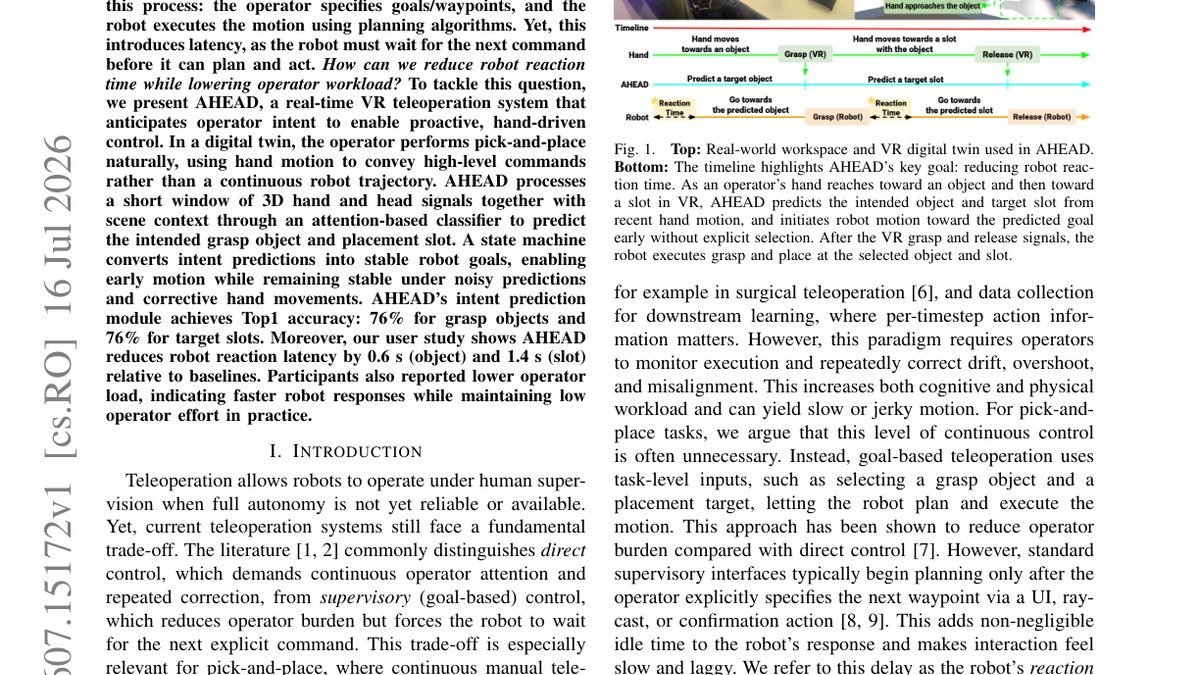
AHEAD: Anticipatory Hand-Driven Teleoperation via Human Intent Prediction
Seok Joon Kim, Junho Lee, Federica Spinola et al. · arXiv preprint · Jul 2026
Direct hand-driven teleoperation maps an operator's hand motion to robot end-effector commands at every frame, enabling precise control, but it requires constant monitoring and correction during approach, grasp, and placement, which can be slow and fatiguing. For repetitive pick-and-place tasks, ...
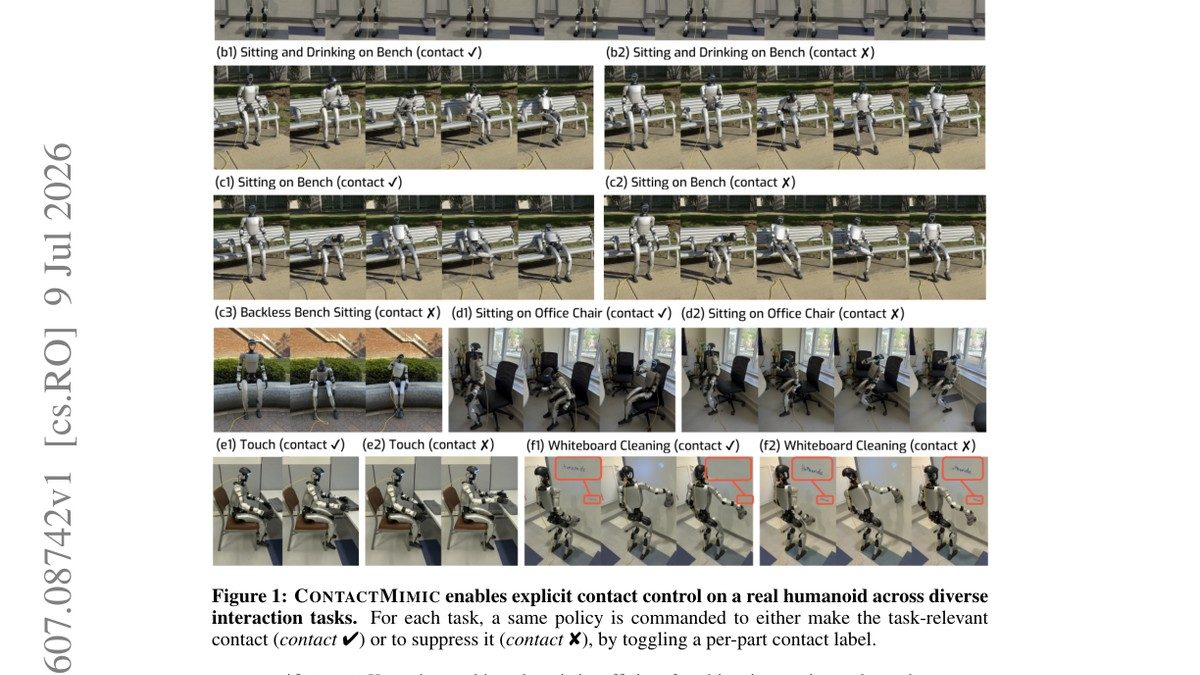
ContactMimic: Humanoid Object Interaction via Contact Control
Xinyao Li, Xialin He, Runpei Dong et al. · arXiv preprint · Jul 2026
Keypoint tracking alone is insufficient for object interaction tasks such as sitting on a chair, wiping a board, or pushing furniture, where the robot can reach the correct pose without making meaningful physical contact with the object. We present CONTACTMIMIC, a learning framework that tracks e...
Decoding Task Progress from VLA Representations
Atiksh Bhardwaj, Edward Weiyi Duan, Prithwish Dan et al. · arXiv preprint · Aug 2026
Vision-language-action models (VLAs) are moving rapidly towards deployment as general-purpose manipulation policies, but we currently lack basic tools for understanding what these models represent internally or for monitoring them at runtime. Leveraging ideas from mechanistic interpretability, we...
DECOWAM: Decoupled Whole-Body World-Action Model for Legged Mobile Manipulation
Siyuan Ma, Boshi Zhang, Yutian Zhang et al. · arXiv preprint · Aug 2026
Mobile manipulation requires a robot to predict how locomotion and arm motion jointly alter future observations and control. Existing world-action models, developed largely for fixed-base platforms, do not explicitly distinguish camera ego-motion from base and arm actions. Here we introduce DECOW...