
ContactMimic: Humanoid Object Interaction via Contact Control
Xinyao Li, Xialin He, Runpei Dong, Saurabh Gupta · N/A · 2026
Framework
N/A
License
N/A
Stars
N/A
Summary
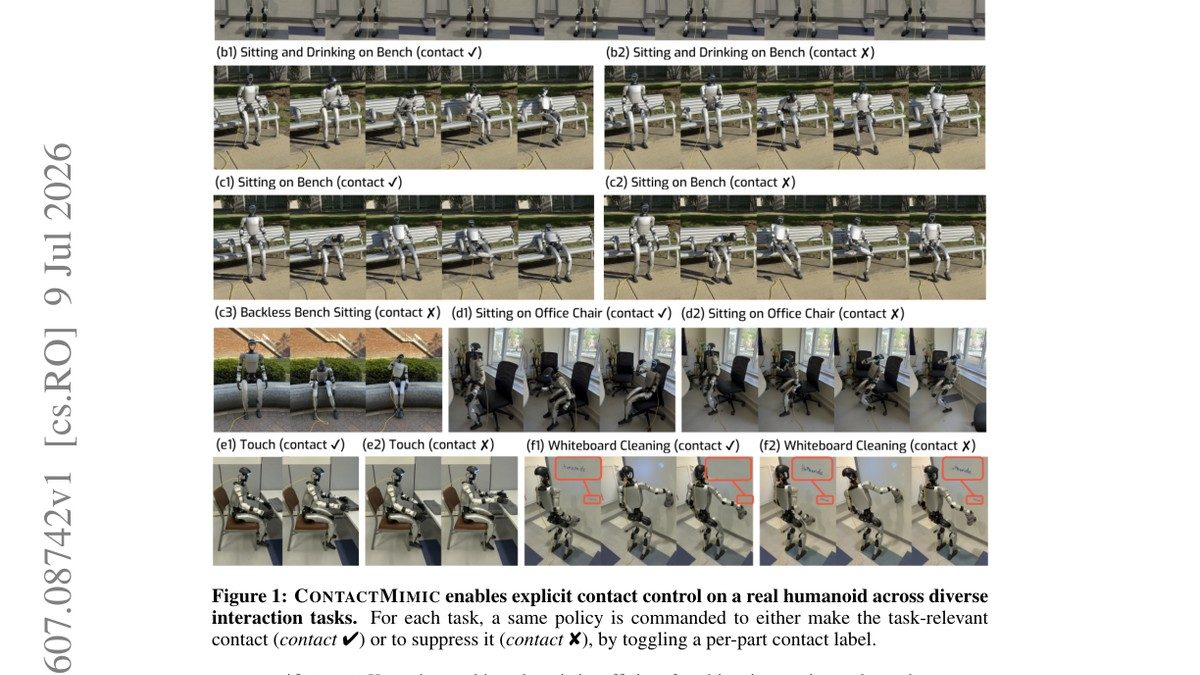
Keypoint tracking alone is insufficient for object interaction tasks such as sitting on a chair, wiping a board, or pushing furniture, where the robot can reach the correct pose without making meaningful physical contact with the object. We present CONTACTMIMIC, a learning framework that tracks e...
Abstract Summary
Key Points
- Keypoint tracking alone is insufficient for object interaction tasks such as sitting on a chair, ...
- We present CONTACTMIMIC, a learning framework that tracks explicit partlevel binary contact comma...
- CONTACTMIMIC is made possible through the use of contact-following rewards and a trajectory augme...
- The resulting policy successfully decouples contact behavior from keypoint geometry, and achieves...
- Simulation experiments across 10 diverse human-object interaction motions confirm that CONTACTMIM...
ContactMimic: Humanoid Object Interaction via Contact Control
|Authors: Xinyao Li, Xialin He, Runpei Dong, Saurabh Gupta
|Venue: arXiv preprint | Year: 2026
|arXiv: 2607.08742v1
Abstract
Keypoint tracking alone is insufficient for object interaction tasks such as sitting on a chair, wiping a board, or pushing furniture, where the robot can reach the correct pose without making meaningful physical contact with the object. We present CONTACTMIMIC, a learning framework that tracks explicit partlevel binary contact commands alongside keypoint trajectories. CONTACTMIMIC is made possible through the use of contact-following rewards and a trajectory augmentation scheme aimed at breaking the correlations between keypoint trajectories and contact labels. The resulting policy successfully decouples contact behavior from keypoint geometry, and achieves precise physical contact as well as contact-controllability (produce or suppress contact during deployment as desired). Simulation experiments across 10 diverse human-object interaction motions confirm that CONTACTMIMIC exhibits contact controllability that enables it to complete manipulation tasks without task-specific rewards, while also outperforming keypoint-only trackers on contact-relevant tasks. Ablations confirm the necessity of the proposed trajectory augmentation scheme and sim2real deployment validates contact controllability in the real world across 5 different motions. Video results are available on https://lixinyao11.github.io/contactmimic-page/.
Key Contributions
- Keypoint tracking alone is insufficient for object interaction tasks such as sitting on a chair, …
- We present CONTACTMIMIC, a learning framework that tracks explicit partlevel binary contact comma…
- CONTACTMIMIC is made possible through the use of contact-following rewards and a trajectory augme…
- The resulting policy successfully decouples contact behavior from keypoint geometry, and achieves…
- Simulation experiments across 10 diverse human-object interaction motions confirm that CONTACTMIM…
Topics
- manipulation
- reinforcement-learning
- control
Code & Data
No code repository linked in paper metadata.
BibTeX
@article{Li2026_260708742v1,
  title     = {ContactMimic: Humanoid Object Interaction via Contact Control},
  author    = {Xinyao Li and Xialin He and Runpei Dong and Saurabh Gupta},
  year      = {2026},
  eprint    = {2607.08742v1},
  archivePrefix = {arXiv},
  primaryClass  = {cs.RO},
  url       = {https://arxiv.org/abs/2607.08742v1}
}
Related Papers
AHEAD: Anticipatory Hand-Driven Teleoperation via Human Intent Prediction
Seok Joon Kim, Junho Lee, Federica Spinola et al. · arXiv preprint · Jul 2026
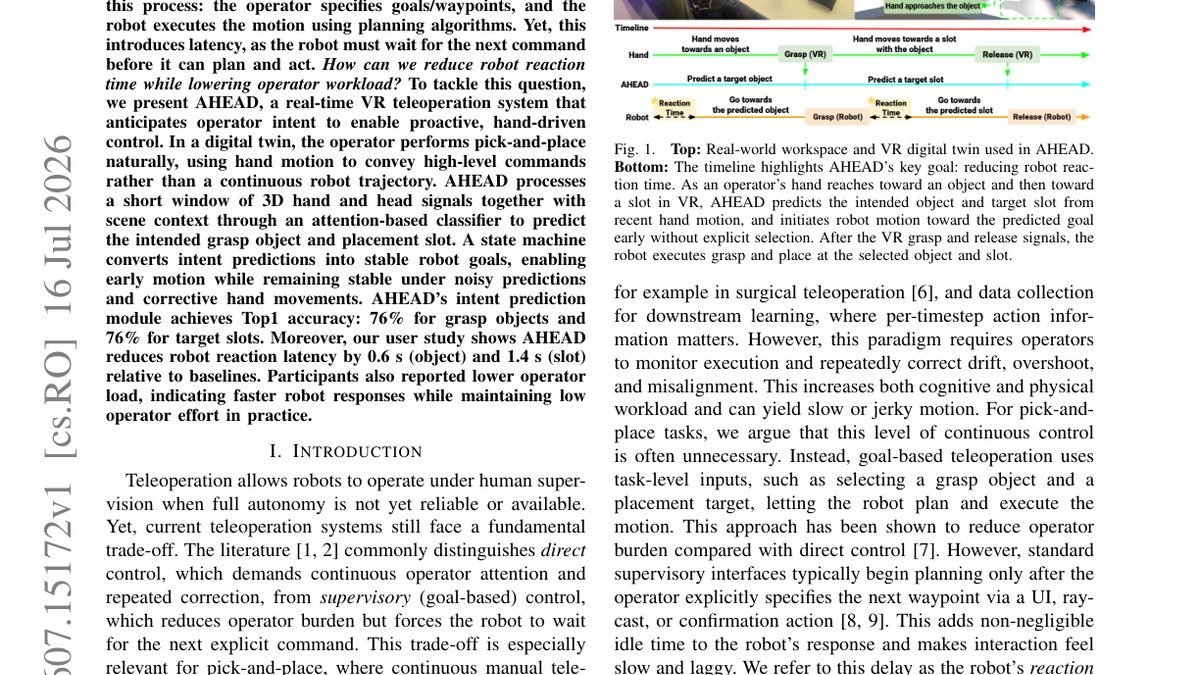
Direct hand-driven teleoperation maps an operator's hand motion to robot end-effector commands at every frame, enabling precise control, but it requires constant monitoring and correction during approach, grasp, and placement, which can be slow and fatiguing. For repetitive pick-and-place tasks, ...
Decoding Task Progress from VLA Representations
Atiksh Bhardwaj, Edward Weiyi Duan, Prithwish Dan et al. · arXiv preprint · Aug 2026
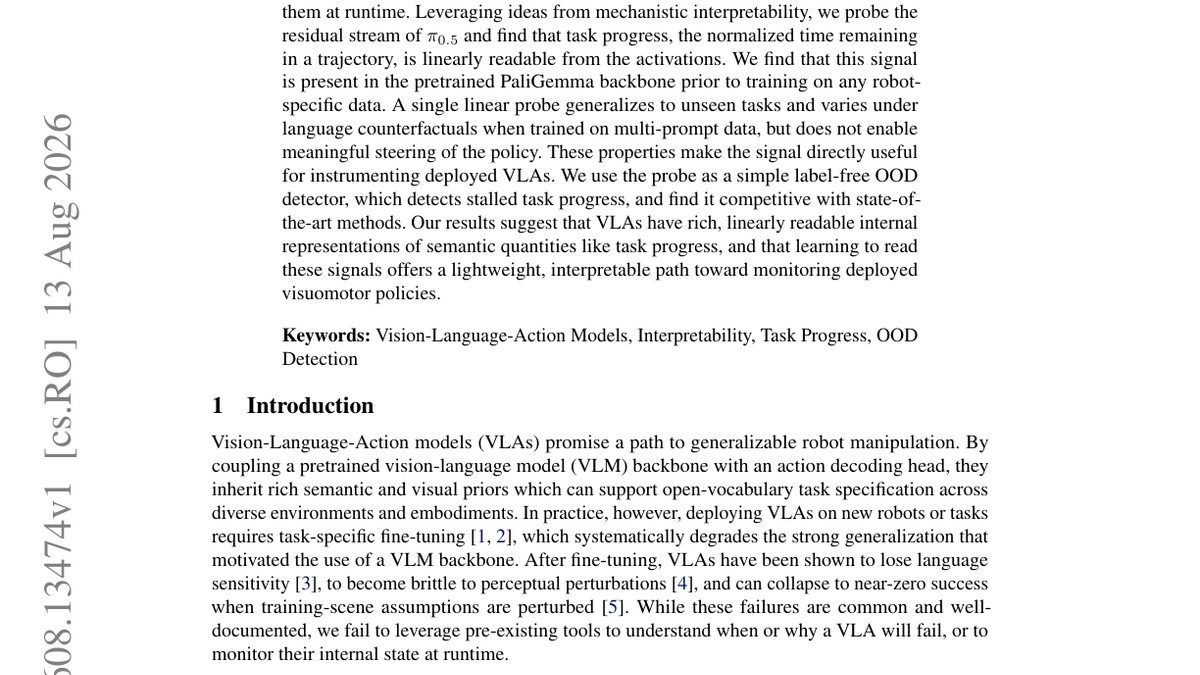
Vision-language-action models (VLAs) are moving rapidly towards deployment as general-purpose manipulation policies, but we currently lack basic tools for understanding what these models represent internally or for monitoring them at runtime. Leveraging ideas from mechanistic interpretability, we...
DECOWAM: Decoupled Whole-Body World-Action Model for Legged Mobile Manipulation
Siyuan Ma, Boshi Zhang, Yutian Zhang et al. · arXiv preprint · Aug 2026
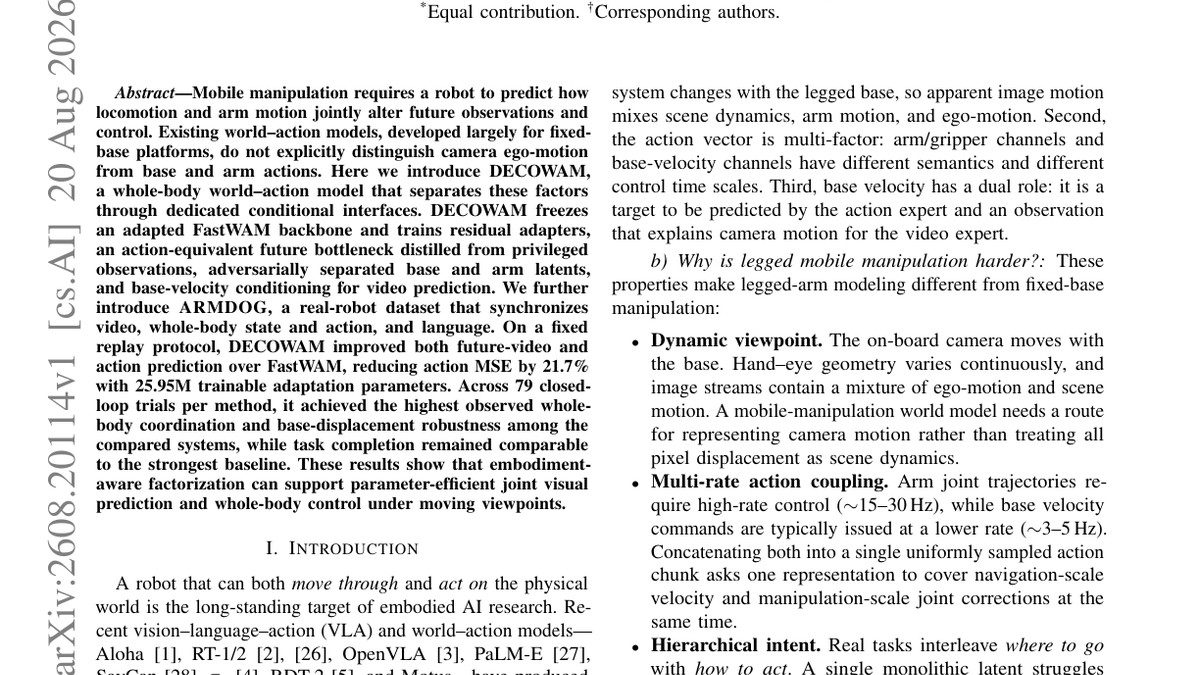
Mobile manipulation requires a robot to predict how locomotion and arm motion jointly alter future observations and control. Existing world-action models, developed largely for fixed-base platforms, do not explicitly distinguish camera ego-motion from base and arm actions. Here we introduce DECOW...
Design and Evaluation of a Touchscreen-Based Teleoperation Interface for Robotic Manipulators
Juan José García Cárdenas, Alperen Kenan, Hamidreza Raei et al. · arXiv preprint · Aug 2026
Intuitive teleoperation interfaces are crucial for the safe and effective operation of robotic manipulators in challenging environments. In the nuclear industry, surface contact tasks such as swab sampling require precise path and force tracking, obstacle avoidance, and sustained operator attenti...