
Subspace Inference Enables Efficient Active Reward Learning from Preferences
Yutai Zhou, Erdem Bıyık · N/A · 2026
Framework
N/A
License
N/A
Stars
N/A
Summary
Reinforcement learning from human feedback (RLHF) has emerged as a powerful yet sample-inefficient approach for learning reward models from human preferences, making active learning a critical component in synthesizing informative preference queries. However, effective uncertainty quantification ...
Abstract Summary
Key Points
- Reinforcement learning from human feedback (RLHF) has emerged as a powerful yet sample-inefficien...
- However, effective uncertainty quantification required for active learning remains a key challeng...
- In this paper, we introduce PreferenceEKF, a sample-efficient approach that tracks reward model u...
- Instead of relying on computationally prohibitive posterior inference over the full neural networ...
- Our approach enables scalable sampling of neural network parameters to efficiently compute acquis...
Subspace Inference Enables Efficient Active Reward Learning from Preferences
|Authors: Yutai Zhou, Erdem Bıyık
|Venue: arXiv preprint | Year: 2026
|arXiv: 2609.04066v1
Abstract
Reinforcement learning from human feedback (RLHF) has emerged as a powerful yet sample-inefficient approach for learning reward models from human preferences, making active learning a critical component in synthesizing informative preference queries. However, effective uncertainty quantification required for active learning remains a key challenge for large neural network reward models. In this paper, we introduce PreferenceEKF, a sample-efficient approach that tracks reward model uncertainty by framing active preference learning as a sequential Bayesian filtering problem. Instead of relying on computationally prohibitive posterior inference over the full neural network parameter space, our method performs sequential inference via an extended Kalman filter within a low-dimensional parameter subspace, continuously updating the reward model posterior as new preference queries arrive. Our approach enables scalable sampling of neural network parameters to efficiently compute acquisition functions for active reward learning. Experiments on the D4RL and V-D4RL benchmarks demonstrate that our approach achieves better sample efficiency, runtime, scalability, and calibration compared to other Bayesian deep learning approaches, and the learned reward models lead to competitive offline reinforcement learning policy performance. This highlights the potential of scalable Bayesian methods for preference-based reward modeling in RLHF. Our code is available at https://github.com/yutaizhou/bnn_pref.
Key Contributions
- Reinforcement learning from human feedback (RLHF) has emerged as a powerful yet sample-inefficien…
- However, effective uncertainty quantification required for active learning remains a key challeng…
- In this paper, we introduce PreferenceEKF, a sample-efficient approach that tracks reward model u…
- Instead of relying on computationally prohibitive posterior inference over the full neural networ…
- Our approach enables scalable sampling of neural network parameters to efficiently compute acquis…
Topics
- reinforcement-learning
- benchmark
Code & Data
- GitHub repository: https://github.com/yutaizhou/bnn_pref
BibTeX
@article{Zhou2026_260904066v1,
  title     = {Subspace Inference Enables Efficient Active Reward Learning from Preferences},
  author    = {Yutai Zhou and Erdem Bıyık},
  year      = {2026},
  eprint    = {2609.04066v1},
  archivePrefix = {arXiv},
  primaryClass  = {cs.LG},
  url       = {https://arxiv.org/abs/2609.04066v1}
}
Related Papers
A Browser-Native Digital Test Range for Benchmarking 4D Ocean-Glider Planning Algorithms
Edward Holmberg, Elias Ioup, Mahdi Abdelguerfi · arXiv preprint · Aug 2026
Repeated in-situ evaluation of ocean-glider planners requires scarce vehicles, operators, deployment and recovery resources, and ocean conditions that cannot be reset for competing algorithms. We present a guided, installation-free browser-native digital test range that transforms a selected regi...
ARDY: Autoregressive Diffusion with Hybrid Representation for Interactive Human Motion Generation
Kaifeng Zhao, Mathis Petrovich, Haotian Zhang et al. · arXiv preprint · Jul 2026
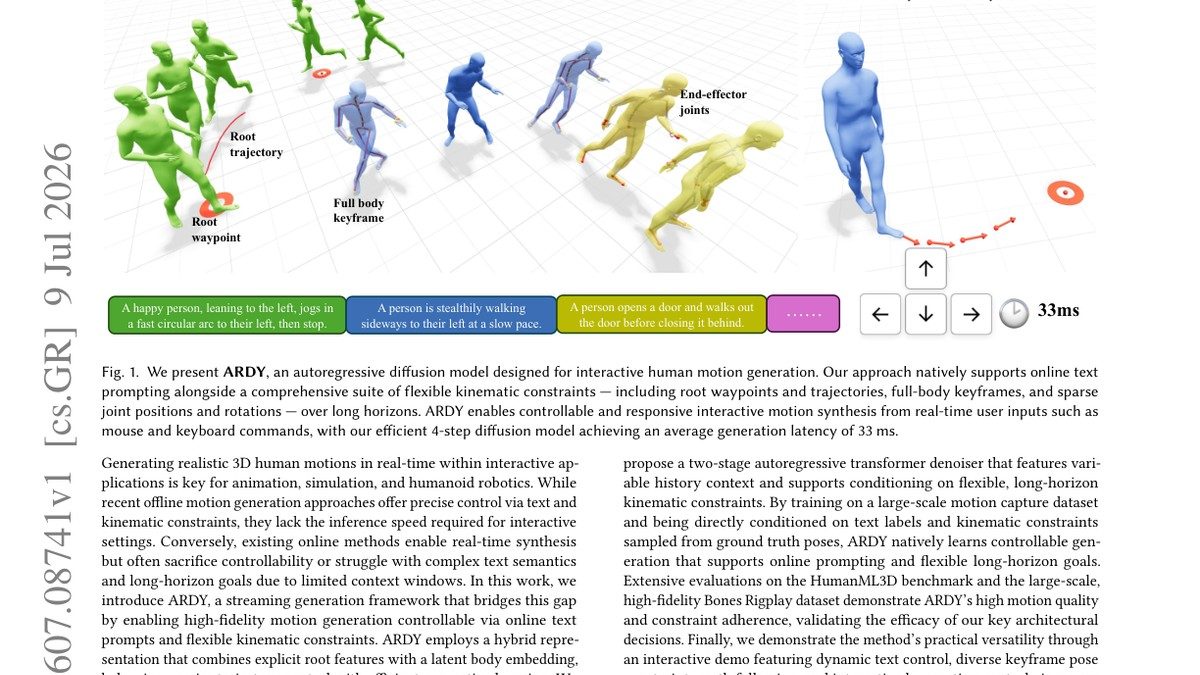
Generating realistic 3D human motions in real-time within interactive applications is key for animation, simulation, and humanoid robotics. While recent offline motion generation approaches offer precise control via text and kinematic constraints, they lack the inference speed required for intera...
Assessing Physical Frailty and Fall-Risk Indicators with Social Robots: An in situ Evaluation with Older Adults
Aniol Civit, Antonio Andriella, Alba Martínez et al. · arXiv preprint · Jul 2026
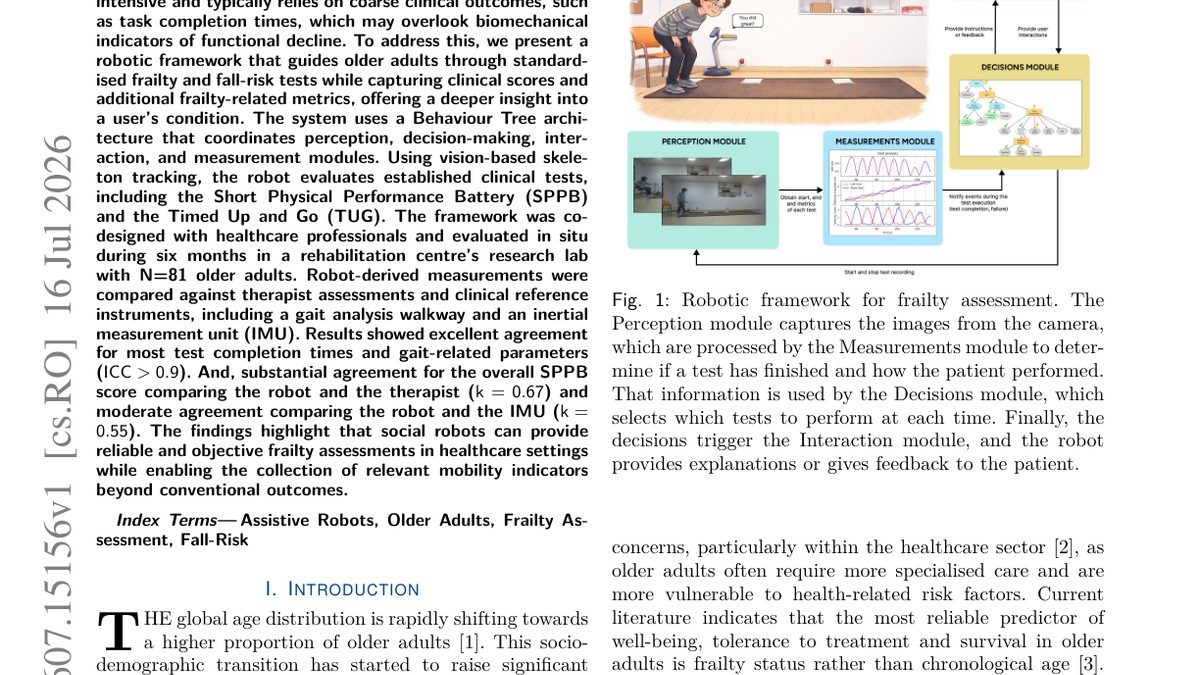
Frailty assessments are crucial to evaluate the risk of adverse events and the health and social care needs of older adults, yet their administration remains resource-intensive and typically relies on coarse clinical outcomes, such as task completion times, which may overlook biomechanical indica...
Beyond Episodic Evaluation: Memory Architectural Bottlenecks in Sequential Embodied Question Answering
Zikui Cai, Kaushal Janga, Tan Dat Dao et al. · arXiv preprint · Jul 2026
Embodied question answering (EQA) is traditionally evaluated under an episodic formulation, where agents solve each task independently and reset internal state between episodes. However, real-world robots operate continuously and must accumulate, retain, and selectively reuse information acquired...