
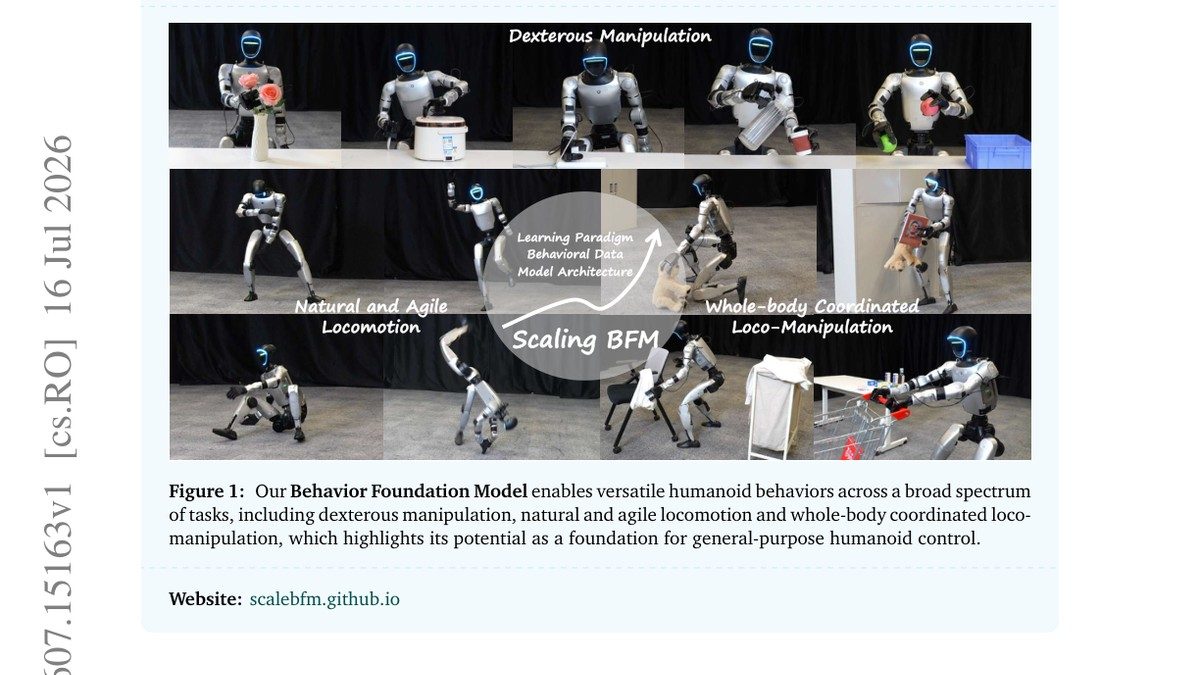
Scaling Behavior Foundation Model for Humanoid Robots
Weishuai Zeng, Kangning Yin, Xiaojie Niu, Shunlin Lu, Weixiang Zhong, Jiahe Chen, Feiyu Jia, Xiao Chen, Zirui Wang, Furui Xu, Ming Zhou, Kailin Li, Weinan Zhang, He Wang, Li Yi, Dahua Lin, Jiangmiao Pang, Jingbo Wang · N/A · 2026
Framework
N/A
License
N/A
Stars
N/A
Summary
Humanoid control requires natural whole-body coordination, precise real-time responses to control signals, and robust generalization across diverse environmental contexts, making it a cornerstone for generalist embodied agents. Behavior Foundation Models (BFMs) have recently emerged as a promisin...
Abstract Summary
Key Points
- Humanoid control requires natural whole-body coordination, precise real-time responses to control...
- Behavior Foundation Models (BFMs) have recently emerged as a promising solution to address these ...
- However, despite growing interest in scaling BFMs to further improve their capabilities, it remai...
- In this work, we revisit the scaling recipe for BFMs and demonstrate that substantial performance...
- Through extensive experiments in both simulation and real-world deployment, we demonstrate that o...
Scaling Behavior Foundation Model for Humanoid Robots
|Authors: Weishuai Zeng, Kangning Yin, Xiaojie Niu, Shunlin Lu, Weixiang Zhong, Jiahe Chen, Feiyu Jia, Xiao Chen, Zirui Wang, Furui Xu, Ming Zhou, Kailin Li, Weinan Zhang, He Wang, Li Yi, Dahua Lin, Jiangmiao Pang, Jingbo Wang
|Venue: arXiv preprint | Year: 2026
|arXiv: 2607.15163v1
Abstract
Humanoid control requires natural whole-body coordination, precise real-time responses to control signals, and robust generalization across diverse environmental contexts, making it a cornerstone for generalist embodied agents. Behavior Foundation Models (BFMs) have recently emerged as a promising solution to address these challenges by leveraging large-scale behavioral data to achieve superior expressiveness, versatility and generalization. However, despite growing interest in scaling BFMs to further improve their capabilities, it remains unclear how key factors, including the learning paradigm, behavioral data and model architecture should be coordinated to enable effective scaling. In this work, we revisit the scaling recipe for BFMs and demonstrate that substantial performance gains can be achieved through the coordination of three core components: 1) the learning paradigm of motion tracking that reformulates diverse humanoid control problems as the reproduction of integrated whole-body behaviors in the global frame; 2) the strategic synergy between on-policy rollout quantity and reference motion diversity; and 3) the expressive and scalable model architecture termed Humanoid Transformer that facilitates the natural emergence of structured behavioral representations. Through extensive experiments in both simulation and real-world deployment, we demonstrate that our approach yields significant improvements in control fidelity and task generalization, reducing Mean Per-Keypoint Position Error (MPKPE) on the test set by over 10% in local mode and 82% in global mode compared with existing humanoid controllers. These results establish BFM as a principled and effective foundation for scalable and general-purpose humanoid control.
Key Contributions
- Humanoid control requires natural whole-body coordination, precise real-time responses to control…
- Behavior Foundation Models (BFMs) have recently emerged as a promising solution to address these …
- However, despite growing interest in scaling BFMs to further improve their capabilities, it remai…
- In this work, we revisit the scaling recipe for BFMs and demonstrate that substantial performance…
- Through extensive experiments in both simulation and real-world deployment, we demonstrate that o…
Topics
- reinforcement-learning
- control
Code & Data
- GitHub repository: https://github.com/NVLabs/ProtoMotions
BibTeX
@article{Zeng2026_260715163v1,
  title     = {Scaling Behavior Foundation Model for Humanoid Robots},
  author    = {Weishuai Zeng and Kangning Yin and Xiaojie Niu and Shunlin Lu and Weixiang Zhong and Jiahe Chen and Feiyu Jia and Xiao Chen and Zirui Wang and Furui Xu and Ming Zhou and Kailin Li and Weinan Zhang and He Wang and Li Yi and Dahua Lin and Jiangmiao Pang and Jingbo Wang},
  year      = {2026},
  eprint    = {2607.15163v1},
  archivePrefix = {arXiv},
  primaryClass  = {cs.RO},
  url       = {https://arxiv.org/abs/2607.15163v1}
}
Related Papers
A Browser-Native Digital Test Range for Benchmarking 4D Ocean-Glider Planning Algorithms
Edward Holmberg, Elias Ioup, Mahdi Abdelguerfi · arXiv preprint · Aug 2026
Repeated in-situ evaluation of ocean-glider planners requires scarce vehicles, operators, deployment and recovery resources, and ocean conditions that cannot be reset for competing algorithms. We present a guided, installation-free browser-native digital test range that transforms a selected regi...
A Low-Cost, Open Platform for End-to-End Autonomous Driving on a Miniature Ackermann Vehicle
Gustavo Claudio Karl Couto, Eric Aislan Antonelo, Gabriel George Zipperer · arXiv preprint · Sep 2026
This paper presents a low-cost, open experimental platform for research in end-to-end autonomous driving with miniature Ackermann vehicles. The platform combines a physical vehicle, a printed urban track, data collection tools, trajectory registration, and a Webots digital twin, enabling controll...
AHEAD: Anticipatory Hand-Driven Teleoperation via Human Intent Prediction
Seok Joon Kim, Junho Lee, Federica Spinola et al. · arXiv preprint · Jul 2026
Direct hand-driven teleoperation maps an operator's hand motion to robot end-effector commands at every frame, enabling precise control, but it requires constant monitoring and correction during approach, grasp, and placement, which can be slow and fatiguing. For repetitive pick-and-place tasks, ...
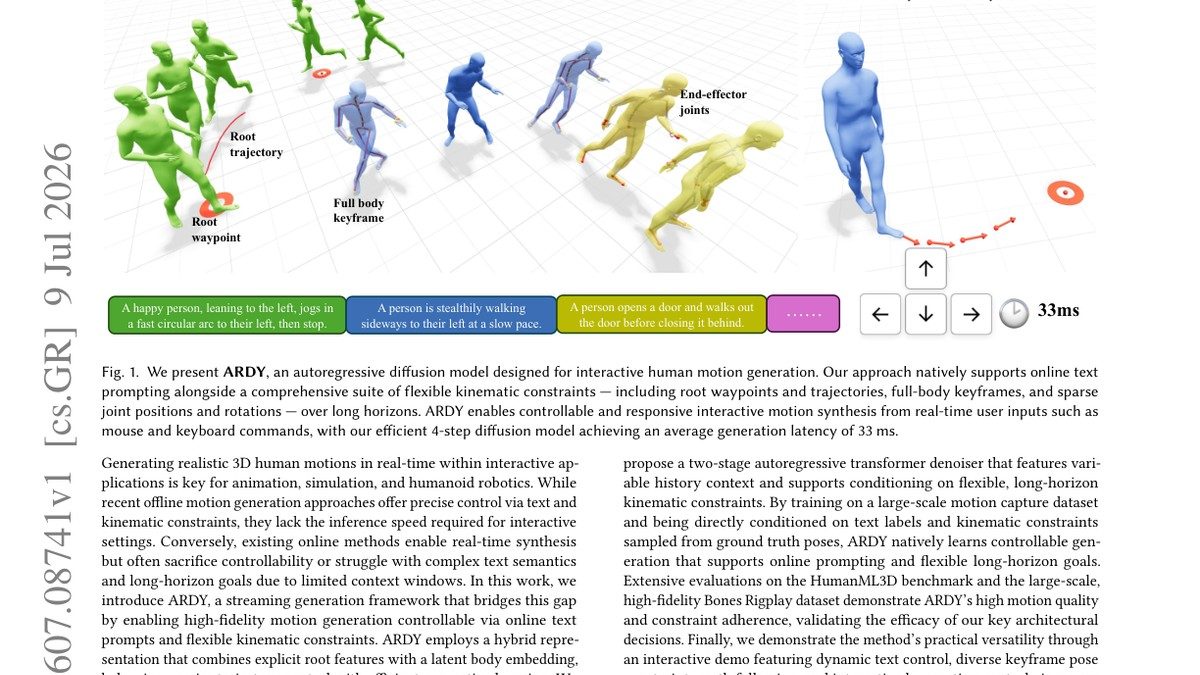
ARDY: Autoregressive Diffusion with Hybrid Representation for Interactive Human Motion Generation
Kaifeng Zhao, Mathis Petrovich, Haotian Zhang et al. · arXiv preprint · Jul 2026
Generating realistic 3D human motions in real-time within interactive applications is key for animation, simulation, and humanoid robotics. While recent offline motion generation approaches offer precise control via text and kinematic constraints, they lack the inference speed required for intera...