
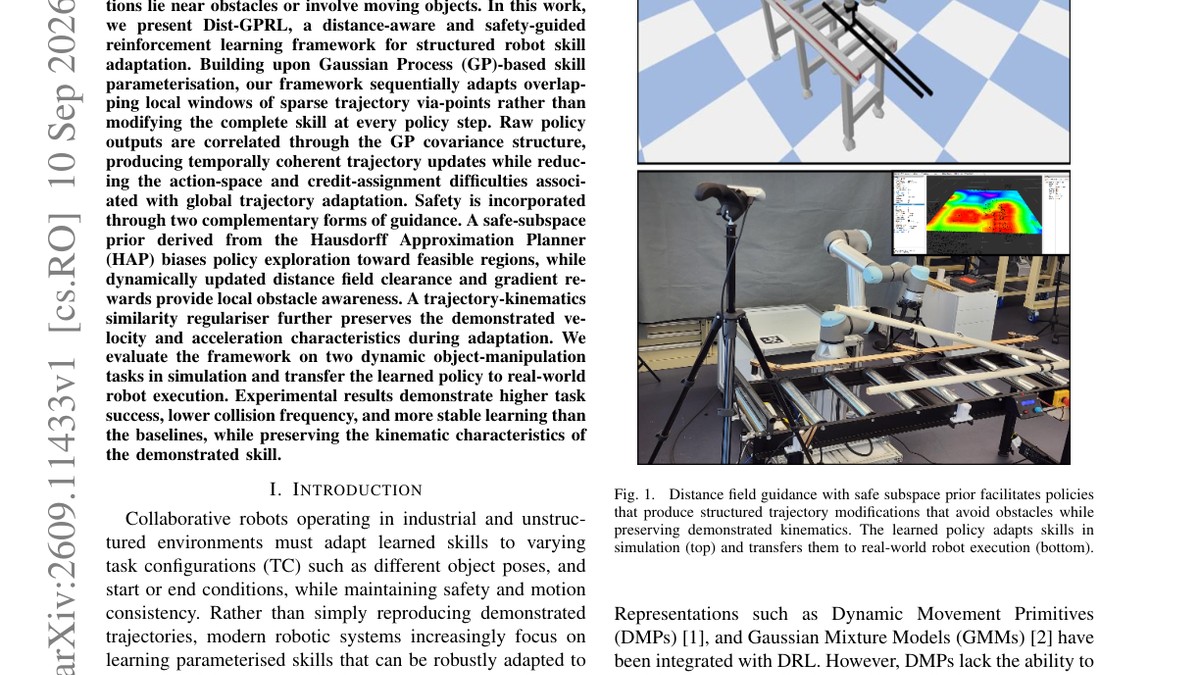
Safety-aware Skill Adaptation for Reinforcement Learning in Dynamic Environments
A K M Nadimul Haque, Sheila Sutjipto, Marc G. Carmichael, Teresa Vidal-Calleja · N/A · 2026
Framework
N/A
License
N/A
Stars
N/A
Summary
Skill adaptation frameworks based on reinforcement learning often require restrictive assumptions to maintain stability, such as fixed observations or tightly controlled exploration schedules. In cluttered and dynamic environments, however, unrestricted exploration can lead to unsafe behaviour an...
Abstract Summary
Key Points
- Skill adaptation frameworks based on reinforcement learning often require restrictive assumptions...
- In cluttered and dynamic environments, however, unrestricted exploration can lead to unsafe behav...
- In this work, we present Dist-GPRL, a distance-aware and safety-guided reinforcement learning fra...
- Building upon Gaussian Process (GP)-based skill parameterisation, our framework sequentially adap...
- Raw policy outputs are correlated through the GP covariance structure, producing temporally coher...
Safety-aware Skill Adaptation for Reinforcement Learning in Dynamic Environments
|Authors: A K M Nadimul Haque, Sheila Sutjipto, Marc G. Carmichael, Teresa Vidal-Calleja
|Venue: arXiv preprint | Year: 2026
|arXiv: 2609.11433v1
Abstract
Skill adaptation frameworks based on reinforcement learning often require restrictive assumptions to maintain stability, such as fixed observations or tightly controlled exploration schedules. In cluttered and dynamic environments, however, unrestricted exploration can lead to unsafe behaviour and unstable learning, particularly when task-relevant observations lie near obstacles or involve moving objects. In this work, we present Dist-GPRL, a distance-aware and safety-guided reinforcement learning framework for structured robot skill adaptation. Building upon Gaussian Process (GP)-based skill parameterisation, our framework sequentially adapts overlapping local windows of sparse trajectory via-points rather than modifying the complete skill at every policy step. Raw policy outputs are correlated through the GP covariance structure, producing temporally coherent trajectory updates while reducing the action-space and credit-assignment difficulties associated with global trajectory adaptation. Safety is incorporated through two complementary forms of guidance. A safe-subspace prior derived from the Hausdorff Approximation Planner (HAP) biases policy exploration toward feasible regions, while dynamically updated distance field clearance and gradient rewards provide local obstacle awareness. A trajectory-kinematics similarity regulariser further preserves the demonstrated velocity and acceleration characteristics during adaptation. We evaluate the framework on two dynamic object-manipulation tasks in simulation and transfer the learned policy to real-world robot execution. Experimental results demonstrate higher task success, lower collision frequency, and more stable learning than the baselines, while preserving the kinematic characteristics of the demonstrated skill.
Key Contributions
- Skill adaptation frameworks based on reinforcement learning often require restrictive assumptions…
- In cluttered and dynamic environments, however, unrestricted exploration can lead to unsafe behav…
- In this work, we present Dist-GPRL, a distance-aware and safety-guided reinforcement learning fra…
- Building upon Gaussian Process (GP)-based skill parameterisation, our framework sequentially adap…
- Raw policy outputs are correlated through the GP covariance structure, producing temporally coher…
Topics
- manipulation
- reinforcement-learning
- control
Code & Data
No code repository linked in paper metadata.
BibTeX
@article{Haque2026_260911433v1,
  title     = {Safety-aware Skill Adaptation for Reinforcement Learning in Dynamic Environments},
  author    = {A K M Nadimul Haque and Sheila Sutjipto and Marc G. Carmichael and Teresa Vidal-Calleja},
  year      = {2026},
  eprint    = {2609.11433v1},
  archivePrefix = {arXiv},
  primaryClass  = {cs.RO},
  url       = {https://arxiv.org/abs/2609.11433v1}
}
Related Papers
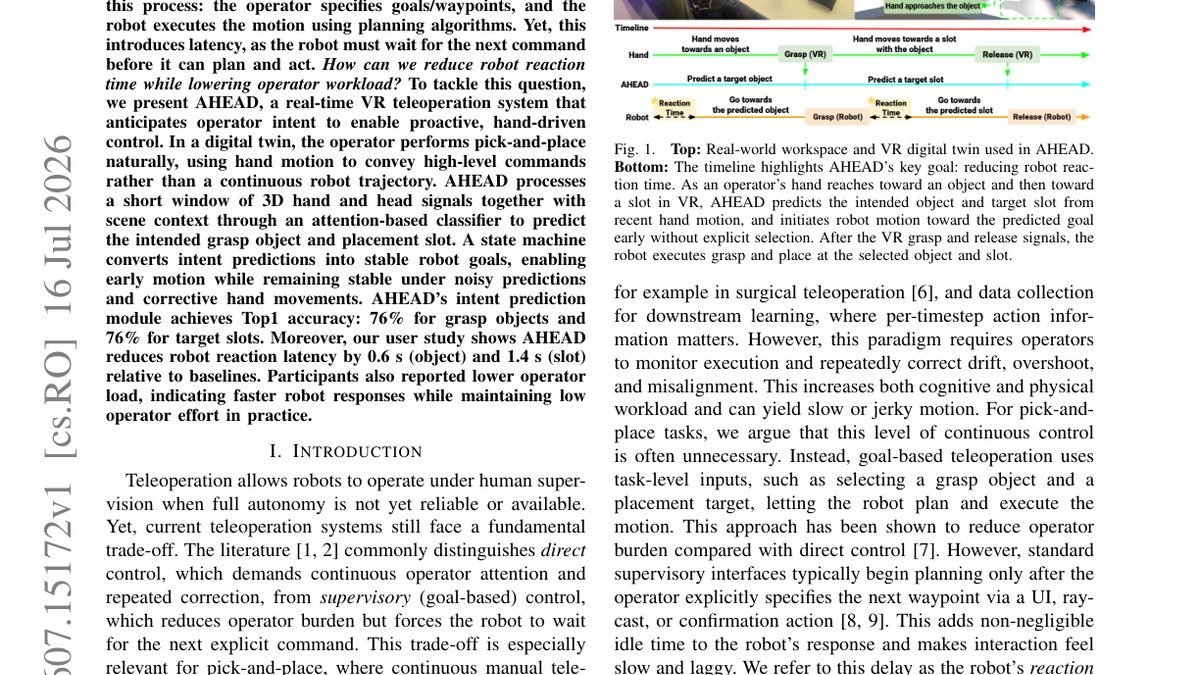
AHEAD: Anticipatory Hand-Driven Teleoperation via Human Intent Prediction
Seok Joon Kim, Junho Lee, Federica Spinola et al. · arXiv preprint · Jul 2026
Direct hand-driven teleoperation maps an operator's hand motion to robot end-effector commands at every frame, enabling precise control, but it requires constant monitoring and correction during approach, grasp, and placement, which can be slow and fatiguing. For repetitive pick-and-place tasks, ...
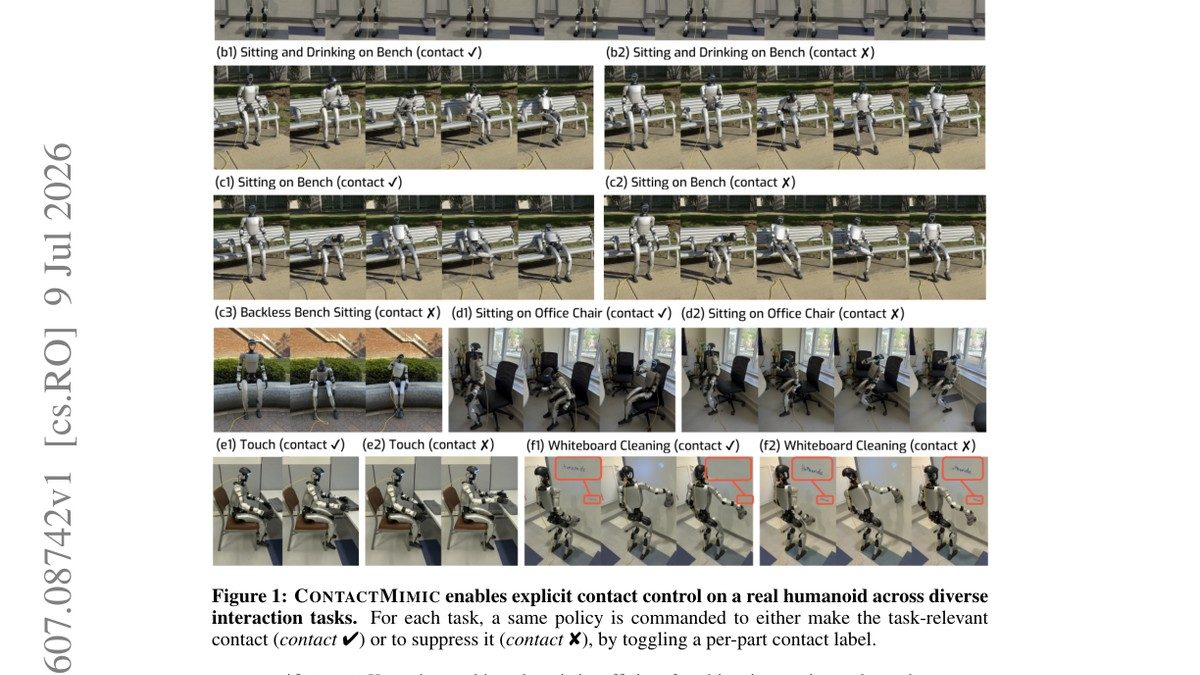
ContactMimic: Humanoid Object Interaction via Contact Control
Xinyao Li, Xialin He, Runpei Dong et al. · arXiv preprint · Jul 2026
Keypoint tracking alone is insufficient for object interaction tasks such as sitting on a chair, wiping a board, or pushing furniture, where the robot can reach the correct pose without making meaningful physical contact with the object. We present CONTACTMIMIC, a learning framework that tracks e...
Decoding Task Progress from VLA Representations
Atiksh Bhardwaj, Edward Weiyi Duan, Prithwish Dan et al. · arXiv preprint · Aug 2026
Vision-language-action models (VLAs) are moving rapidly towards deployment as general-purpose manipulation policies, but we currently lack basic tools for understanding what these models represent internally or for monitoring them at runtime. Leveraging ideas from mechanistic interpretability, we...
DECOWAM: Decoupled Whole-Body World-Action Model for Legged Mobile Manipulation
Siyuan Ma, Boshi Zhang, Yutian Zhang et al. · arXiv preprint · Aug 2026
Mobile manipulation requires a robot to predict how locomotion and arm motion jointly alter future observations and control. Existing world-action models, developed largely for fixed-base platforms, do not explicitly distinguish camera ego-motion from base and arm actions. Here we introduce DECOW...