

Quasi-static analysis of passive stability in a novel underactuated multi-finger hand
Léonie Plancoulaine, Sylvain Guégan, Franck Plestan, Damien Chablat · N/A · 2026
Framework
N/A
License
N/A
Stars
N/A
Summary
Underactuated robotic hands achieve adaptive and robust grasping with a reduced number of actuators, but predicting the stable equilibrium pose of the grasped object remains a significant challenge. This paper introduces a quasi-static analytical approach to assess passive stability in underactua...
Abstract Summary
Key Points
- Underactuated robotic hands achieve adaptive and robust grasping with a reduced number of actuato...
- This paper introduces a quasi-static analytical approach to assess passive stability in underactu...
- A novel three-finger hand architecture integrating a differential spring-loaded slider mechanism ...
- The study focuses on how the differential mechanism influences the overall grasp behavior and ana...
Quasi-static analysis of passive stability in a novel underactuated multi-finger hand
|Authors: Léonie Plancoulaine, Sylvain Guégan, Franck Plestan, Damien Chablat
|Venue: arXiv preprint | Year: 2026
|arXiv: 2609.11579v1
Abstract
Underactuated robotic hands achieve adaptive and robust grasping with a reduced number of actuators, but predicting the stable equilibrium pose of the grasped object remains a significant challenge. This paper introduces a quasi-static analytical approach to assess passive stability in underactuated multi-finger hands. A novel three-finger hand architecture integrating a differential spring-loaded slider mechanism is introduced, enabling versatile and adaptive grasping. The study focuses on how the differential mechanism influences the overall grasp behavior and analyzes the effect of object size on the stable equilibrium configurations for two canonical grasp types: cylindrical and spherical.
Key Contributions
- Underactuated robotic hands achieve adaptive and robust grasping with a reduced number of actuato…
- This paper introduces a quasi-static analytical approach to assess passive stability in underactu…
- A novel three-finger hand architecture integrating a differential spring-loaded slider mechanism …
- The study focuses on how the differential mechanism influences the overall grasp behavior and ana…
Topics
- manipulation
Code & Data
No code repository linked in paper metadata.
BibTeX
@article{Plancoulaine2026_260911579v1,
  title     = {Quasi-static analysis of passive stability in a novel underactuated multi-finger hand},
  author    = {Léonie Plancoulaine and Sylvain Guégan and Franck Plestan and Damien Chablat},
  year      = {2026},
  eprint    = {2609.11579v1},
  archivePrefix = {arXiv},
  primaryClass  = {cs.RO},
  url       = {https://arxiv.org/abs/2609.11579v1}
}
Related Papers
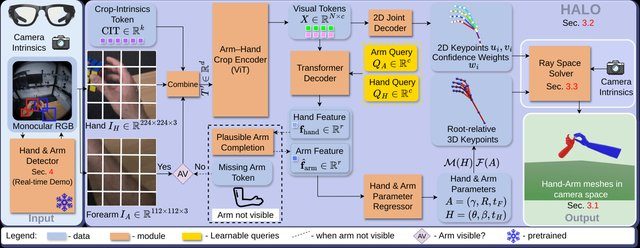
EgoForce: Forearm-Guided Camera-Space 3D Hand Pose from a Monocular Egocentric Camera
Christen Millerdurai, Shaoxiang Wang, Yaxu Xie et al. · SIGGRAPH 2026 · May 2026
Reconstructing the absolute 3D pose and shape of the hands from the user's viewpoint using a single head-mounted camera is crucial for practical egocentric interaction in AR/VR, telepresence, and hand-centric manipulation tasks, where sensing must...
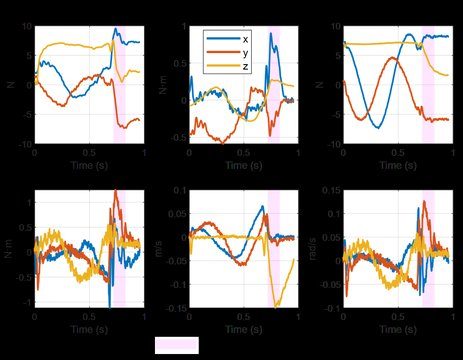
SI-Diff: A Framework for Learning Search and High-Precision Insertion with a Force-Domain Diffusion Policy
Yibo Liu, Stanko Oparnica, Simon Shewchun-Jakaitis et al. · arXiv · May 2026
Contact-rich manipulation is fundamental in robotics but poses significant challenges due to uncertainties in relative poses, such as misalignments and small clearances in peg-in-hole tasks. Existing approaches typically address search and...
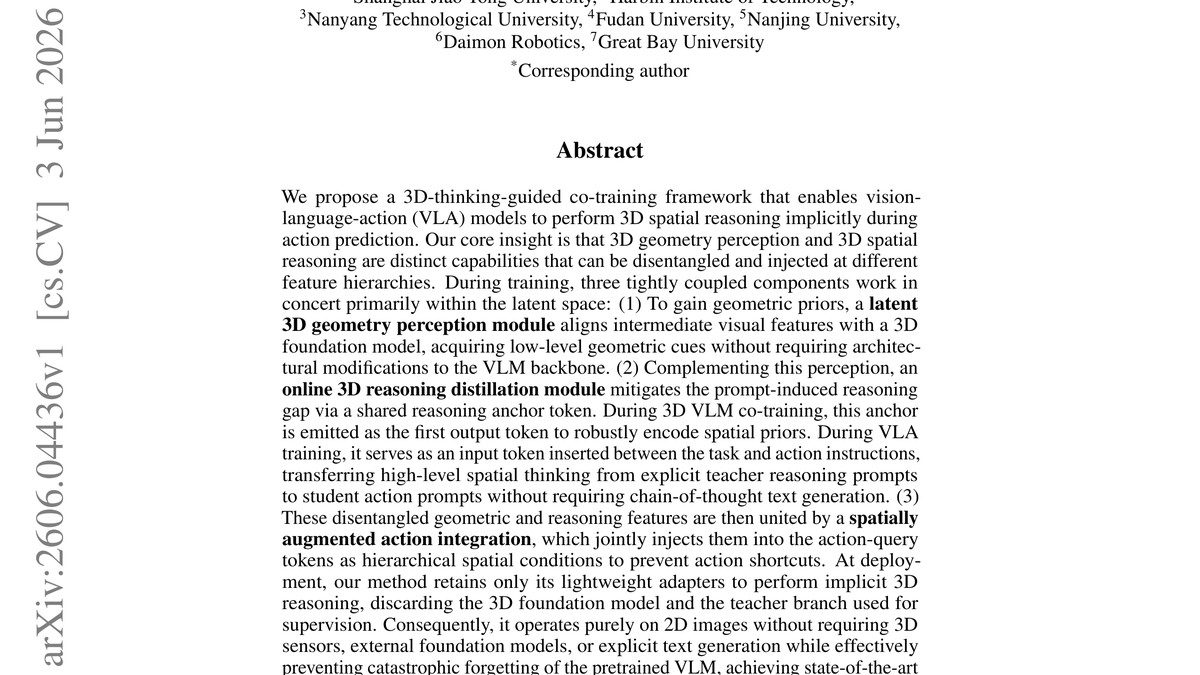
3DThinkVLA: Endowing Vision-Language-Action Models with Latent 3D Priors via 3D-Thinking-Guided Co-training
Jiaxin Shi, Xidong Zhang, Fucai Zhu et al. · arXiv preprint · Jun 2026
We propose a 3D-thinking-guided co-training framework that enables vision-language-action (VLA) models to perform 3D spatial reasoning implicitly during action prediction. Our core insight is that 3D geometry perception and 3D spatial reasoning are distinct capabilities that can be disentangled and ...
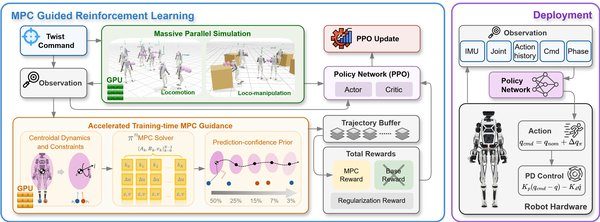
Accelerating and Scaling MPC-Guided Reinforcement Learning for Humanoid Locomotion and Manipulation
Junheng Li, Liang Wu, Sergio A. Esteban et al. · arXiv preprint · Jun 2026
In humanoid motion control, model predictive control (MPC) offers physically grounded prediction and constraint handling, while reinforcement learning (RL) enables robust whole-body skills through large-scale simulation. However, using MPC inside RL often requires time-consuming problem construction or excessive training overhead, making such frameworks difficult to justify in practice. This work studies efficient training-time MPC guidance for humanoid locomotion and manipulation, termed MPC-RL. We introduce a centroidal-dynamics MPC reward formulation that leverages guidance from MPC trajectories in training time. To make this practical in massively parallel RL, we develop π^nMPC, a parallel-in-horizon and construction-free batched GPU MPC solver that operates directly on time-varying dynamics to avoid high memory usage and pre-compilation. Through a variety of comparative studies and hardware validations, we have found that MPC-RL achieves superior performance in locomotion and manipulation skills.