

Odometer-Agnostic Drift Correction Using OpenStreetMap Lane Geometry
Joaquin Caballero, Emilio Garcia-Fidalgo, Alberto Ortiz, Jarno Ralli · N/A · 2026
Framework
N/A
License
N/A
Stars
N/A
Summary
Despite significant progress in odometry estimation, long-term drift remains a fundamental limitation of incremental pose integration, especially in large-scale or loop-free environments. Existing map-assisted methods can reduce drift, but often depend on dense maps, sensor-specific processing, o...
Abstract Summary
Key Points
- Despite significant progress in odometry estimation, long-term drift remains a fundamental limita...
- Existing map-assisted methods can reduce drift, but often depend on dense maps, sensor-specific p...
- We propose a lightweight open-source, odometry-agnostic correction method that aligns short traje...
- By formulating drift correction as a direct alignment between recent odometry and sparse lane geo...
- Experiments with LiDAR and visual odometry backends demonstrate consistent improvements, with par...
Odometer-Agnostic Drift Correction Using OpenStreetMap Lane Geometry
|Authors: Joaquin Caballero, Emilio Garcia-Fidalgo, Alberto Ortiz, Jarno Ralli
|Venue: arXiv preprint | Year: 2026
|arXiv: 2609.10336v1
Abstract
Despite significant progress in odometry estimation, long-term drift remains a fundamental limitation of incremental pose integration, especially in large-scale or loop-free environments. Existing map-assisted methods can reduce drift, but often depend on dense maps, sensor-specific processing, or complex matching pipelines. We propose a lightweight open-source, odometry-agnostic correction method that aligns short trajectory segments to OpenStreetMap (OSM) lane centerlines. By formulating drift correction as a direct alignment between recent odometry and sparse lane geometry, the method enables efficient online operation without dense priors or expensive preprocessing. Experiments with LiDAR and visual odometry backends demonstrate consistent improvements, with particularly strong gains under severe drift.
Key Contributions
- Despite significant progress in odometry estimation, long-term drift remains a fundamental limita…
- Existing map-assisted methods can reduce drift, but often depend on dense maps, sensor-specific p…
- We propose a lightweight open-source, odometry-agnostic correction method that aligns short traje…
- By formulating drift correction as a direct alignment between recent odometry and sparse lane geo…
- Experiments with LiDAR and visual odometry backends demonstrate consistent improvements, with par…
Topics
- vision
- reinforcement-learning
Code & Data
No code repository linked in paper metadata.
BibTeX
@article{Caballero2026_260910336v1,
  title     = {Odometer-Agnostic Drift Correction Using OpenStreetMap Lane Geometry},
  author    = {Joaquin Caballero and Emilio Garcia-Fidalgo and Alberto Ortiz and Jarno Ralli},
  year      = {2026},
  eprint    = {2609.10336v1},
  archivePrefix = {arXiv},
  primaryClass  = {cs.RO},
  url       = {https://arxiv.org/abs/2609.10336v1}
}
Related Papers
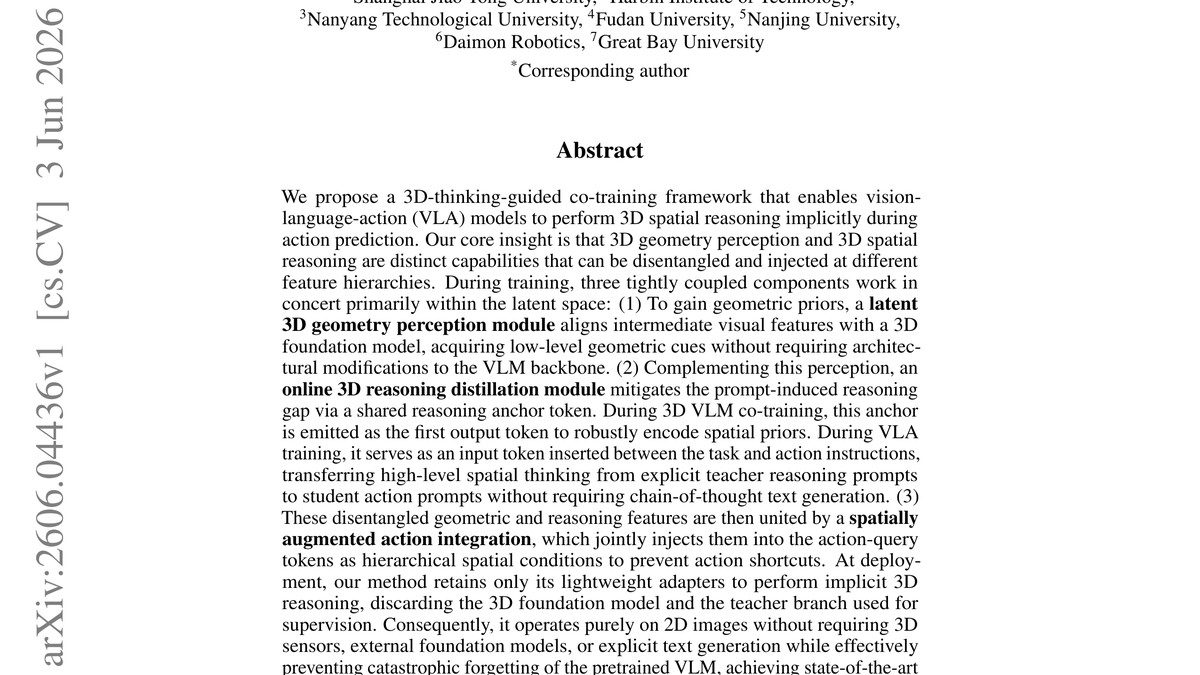
3DThinkVLA: Endowing Vision-Language-Action Models with Latent 3D Priors via 3D-Thinking-Guided Co-training
Jiaxin Shi, Xidong Zhang, Fucai Zhu et al. · arXiv preprint · Jun 2026
We propose a 3D-thinking-guided co-training framework that enables vision-language-action (VLA) models to perform 3D spatial reasoning implicitly during action prediction. Our core insight is that 3D geometry perception and 3D spatial reasoning are distinct capabilities that can be disentangled and ...
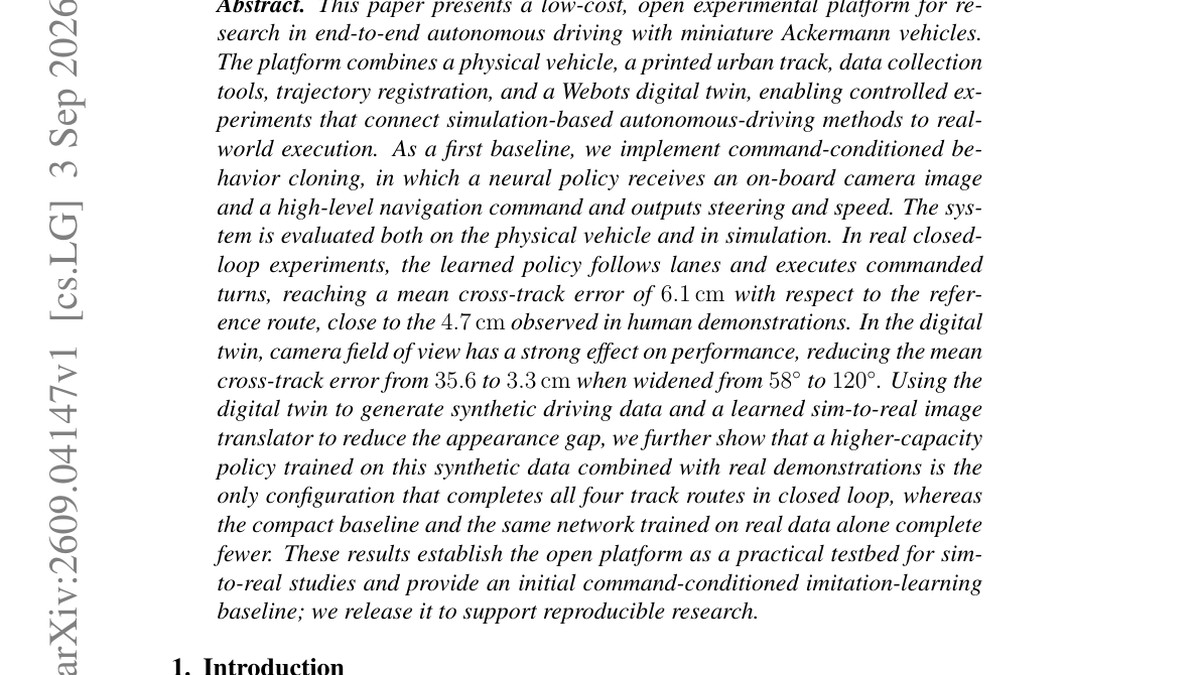
A Low-Cost, Open Platform for End-to-End Autonomous Driving on a Miniature Ackermann Vehicle
Gustavo Claudio Karl Couto, Eric Aislan Antonelo, Gabriel George Zipperer · arXiv preprint · Sep 2026
This paper presents a low-cost, open experimental platform for research in end-to-end autonomous driving with miniature Ackermann vehicles. The platform combines a physical vehicle, a printed urban track, data collection tools, trajectory registration, and a Webots digital twin, enabling controll...
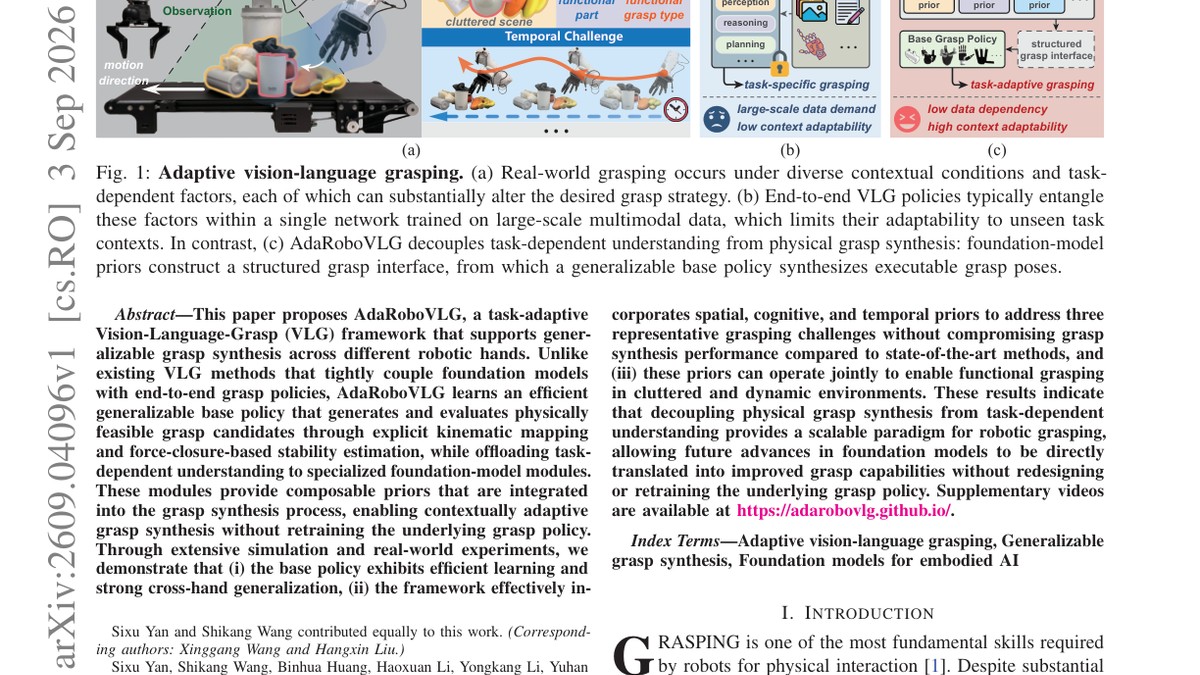
Adaptive Vision-Language Grasping via Composable Foundation Priors and Generalizable Grasp Synthesis
Sixu Yan, Shikang Wang, Binhua Huang et al. · arXiv preprint · Sep 2026
This paper proposes AdaRoboVLG, a task-adaptive Vision-Language-Grasp (VLG) framework that supports generalizable grasp synthesis across different robotic hands. Unlike existing VLG methods that tightly couple foundation models with end-to-end grasp policies, AdaRoboVLG learns an efficient genera...
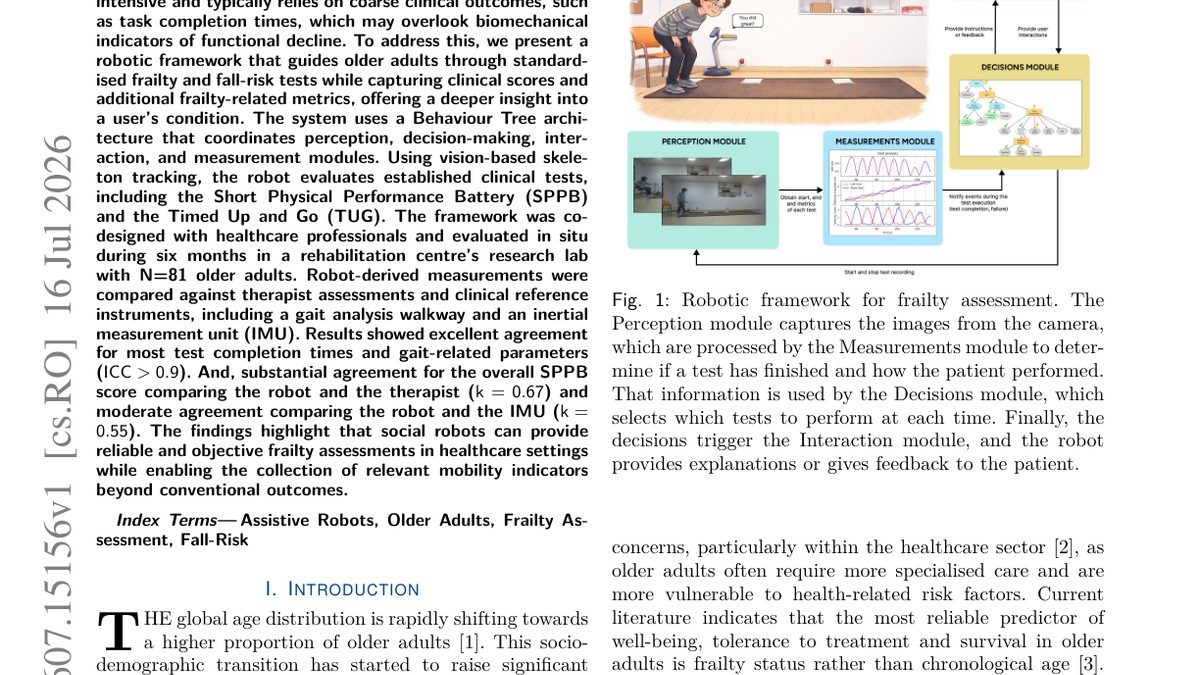
Assessing Physical Frailty and Fall-Risk Indicators with Social Robots: An in situ Evaluation with Older Adults
Aniol Civit, Antonio Andriella, Alba Martínez et al. · arXiv preprint · Jul 2026
Frailty assessments are crucial to evaluate the risk of adverse events and the health and social care needs of older adults, yet their administration remains resource-intensive and typically relies on coarse clinical outcomes, such as task completion times, which may overlook biomechanical indica...