
Marine Autonomous Vehicle Fleet Scheduling to Maximise Scientific Impact
Mehdi El Krari, Jonathan Smith, Maria Fox · N/A · 2026
Framework
N/A
License
N/A
Stars
N/A
Summary
The marine science community increasingly relies on Marine Autonomous Vehicles (MAVs) to collect the critical environmental data required to understand global ocean systems. However, as these operations scale, manually routing and planning large autonomous fleets becomes exponentially complex and...
Abstract Summary
Key Points
- The marine science community increasingly relies on Marine Autonomous Vehicles (MAVs) to collect ...
- However, as these operations scale, manually routing and planning large autonomous fleets becomes...
- To address this, we propose a mixed-integer linear programming (MILP) model designed to automate ...
- The model accounts for strict operational constraints, including battery capacities and time wind...
- A key novelty of this framework is integrating conventional ship itineraries, allowing MAVs to su...
Marine Autonomous Vehicle Fleet Scheduling to Maximise Scientific Impact
|Authors: Mehdi El Krari, Jonathan Smith, Maria Fox
|Venue: arXiv preprint | Year: 2026
|arXiv: 2608.27271v1
Abstract
The marine science community increasingly relies on Marine Autonomous Vehicles (MAVs) to collect the critical environmental data required to understand global ocean systems. However, as these operations scale, manually routing and planning large autonomous fleets becomes exponentially complex and time-consuming. To address this, we propose a mixed-integer linear programming (MILP) model designed to automate and optimise MAV deployment schedules. The model accounts for strict operational constraints, including battery capacities and time windows for data collection, while aiming to maximise total data collection and minimise both the number of deployed vehicles and their energy consumption. A key novelty of this framework is integrating conventional ship itineraries, allowing MAVs to support vessels with mid-mission battery swapping or accelerated transit between waypoints. Computational experiments demonstrate that the model is highly scalable, solving routing problems for fleets of dozens of MAVs in seconds, and scaling to hundreds of vehicles in only a few minutes. Beyond operational scheduling, the framework serves as a robust simulation tool for evaluating ‘what-if’ scenarios and analysing the impact of varying parameters on deployment strategies. Finally, the solution generates a suite of visualisations designed to enhance explainability and support strategic decision-making for stakeholders.
Key Contributions
- The marine science community increasingly relies on Marine Autonomous Vehicles (MAVs) to collect …
- However, as these operations scale, manually routing and planning large autonomous fleets becomes…
- To address this, we propose a mixed-integer linear programming (MILP) model designed to automate …
- The model accounts for strict operational constraints, including battery capacities and time wind…
- A key novelty of this framework is integrating conventional ship itineraries, allowing MAVs to su…
Topics
- vision
- reinforcement-learning
- planning
Code & Data
No code repository linked in paper metadata.
BibTeX
@article{Krari2026_260827271v1,
  title     = {Marine Autonomous Vehicle Fleet Scheduling to Maximise Scientific Impact},
  author    = {Mehdi El Krari and Jonathan Smith and Maria Fox},
  year      = {2026},
  eprint    = {2608.27271v1},
  archivePrefix = {arXiv},
  primaryClass  = {math.OC},
  url       = {https://arxiv.org/abs/2608.27271v1}
}
Related Papers
A Low-Cost, Open Platform for End-to-End Autonomous Driving on a Miniature Ackermann Vehicle
Gustavo Claudio Karl Couto, Eric Aislan Antonelo, Gabriel George Zipperer · arXiv preprint · Sep 2026
This paper presents a low-cost, open experimental platform for research in end-to-end autonomous driving with miniature Ackermann vehicles. The platform combines a physical vehicle, a printed urban track, data collection tools, trajectory registration, and a Webots digital twin, enabling controll...

Beyond Episodic Evaluation: Memory Architectural Bottlenecks in Sequential Embodied Question Answering
Zikui Cai, Kaushal Janga, Tan Dat Dao et al. · arXiv preprint · Jul 2026
Embodied question answering (EQA) is traditionally evaluated under an episodic formulation, where agents solve each task independently and reset internal state between episodes. However, real-world robots operate continuously and must accumulate, retain, and selectively reuse information acquired...
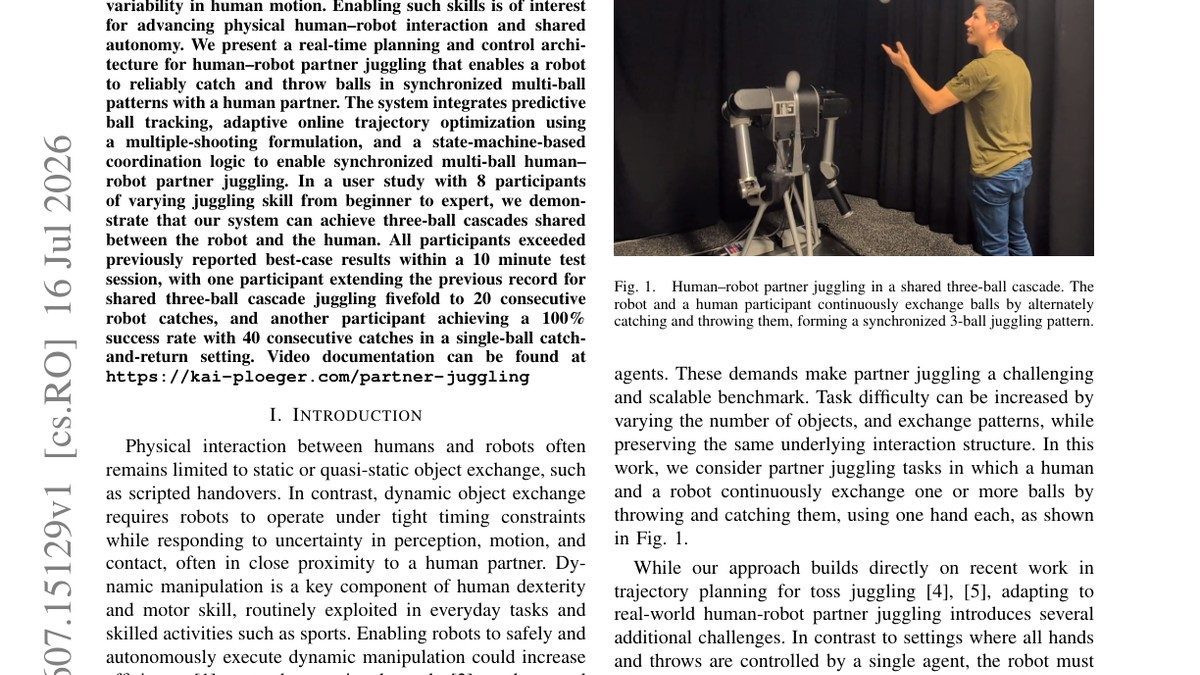
Catch, Throw, Repeat: Planning for Human-Robot Partner Juggling
Jonathan Rainer Lippert, Kai Ploeger, Abir Chowdhury et al. · arXiv preprint · Jul 2026
Dynamic object exchange between humans and robots remains a challenging problem due to uncertainty in perception, timing, and contact-rich interaction. Human-robot juggling represents a particularly demanding instance of this problem, requiring precise real-time coordination, predictive motion pl...
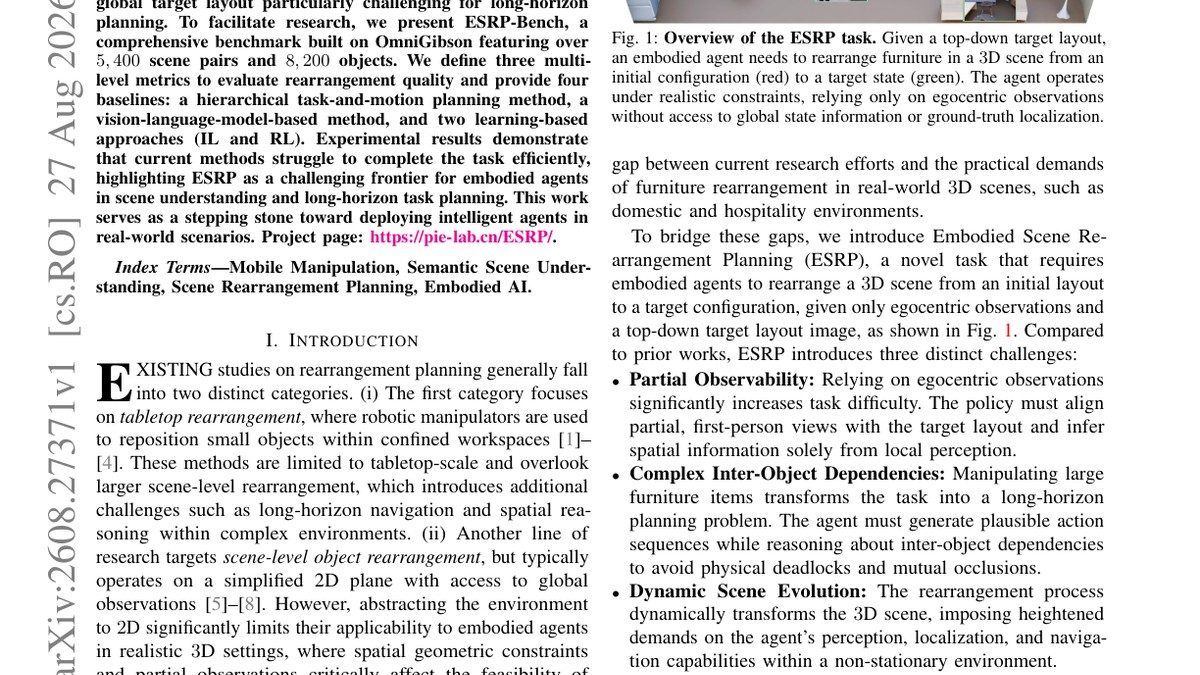
Embodied Scene Rearrangement Planning
Canzhi Chen, Zan Wang, Siqi Zhu et al. · arXiv preprint · Aug 2026
This paper introduces Embodied Scene Rearrangement Planning (ESRP), a novel task requiring embodied agents to rearrange furniture in 3D scenes to match a target configuration using only egocentric observations and a top-down target layout. Unlike prior rearrangement tasks, ESRP precludes global s...