
Learning Agent-based Model Predictive Control for Holistic Vehicle Performance
Jiaming Zhong, Reza Valiollahi Mehrizi, Mohammad Pirani, Chao Yu, Alireza Kasaiezadeh, Yash Vardhan Pant, Amir Khajepour · N/A · 2026
Framework
N/A
License
N/A
Stars
N/A
Summary
Agent-based model predictive control (AMPC) has recently been proposed as a distributed scheme that collaborates with all agents to achieve optimal holistic performance. However, its optimality highly depends on the prediction accuracy that requires all agents or their contributions to be known, ...
Abstract Summary
Key Points
- Agent-based model predictive control (AMPC) has recently been proposed as a distributed scheme th...
- However, its optimality highly depends on the prediction accuracy that requires all agents or the...
- This research proposes a novel practical hybrid control scheme - learning agent-based MPC (LAMPC)...
- The Gaussian process regression (GPR) enhanced by an online data management strategy serves as th...
- A novel multi-step prediction mechanism leverages the GPR learning potential along the horizon
Learning Agent-based Model Predictive Control for Holistic Vehicle Performance
|Authors: Jiaming Zhong, Reza Valiollahi Mehrizi, Mohammad Pirani, Chao Yu, Alireza Kasaiezadeh, Yash Vardhan Pant, Amir Khajepour
|Venue: arXiv preprint | Year: 2026
|arXiv: 2609.11871v1
Abstract
Agent-based model predictive control (AMPC) has recently been proposed as a distributed scheme that collaborates with all agents to achieve optimal holistic performance. However, its optimality highly depends on the prediction accuracy that requires all agents or their contributions to be known, which is too idealistic for actual implementation. This research proposes a novel practical hybrid control scheme - learning agent-based MPC (LAMPC), combining the model-based AMPC approach and data-based learning methods to improve the holistic vehicle performance for multi-agent systems. The Gaussian process regression (GPR) enhanced by an online data management strategy serves as the learning core to predict unknown contributions. A novel multi-step prediction mechanism leverages the GPR learning potential along the horizon. The predicted mean, representing the learned unknown contributions, completes the system model in the MPC for more accurate control. Meanwhile, a stochastic framework is formulated to guarantee control safety and feasibility using soft chance constraints based on the prediction variance. Both simulations and experiments show that, with the learning capability, LAMPC outperforms the traditional AMPC. LAMPC can achieve higher tracking performance in well-learned scenarios and always guarantee constraint satisfaction even in less-learned scenarios. Moreover, the proposed hybrid control scheme is efficient for real-time implementation and is flexible to any control agent topology.
Key Contributions
- Agent-based model predictive control (AMPC) has recently been proposed as a distributed scheme th…
- However, its optimality highly depends on the prediction accuracy that requires all agents or the…
- This research proposes a novel practical hybrid control scheme - learning agent-based MPC (LAMPC)…
- The Gaussian process regression (GPR) enhanced by an online data management strategy serves as th…
- A novel multi-step prediction mechanism leverages the GPR learning potential along the horizon
Topics
- control
Code & Data
No code repository linked in paper metadata.
BibTeX
@article{Zhong2026_260911871v1,
  title     = {Learning Agent-based Model Predictive Control for Holistic Vehicle Performance},
  author    = {Jiaming Zhong and Reza Valiollahi Mehrizi and Mohammad Pirani and Chao Yu and Alireza Kasaiezadeh and Yash Vardhan Pant and Amir Khajepour},
  year      = {2026},
  eprint    = {2609.11871v1},
  archivePrefix = {arXiv},
  primaryClass  = {cs.RO},
  url       = {https://arxiv.org/abs/2609.11871v1}
}
Related Papers

3D Euler-Angle Orientation Control for Two-Ray Fading Mitigation in Maritime Air-to-Sea Communications
Mohammed Bajja, Abdoul Karim A. H. Saliah, Hajar El Hammouti et al. · arXiv preprint · Sep 2026
Maritime Air-to-Sea links are dominated by a line-of-sight ray and a sea-surface reflected ray whose destructive combination produces deep fades. Existing mitigation strategies optimize Unmanned Aerial Vehicle position or trajectory but leave attitude unexploited. This paper treats the full three...
A Browser-Native Digital Test Range for Benchmarking 4D Ocean-Glider Planning Algorithms
Edward Holmberg, Elias Ioup, Mahdi Abdelguerfi · arXiv preprint · Aug 2026
Repeated in-situ evaluation of ocean-glider planners requires scarce vehicles, operators, deployment and recovery resources, and ocean conditions that cannot be reset for competing algorithms. We present a guided, installation-free browser-native digital test range that transforms a selected regi...
A Low-Cost, Open Platform for End-to-End Autonomous Driving on a Miniature Ackermann Vehicle
Gustavo Claudio Karl Couto, Eric Aislan Antonelo, Gabriel George Zipperer · arXiv preprint · Sep 2026
This paper presents a low-cost, open experimental platform for research in end-to-end autonomous driving with miniature Ackermann vehicles. The platform combines a physical vehicle, a printed urban track, data collection tools, trajectory registration, and a Webots digital twin, enabling controll...
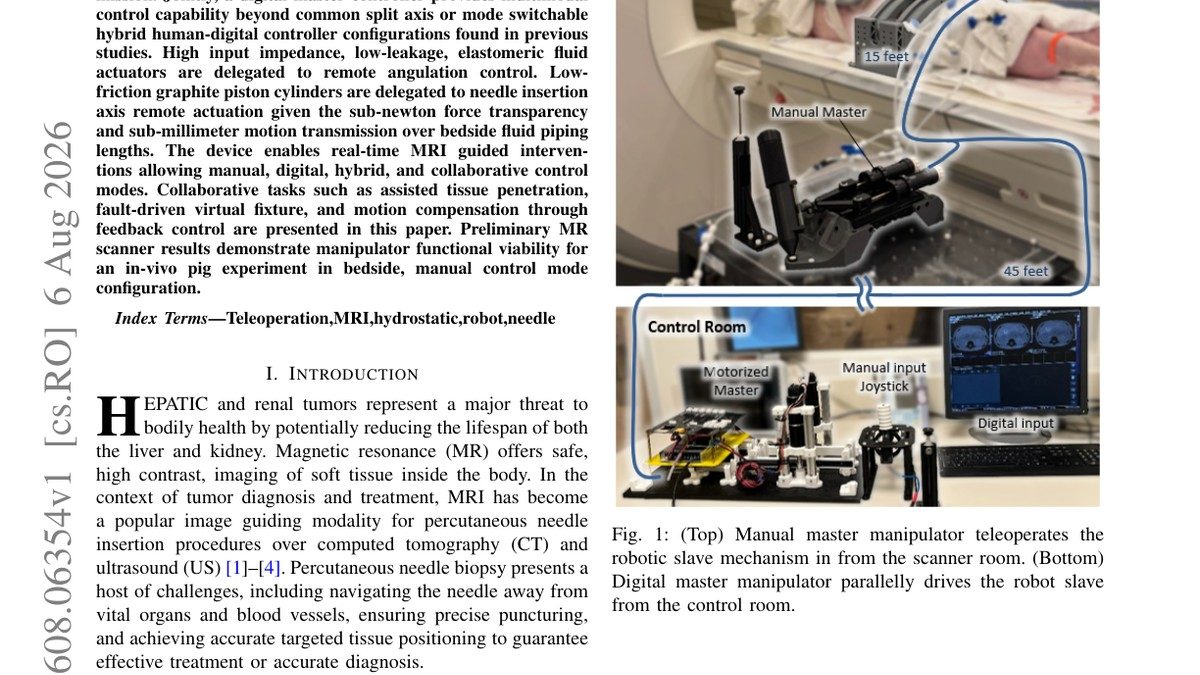
A Master-Salve Robot Manipulator for Needle-Based Teleoperation in MRI Chamber
Omar Curiel, Jing-Yuan Huang, Po-Chih Chen et al. · arXiv preprint · Aug 2026
We present a MR safe, master-slave robot manipulator for abdominal interventions in the MRI chamber. A human operated 2+1-DoF master controller manipulator transmits motion and force to a 2+1-DoF slave manipulator via fluid transmission. Jointly, a digital master controller provides multimodal co...