

3D Euler-Angle Orientation Control for Two-Ray Fading Mitigation in Maritime Air-to-Sea Communications
Mohammed Bajja, Abdoul Karim A. H. Saliah, Hajar El Hammouti, Daniel Bonilla Licea, Giuseppe Silano · N/A · 2026
Framework
N/A
License
N/A
Stars
N/A
Summary
Maritime Air-to-Sea links are dominated by a line-of-sight ray and a sea-surface reflected ray whose destructive combination produces deep fades. Existing mitigation strategies optimize Unmanned Aerial Vehicle position or trajectory but leave attitude unexploited. This paper treats the full three...
Abstract Summary
Key Points
- Maritime Air-to-Sea links are dominated by a line-of-sight ray and a sea-surface reflected ray wh...
- Existing mitigation strategies optimize Unmanned Aerial Vehicle position or trajectory but leave ...
- This paper treats the full three dimensional attitude as a physical-layer control variable that s...
- Under small-angle and far-field assumptions, the constructive-interference condition reduces to a...
- A differentiable soft-minimum rule yields a smooth reference tracked by a constrained Nonlinear M...
3D Euler-Angle Orientation Control for Two-Ray Fading Mitigation in Maritime Air-to-Sea Communications
|Authors: Mohammed Bajja, Abdoul Karim A. H. Saliah, Hajar El Hammouti, Daniel Bonilla Licea, Giuseppe Silano
|Venue: arXiv preprint | Year: 2026
|arXiv: 2609.11476v1
Abstract
Maritime Air-to-Sea links are dominated by a line-of-sight ray and a sea-surface reflected ray whose destructive combination produces deep fades. Existing mitigation strategies optimize Unmanned Aerial Vehicle position or trajectory but leave attitude unexploited. This paper treats the full three dimensional attitude as a physical-layer control variable that shapes the two-ray interference through antenna phase-center displacement. Under small-angle and far-field assumptions, the constructive-interference condition reduces to an affine constraint in the Euler angles and admits a closed-form family of minimum-norm attitude candidates. A differentiable soft-minimum rule yields a smooth reference tracked by a constrained Nonlinear Model Predictive Control controller on a fully-actuated tilting multirotor. The proposed scheme increases cumulative throughput by 11.4% over a pitch-only benchmark and 22.2% over a zero-orientation baseline, while preserving trajectory tracking and respecting actuator limits.
Key Contributions
- Maritime Air-to-Sea links are dominated by a line-of-sight ray and a sea-surface reflected ray wh…
- Existing mitigation strategies optimize Unmanned Aerial Vehicle position or trajectory but leave …
- This paper treats the full three dimensional attitude as a physical-layer control variable that s…
- Under small-angle and far-field assumptions, the constructive-interference condition reduces to a…
- A differentiable soft-minimum rule yields a smooth reference tracked by a constrained Nonlinear M…
Topics
- control
- benchmark
Code & Data
No code repository linked in paper metadata.
BibTeX
@article{Bajja2026_260911476v1,
  title     = {3D Euler-Angle Orientation Control for Two-Ray Fading Mitigation in Maritime Air-to-Sea Communications},
  author    = {Mohammed Bajja and Abdoul Karim A. H. Saliah and Hajar El Hammouti and Daniel Bonilla Licea and Giuseppe Silano},
  year      = {2026},
  eprint    = {2609.11476v1},
  archivePrefix = {arXiv},
  primaryClass  = {cs.RO},
  url       = {https://arxiv.org/abs/2609.11476v1}
}
Related Papers
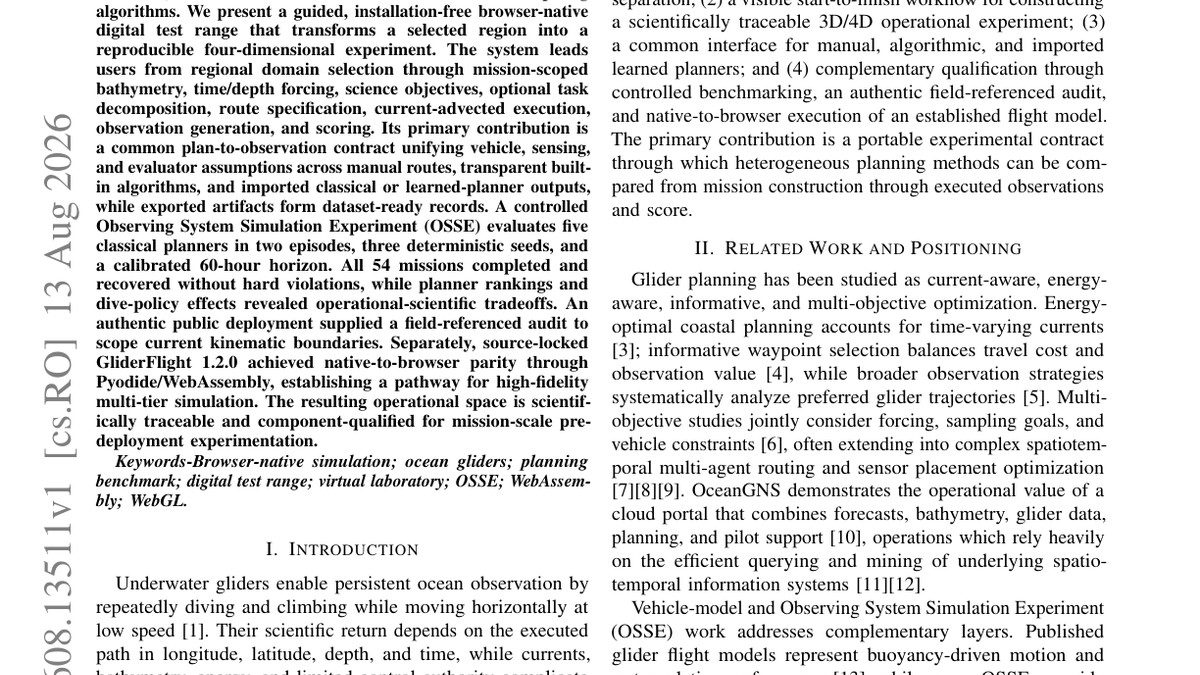
A Browser-Native Digital Test Range for Benchmarking 4D Ocean-Glider Planning Algorithms
Edward Holmberg, Elias Ioup, Mahdi Abdelguerfi · arXiv preprint · Aug 2026
Repeated in-situ evaluation of ocean-glider planners requires scarce vehicles, operators, deployment and recovery resources, and ocean conditions that cannot be reset for competing algorithms. We present a guided, installation-free browser-native digital test range that transforms a selected regi...
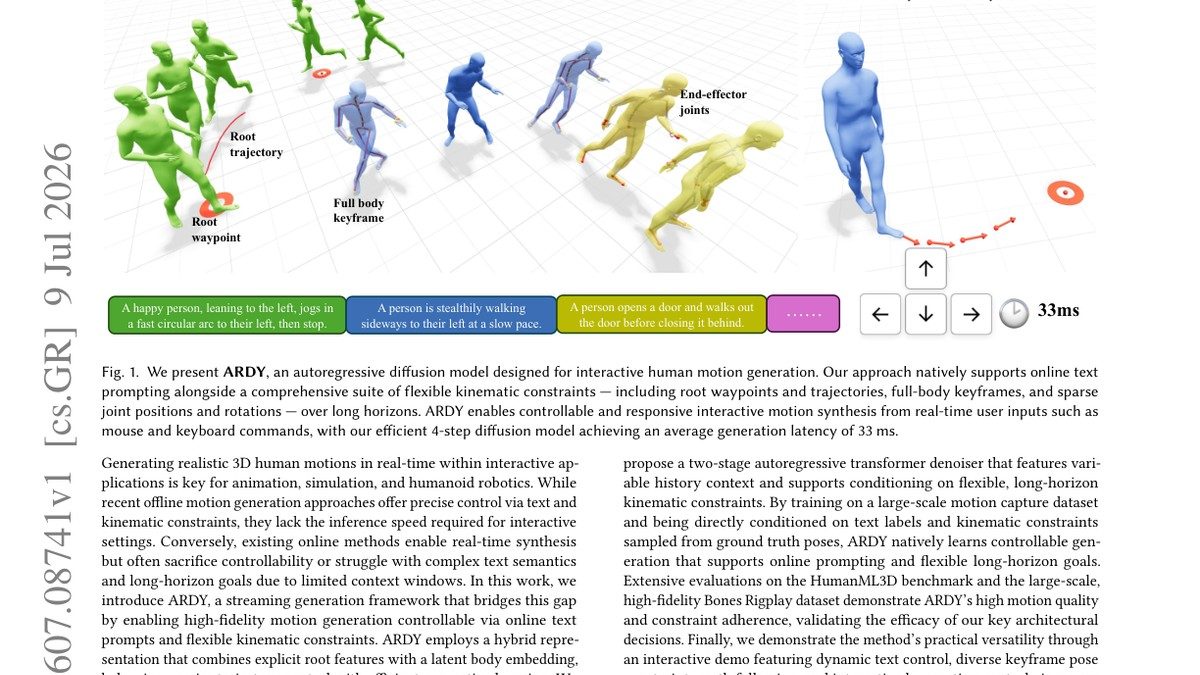
ARDY: Autoregressive Diffusion with Hybrid Representation for Interactive Human Motion Generation
Kaifeng Zhao, Mathis Petrovich, Haotian Zhang et al. · arXiv preprint · Jul 2026
Generating realistic 3D human motions in real-time within interactive applications is key for animation, simulation, and humanoid robotics. While recent offline motion generation approaches offer precise control via text and kinematic constraints, they lack the inference speed required for intera...
Compact Latent Coordination for Autonomous Vehicles at Unsignalized Intersections
Gil Lifshits, Igal Bilik, Gilad Katz · arXiv preprint · Jul 2026
Coordinating autonomous vehicles at unsignalized intersections remains a critical challenge for multi-agent reinforcement learning (MARL) systems, which typically struggle with combinatorial action spaces, reliance on privileged information, or rigid agent designs. We propose Master-Agent Proto-p...
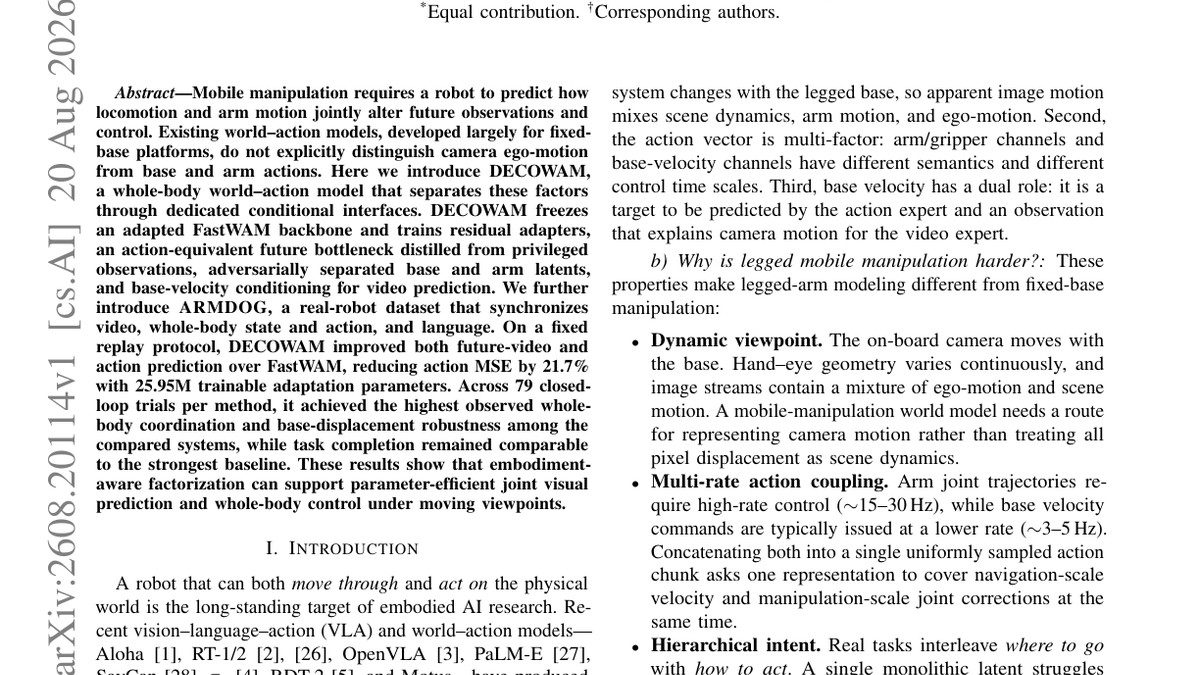
DECOWAM: Decoupled Whole-Body World-Action Model for Legged Mobile Manipulation
Siyuan Ma, Boshi Zhang, Yutian Zhang et al. · arXiv preprint · Aug 2026
Mobile manipulation requires a robot to predict how locomotion and arm motion jointly alter future observations and control. Existing world-action models, developed largely for fixed-base platforms, do not explicitly distinguish camera ego-motion from base and arm actions. Here we introduce DECOW...