
A Master-Salve Robot Manipulator for Needle-Based Teleoperation in MRI Chamber
Omar Curiel, Jing-Yuan Huang, Po-Chih Chen, Ji Ma, Qing Dai, Wenqi Zhou, David Lu, Holden H. Wu, Tsu-Chin Tsao · N/A · 2026
Framework
N/A
License
N/A
Stars
N/A
Summary
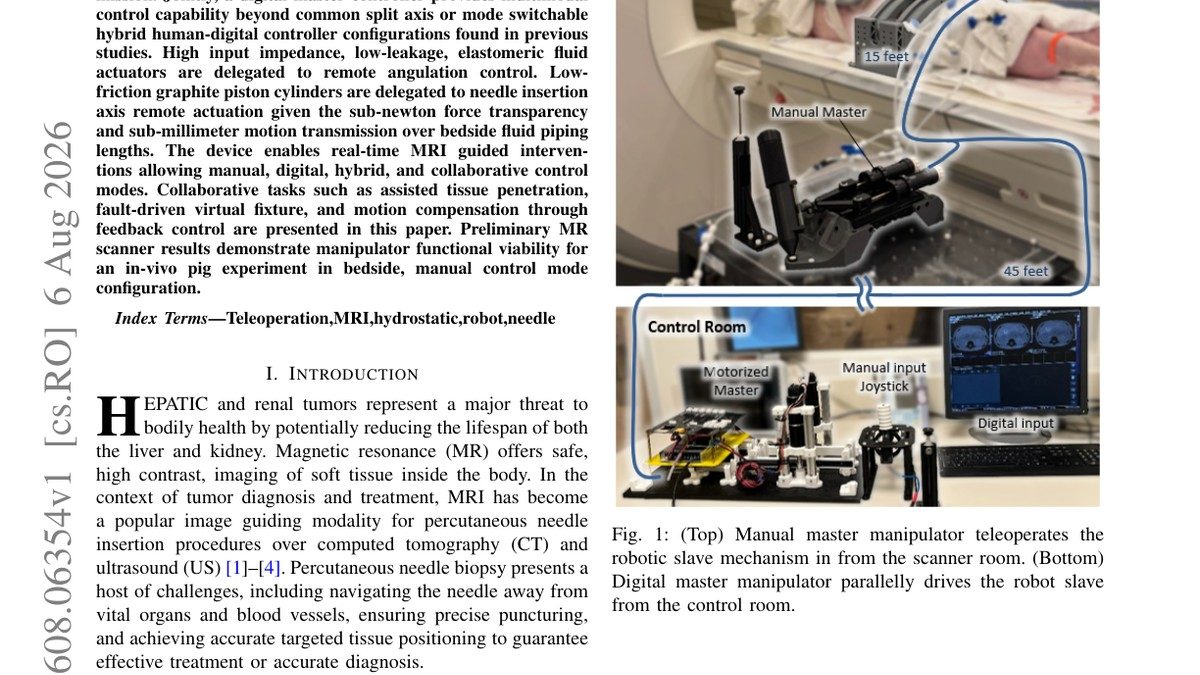
We present a MR safe, master-slave robot manipulator for abdominal interventions in the MRI chamber. A human operated 2+1-DoF master controller manipulator transmits motion and force to a 2+1-DoF slave manipulator via fluid transmission. Jointly, a digital master controller provides multimodal co...
Abstract Summary
Key Points
- We present a MR safe, master-slave robot manipulator for abdominal interventions in the MRI chamber
- A human operated 2+1-DoF master controller manipulator transmits motion and force to a 2+1-DoF sl...
- Jointly, a digital master controller provides multimodal control capability beyond common split a...
- High input impedance, low-leakage, elastomeric fluid actuators are delegated to remote angulation...
- Low-friction graphite piston cylinders are delegated to needle insertion axis remote actuation gi...
A Master-Salve Robot Manipulator for Needle-Based Teleoperation in MRI Chamber
|Authors: Omar Curiel, Jing-Yuan Huang, Po-Chih Chen, Ji Ma, Qing Dai, Wenqi Zhou, David Lu, Holden H. Wu, Tsu-Chin Tsao
|Venue: arXiv preprint | Year: 2026
|arXiv: 2608.06354v1
Abstract
We present a MR safe, master-slave robot manipulator for abdominal interventions in the MRI chamber. A human operated 2+1-DoF master controller manipulator transmits motion and force to a 2+1-DoF slave manipulator via fluid transmission. Jointly, a digital master controller provides multimodal control capability beyond common split axis or mode switchable hybrid human-digital controller configurations found in previous studies. High input impedance, low-leakage, elastomeric fluid actuators are delegated to remote angulation control. Low-friction graphite piston cylinders are delegated to needle insertion axis remote actuation given the sub-newton force transparency and sub-millimeter motion transmission over bedside fluid piping lengths. The device enables real-time MRI guided interventions allowing manual, digital, hybrid, and collaborative control modes. Collaborative tasks such as assisted tissue penetration, fault-driven virtual fixture, and motion compensation through feedback control are presented in this paper. Preliminary MR scanner results demonstrate manipulator functional viability for an in-vivo pig experiment in bedside, manual control mode configuration.
Key Contributions
- We present a MR safe, master-slave robot manipulator for abdominal interventions in the MRI chamber
- A human operated 2+1-DoF master controller manipulator transmits motion and force to a 2+1-DoF sl…
- Jointly, a digital master controller provides multimodal control capability beyond common split a…
- High input impedance, low-leakage, elastomeric fluid actuators are delegated to remote angulation…
- Low-friction graphite piston cylinders are delegated to needle insertion axis remote actuation gi…
Topics
- control
- learning-from-demonstration
Code & Data
No code repository linked in paper metadata.
BibTeX
@article{Curiel2026_260806354v1,
  title     = {A Master-Salve Robot Manipulator for Needle-Based Teleoperation in MRI Chamber},
  author    = {Omar Curiel and Jing-Yuan Huang and Po-Chih Chen and Ji Ma and Qing Dai and Wenqi Zhou and David Lu and Holden H. Wu and Tsu-Chin Tsao},
  year      = {2026},
  eprint    = {2608.06354v1},
  archivePrefix = {arXiv},
  primaryClass  = {cs.RO},
  url       = {https://arxiv.org/abs/2608.06354v1}
}
Related Papers
A Low-Cost, Open Platform for End-to-End Autonomous Driving on a Miniature Ackermann Vehicle
Gustavo Claudio Karl Couto, Eric Aislan Antonelo, Gabriel George Zipperer · arXiv preprint · Sep 2026
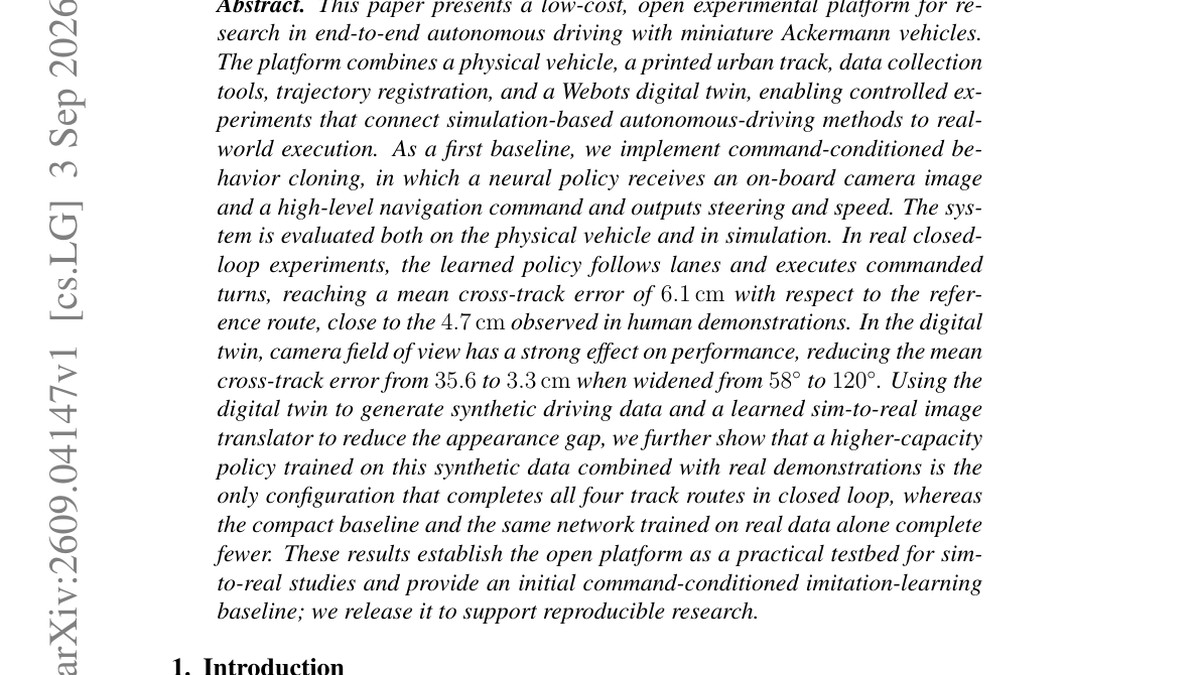
This paper presents a low-cost, open experimental platform for research in end-to-end autonomous driving with miniature Ackermann vehicles. The platform combines a physical vehicle, a printed urban track, data collection tools, trajectory registration, and a Webots digital twin, enabling controll...
AHEAD: Anticipatory Hand-Driven Teleoperation via Human Intent Prediction
Seok Joon Kim, Junho Lee, Federica Spinola et al. · arXiv preprint · Jul 2026
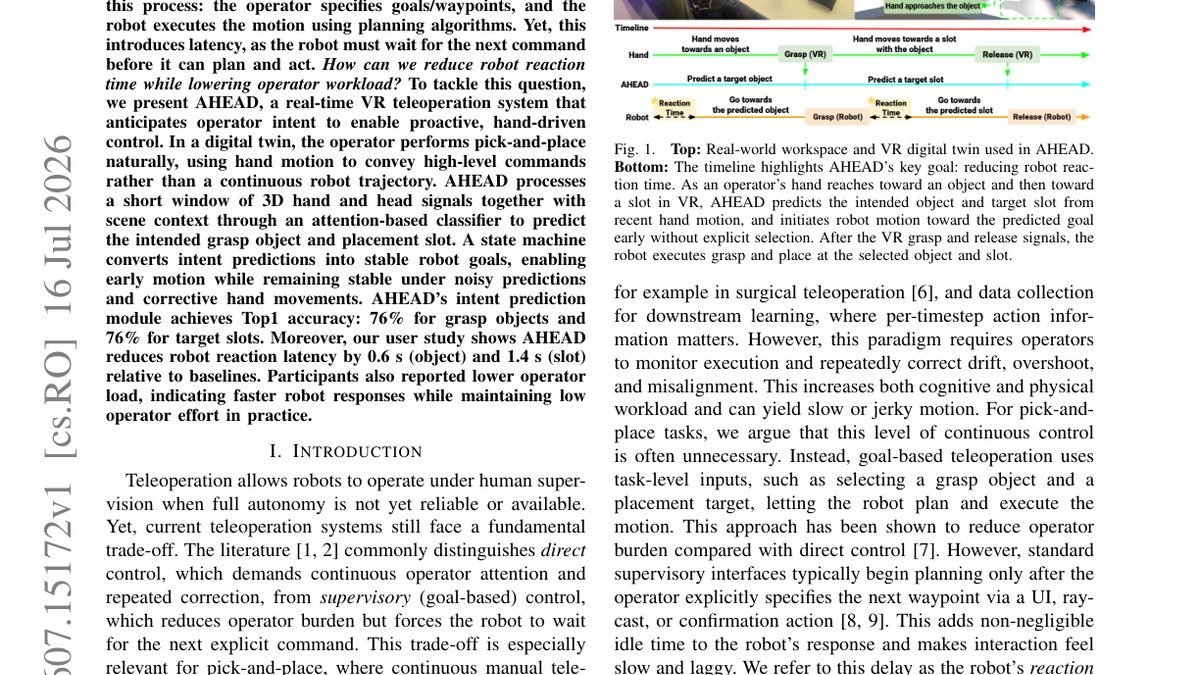
Direct hand-driven teleoperation maps an operator's hand motion to robot end-effector commands at every frame, enabling precise control, but it requires constant monitoring and correction during approach, grasp, and placement, which can be slow and fatiguing. For repetitive pick-and-place tasks, ...
Can People Distinguish Human and AI Agency in Humanoid Teleoperation? A Preliminary Study of Agency Perception
Xiang Li, Koya Dendo, Keigo Minamida et al. · arXiv preprint · Sep 2026
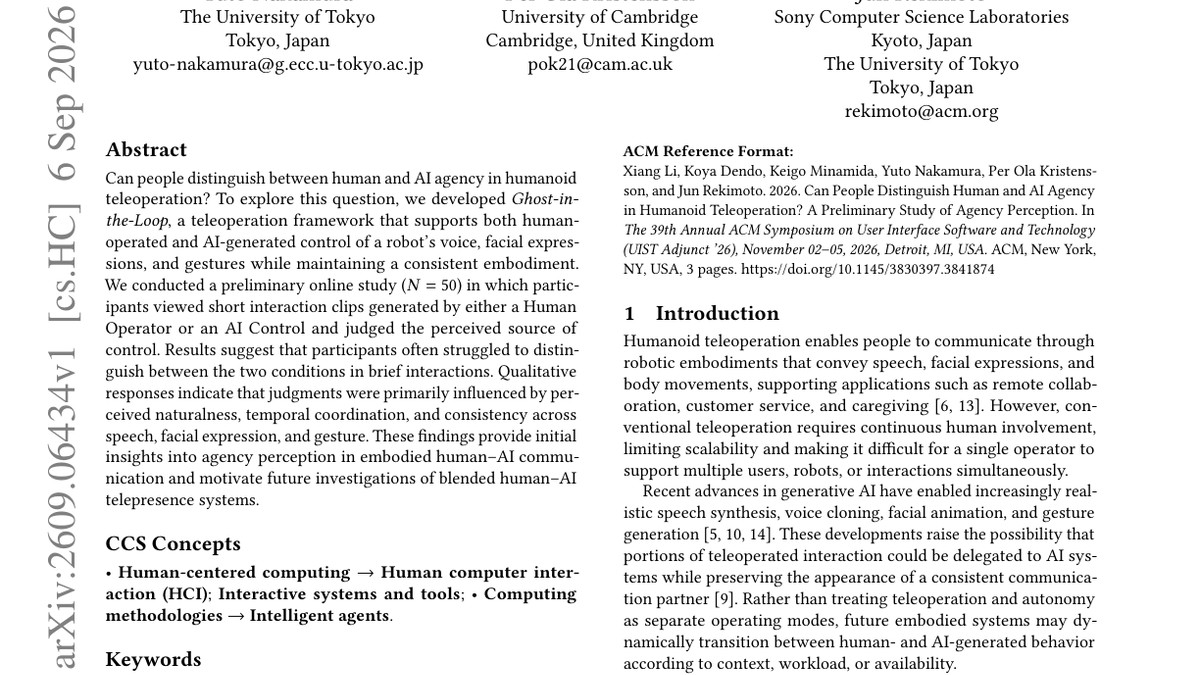
Can people distinguish between human and AI agency in humanoid teleoperation? To explore this question, we developed \textit{Ghost-in-the-Loop}, a teleoperation framework that supports both human-operated and AI-generated control of a robot's voice, facial expressions, and gestures while maintain...
Design and Evaluation of a Touchscreen-Based Teleoperation Interface for Robotic Manipulators
Juan José García Cárdenas, Alperen Kenan, Hamidreza Raei et al. · arXiv preprint · Aug 2026
Intuitive teleoperation interfaces are crucial for the safe and effective operation of robotic manipulators in challenging environments. In the nuclear industry, surface contact tasks such as swab sampling require precise path and force tracking, obstacle avoidance, and sustained operator attenti...