
GenHOI: Contact-Aware Humanoid-Object Interaction by Imitating Generated Videos without Task-Specific Training
Zhihai Bi, Qiang Zhang, Guoyang Zhao, Jiahang Cao, Xueyin Luo, Yushan Zhang, Jinglan Xu, Ruoyu Geng, Yulin Li, Andrew F. Luo, Jun Ma · N/A · 2026
Framework
N/A
License
N/A
Stars
N/A
Summary
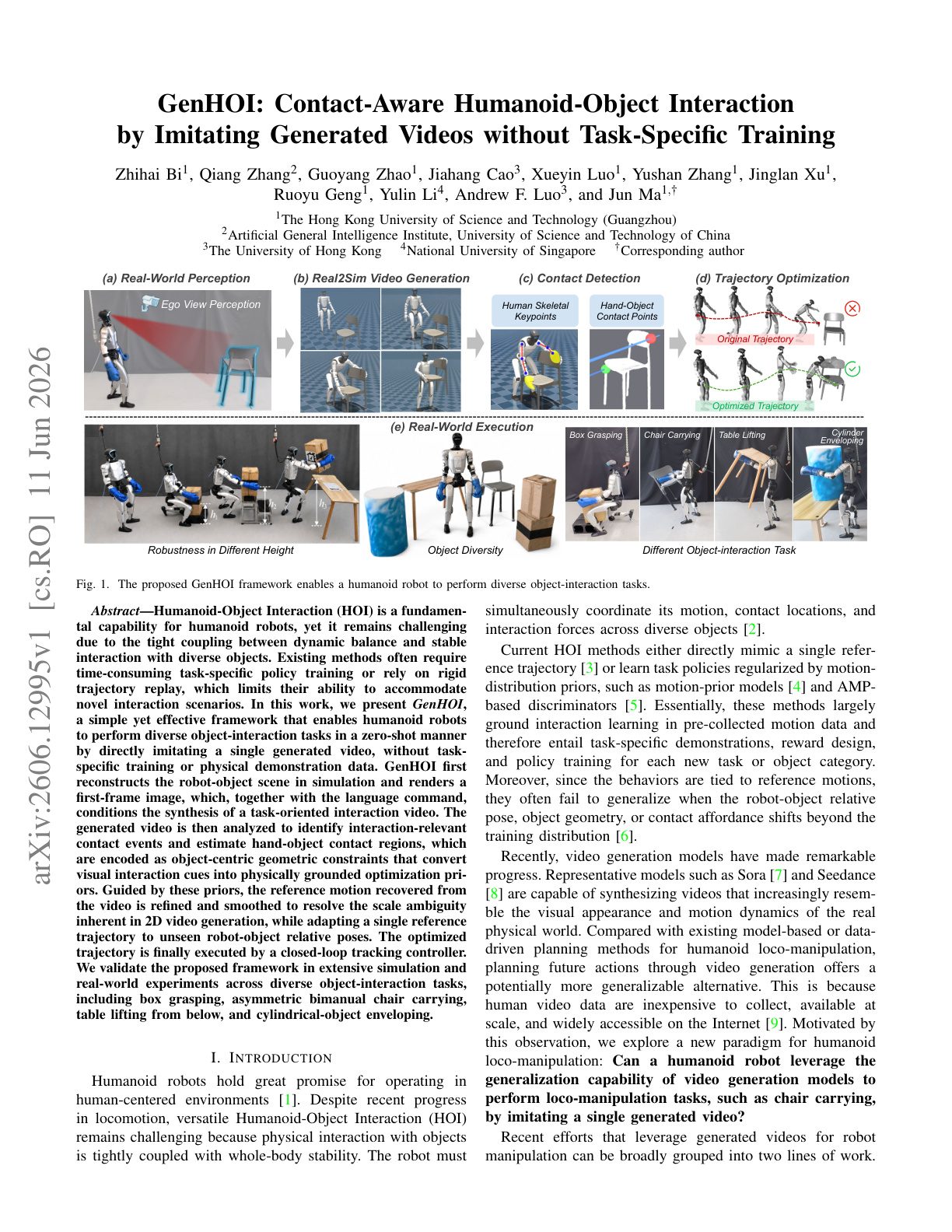
Humanoid-Object Interaction (HOI) is a fundamental capability for humanoid robots, yet it remains challenging due to the tight coupling between dynamic balance and stable interaction with diverse objects. Existing methods often require time-consuming task-specific policy training or rely on rigid tr...
Abstract Summary
Key Points
- GenHOI enables zero-shot humanoid-object interaction by imitating a single generated video.
- Reconstructs robot-object scenes in simulation to condition video generation with language commands.
- Extracts contact events and geometric constraints from generated videos for physically grounded motion optimization.
- Validates on diverse real-world tasks including bimanual chair carrying and table lifting.
Related Papers
GRAIL: Generating Humanoid Loco-Manipulation from 3D Assets and Video Priors
Tianyi Xie, Haotian Zhang, Jinhyung Park et al. · arXiv preprint · Jun 2026
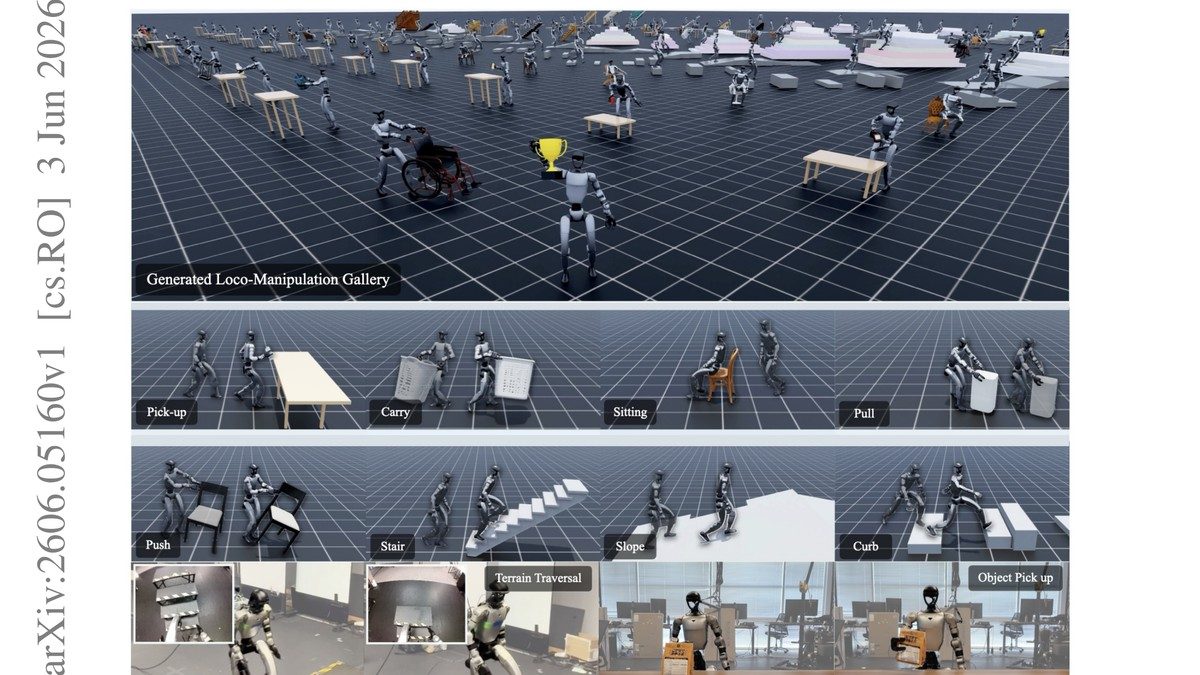
Scaling humanoid loco-manipulation requires robot-compatible demonstrations across diverse objects, whole-body motions, and scene geometries, but teleoperation and motion capture are difficult to scale because each collection depends on physical setups, instrumented actors, and robot operation. We p...
LadderMan: Learning Humanoid Perceptive Ladder Climbing
Siheng Zhao, Yuanhang Zhang, Ziqi Lu et al. · arXiv preprint · Jun 2026
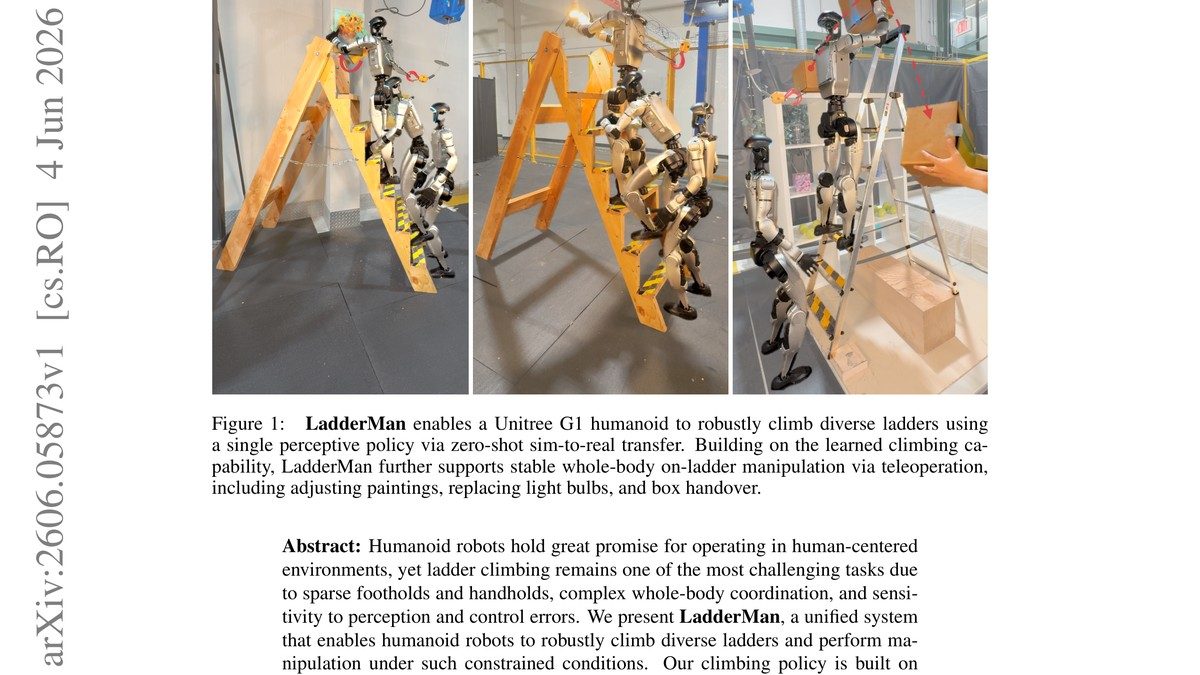
Humanoid robots hold great promise for operating in human-centered environments, yet ladder climbing remains one of the most challenging tasks due to sparse footholds and handholds, complex whole-body coordination, and sensitivity to perception and control errors. We present extbf{LadderMan}, a un...
3DThinkVLA: Endowing Vision-Language-Action Models with Latent 3D Priors via 3D-Thinking-Guided Co-training
Jiaxin Shi, Xidong Zhang, Fucai Zhu et al. · arXiv preprint · Jun 2026
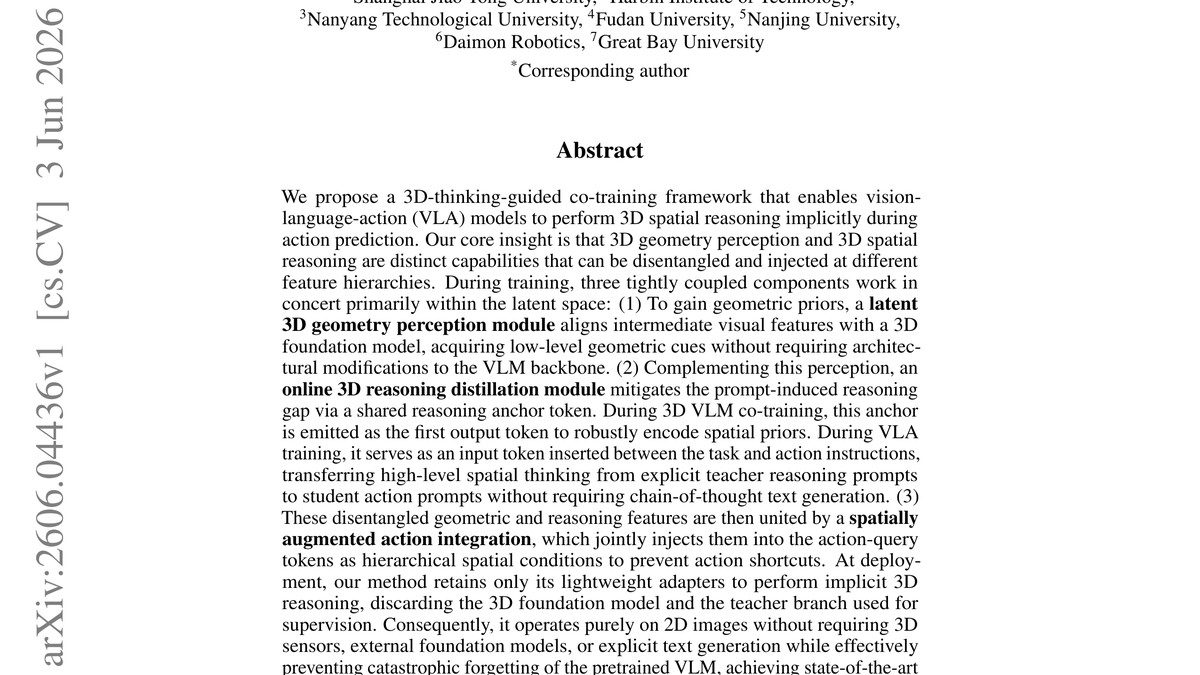
We propose a 3D-thinking-guided co-training framework that enables vision-language-action (VLA) models to perform 3D spatial reasoning implicitly during action prediction. Our core insight is that 3D geometry perception and 3D spatial reasoning are distinct capabilities that can be disentangled and ...
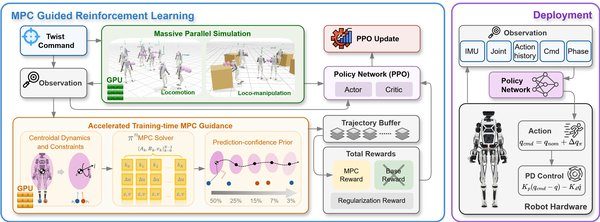
Accelerating and Scaling MPC-Guided Reinforcement Learning for Humanoid Locomotion and Manipulation
Junheng Li, Liang Wu, Sergio A. Esteban et al. · arXiv preprint · Jun 2026
In humanoid motion control, model predictive control (MPC) offers physically grounded prediction and constraint handling, while reinforcement learning (RL) enables robust whole-body skills through large-scale simulation. However, using MPC inside RL often requires time-consuming problem construction or excessive training overhead, making such frameworks difficult to justify in practice. This work studies efficient training-time MPC guidance for humanoid locomotion and manipulation, termed MPC-RL. We introduce a centroidal-dynamics MPC reward formulation that leverages guidance from MPC trajectories in training time. To make this practical in massively parallel RL, we develop π^nMPC, a parallel-in-horizon and construction-free batched GPU MPC solver that operates directly on time-varying dynamics to avoid high memory usage and pre-compilation. Through a variety of comparative studies and hardware validations, we have found that MPC-RL achieves superior performance in locomotion and manipulation skills.