
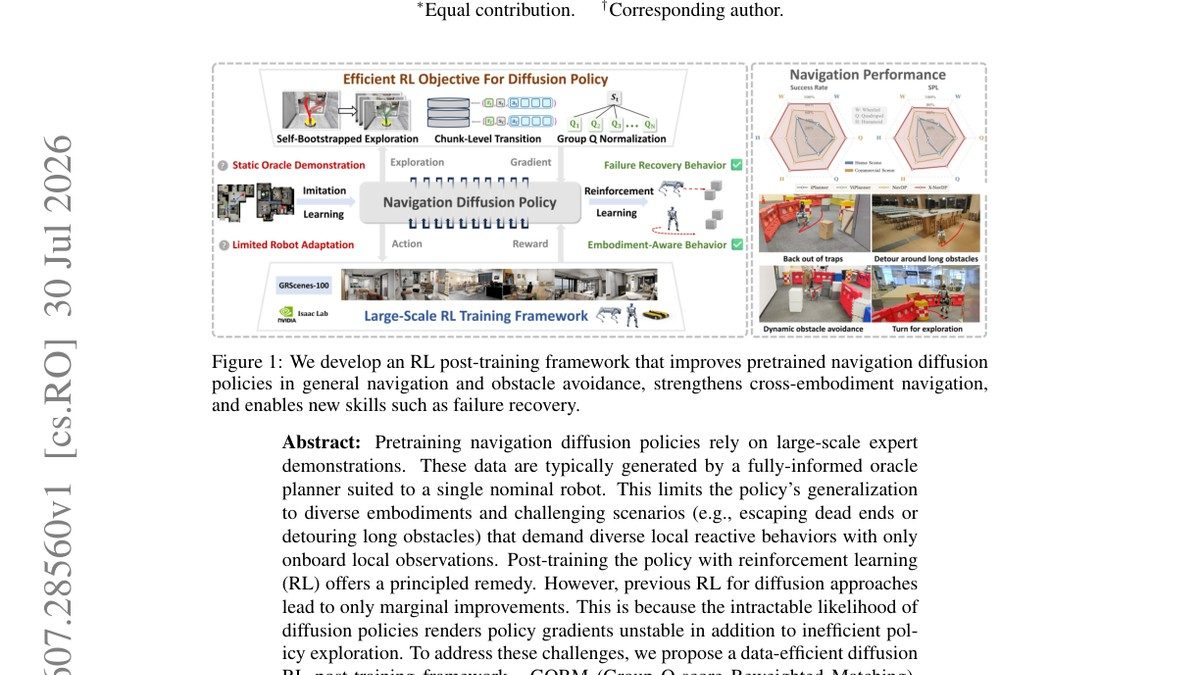
X-NavDP: Generalizing Navigation Diffusion Policy to Novel Behavior and Embodiments with Group Q-score Reweighted Matching
Tianyu Yang, Yiming Zeng, Wenzhe Cai, Yuqiang Yang, Jiaqi Peng, Hui Cheng, Jiangmiao Pang, Tai Wang · N/A · 2026
Framework
N/A
License
N/A
Stars
N/A
Summary
Pretraining navigation diffusion policies rely on large-scale expert demonstrations. These data are typically generated by a fully-informed oracle planner suited to a single nominal robot. This limits the policy's generalization to diverse embodiments and challenging scenarios (e.g., escaping dea...
Abstract Summary
Key Points
- Pretraining navigation diffusion policies rely on large-scale expert demonstrations
- These data are typically generated by a fully-informed oracle planner suited to a single nominal ...
- This limits the policy's generalization to diverse embodiments and challenging scenarios (e.g., e...
- Post-training the policy with reinforcement learning (RL) offers a principled remedy
- However, previous RL for diffusion approaches lead to only marginal improvements
X-NavDP: Generalizing Navigation Diffusion Policy to Novel Behavior and Embodiments with Group Q-score Reweighted Matching
|Authors: Tianyu Yang, Yiming Zeng, Wenzhe Cai, Yuqiang Yang, Jiaqi Peng, Hui Cheng, Jiangmiao Pang, Tai Wang
|Venue: arXiv preprint | Year: 2026
|arXiv: 2607.28560v1
Abstract
Pretraining navigation diffusion policies rely on large-scale expert demonstrations. These data are typically generated by a fully-informed oracle planner suited to a single nominal robot. This limits the policy’s generalization to diverse embodiments and challenging scenarios (e.g., escaping dead ends or detouring long obstacles) that demand diverse local reactive behaviors with only onboard local observations. Post-training the policy with reinforcement learning (RL) offers a principled remedy. However, previous RL for diffusion approaches lead to only marginal improvements. This is because the intractable likelihood of diffusion policies renders policy gradients unstable in addition to inefficient policy exploration. To address these challenges, we propose a data-efficient diffusion RL post-training framework - GQRM (Group Q-score Reweighted Matching). Our framework introduces two complementary designs: (i) a self-bootstrapped exploration strategy with behavior perturbation that preserves the pretrained policy prior, and (ii) a group Q-score normalization mechanism that computes per-trajectory values on each state for efficient reweighted score matching. By conducting distributed online RL training across heterogeneous embodiments, the resulting fine-tuned policy, X-NavDP, achieves state-of-the-art cross-embodiment visual navigation performance, improving the overall success rate from 61.20% to 84.28% in simulation and 10% to 65% in real-world hard cases. The code and model are publicly available at https://yty-sky.github.io/x-navdp-project-page.
Key Contributions
- Pretraining navigation diffusion policies rely on large-scale expert demonstrations
- These data are typically generated by a fully-informed oracle planner suited to a single nominal …
- This limits the policy’s generalization to diverse embodiments and challenging scenarios (e.g., e…
- Post-training the policy with reinforcement learning (RL) offers a principled remedy
- However, previous RL for diffusion approaches lead to only marginal improvements
Topics
- vision
- reinforcement-learning
- planning
- learning-from-demonstration
Code & Data
- GitHub repository: https://github.com/InternRobotics/NavDP/tree/master/baselines/x-navdp
BibTeX
@article{Yang2026_260728560v1,
  title     = {X-NavDP: Generalizing Navigation Diffusion Policy to Novel Behavior and Embodiments with Group Q-score Reweighted Matching},
  author    = {Tianyu Yang and Yiming Zeng and Wenzhe Cai and Yuqiang Yang and Jiaqi Peng and Hui Cheng and Jiangmiao Pang and Tai Wang},
  year      = {2026},
  eprint    = {2607.28560v1},
  archivePrefix = {arXiv},
  primaryClass  = {cs.RO},
  url       = {https://arxiv.org/abs/2607.28560v1}
}
Related Papers
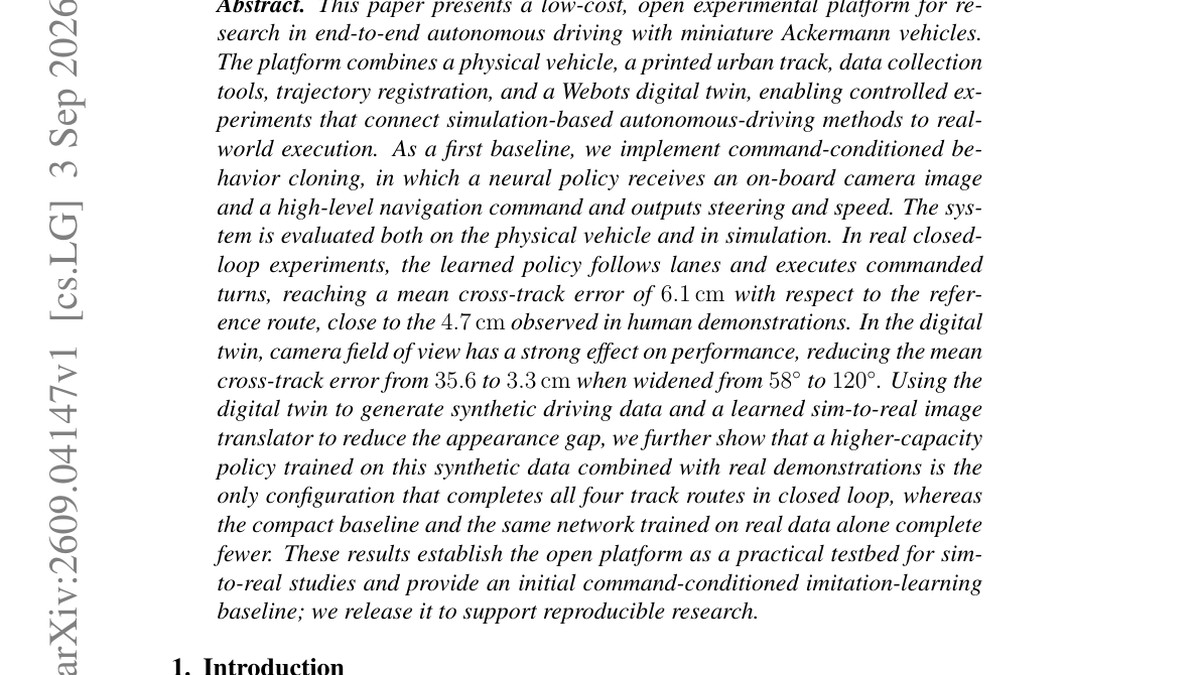
A Low-Cost, Open Platform for End-to-End Autonomous Driving on a Miniature Ackermann Vehicle
Gustavo Claudio Karl Couto, Eric Aislan Antonelo, Gabriel George Zipperer · arXiv preprint · Sep 2026
This paper presents a low-cost, open experimental platform for research in end-to-end autonomous driving with miniature Ackermann vehicles. The platform combines a physical vehicle, a printed urban track, data collection tools, trajectory registration, and a Webots digital twin, enabling controll...
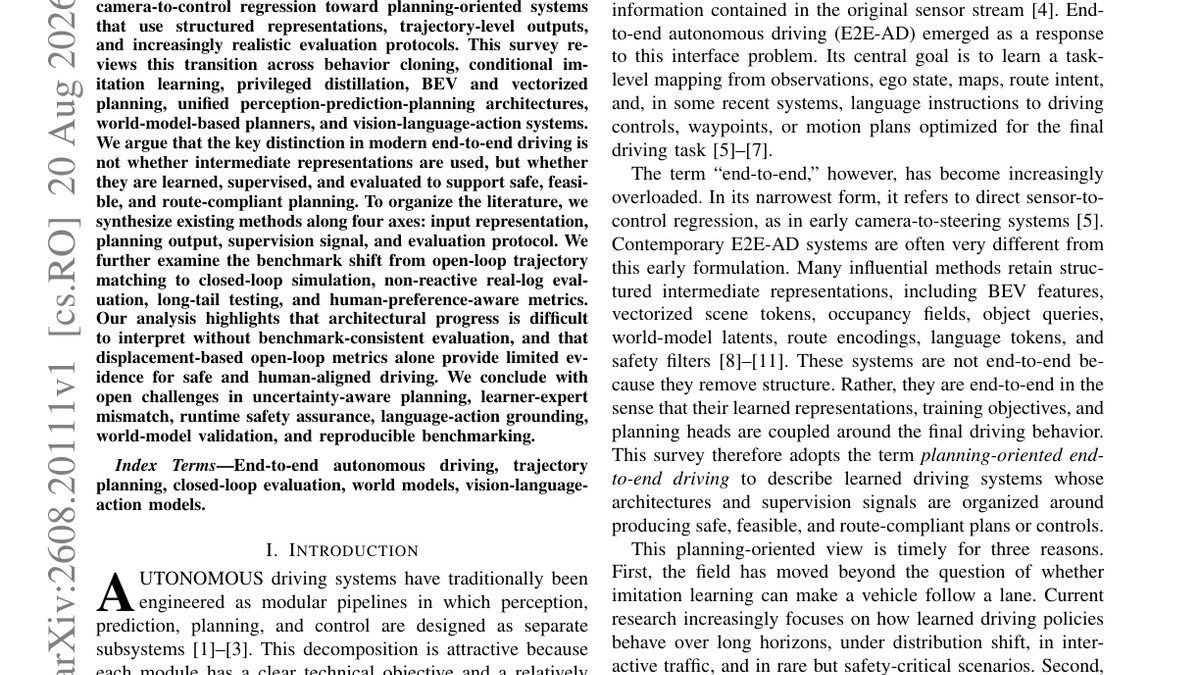
Planning-Oriented End-to-End Autonomous Driving: Architectures, Evaluation, and Emerging Paradigms
Yanchen Guan, Xingcheng Liu, Bin Rao et al. · arXiv preprint · Aug 2026
End-to-end autonomous driving has evolved from camera-to-control regression toward planning-oriented systems that use structured representations, trajectory-level outputs, and increasingly realistic evaluation protocols. This survey reviews this transition across behavior cloning, conditional imi...
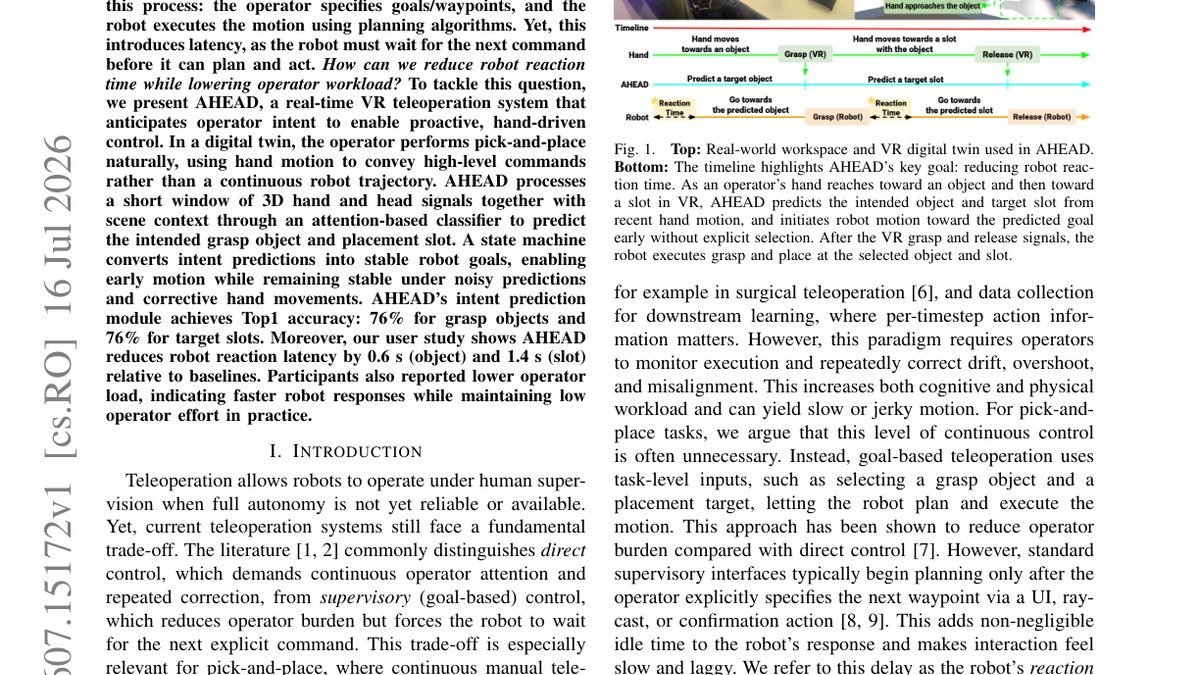
AHEAD: Anticipatory Hand-Driven Teleoperation via Human Intent Prediction
Seok Joon Kim, Junho Lee, Federica Spinola et al. · arXiv preprint · Jul 2026
Direct hand-driven teleoperation maps an operator's hand motion to robot end-effector commands at every frame, enabling precise control, but it requires constant monitoring and correction during approach, grasp, and placement, which can be slow and fatiguing. For repetitive pick-and-place tasks, ...
Beyond Episodic Evaluation: Memory Architectural Bottlenecks in Sequential Embodied Question Answering
Zikui Cai, Kaushal Janga, Tan Dat Dao et al. · arXiv preprint · Jul 2026
Embodied question answering (EQA) is traditionally evaluated under an episodic formulation, where agents solve each task independently and reset internal state between episodes. However, real-world robots operate continuously and must accumulate, retain, and selectively reuse information acquired...