
Visual-SLAM for the detection of hidden tomatoes in greenhouses by Hierarchical Localization and GLOMAPfor robotized harvesting
Fernando Cañadas-Aránega, José C. Moreno, José L. Blanco-Claraco, Francisco Rodríguez · N/A · 2026
Framework
N/A
License
N/A
Stars
N/A
Summary
Advanced crop monitoring inside greenhouses is becoming one of the primary objectives of research centers. High-performance sensors, such as LiDAR or stereo cameras, have traditionally been employed for this purpose, though these often have a high cost. This work proposes a Visual-SLAM system usi...
Abstract Summary
Key Points
- Advanced crop monitoring inside greenhouses is becoming one of the primary objectives of research...
- High-performance sensors, such as LiDAR or stereo cameras, have traditionally been employed for t...
- This work proposes a Visual-SLAM system using a monocular camera, which is significantly more cos...
- Tests were carried out on a real tomato bunch, located in the Agroconnect experimental greenhouse
- A ROS 2 Humble node was developed to run on the robot in order to capture images of these crops, ...
Visual-SLAM for the detection of hidden tomatoes in greenhouses by Hierarchical Localization and GLOMAPfor robotized harvesting
|Authors: Fernando Cañadas-Aránega, José C. Moreno, José L. Blanco-Claraco, Francisco Rodríguez
|Venue: arXiv preprint | Year: 2026
|arXiv: 2609.11766v1
Abstract
Advanced crop monitoring inside greenhouses is becoming one of the primary objectives of research centers. High-performance sensors, such as LiDAR or stereo cameras, have traditionally been employed for this purpose, though these often have a high cost. This work proposes a Visual-SLAM system using a monocular camera, which is significantly more cost-effective and specifically tailored for agricultural applications, such as mapping tomato crops in a greenhouse. Tests were carried out on a real tomato bunch, located in the Agroconnect experimental greenhouse. A ROS 2 Humble node was developed to run on the robot in order to capture images of these crops, which were then stored for offline processing. To generate a 3D mapped model for the crop in the greenhouse, the GLOMAP mapper, based on Structure-From-Motion, was integrated with the Hierarchical Localization toolbox. This initial mapping is a foundation for future, more advanced algorithms to analyze growth patterns, and optimize agricultural management. The system leverages a hierarchical localization paradigm based on a coarse-to-fine strategy: it first performs global retrieval to generate location hypotheses, then combines local features within the identified candidate regions. The results show a correct identification of the tomato cluster, correctly characterising the tomato that is occluded and inaccessible by classical vision technologies. The reconstructed 3D model was further validated against manual ground-truth measurements of fruit size, centroid position, and orientation, confirming the geometric accuracy of the proposed low-cost monocular pipeline.
Key Contributions
- Advanced crop monitoring inside greenhouses is becoming one of the primary objectives of research…
- High-performance sensors, such as LiDAR or stereo cameras, have traditionally been employed for t…
- This work proposes a Visual-SLAM system using a monocular camera, which is significantly more cos…
- Tests were carried out on a real tomato bunch, located in the Agroconnect experimental greenhouse
- A ROS 2 Humble node was developed to run on the robot in order to capture images of these crops, …
Topics
- vision
- planning
Code & Data
- GitHub repository: https://github.com/pablovela5620/hloc-g
BibTeX
@article{Cañadas-Aránega2026_260911766v1,
  title     = {Visual-SLAM for the detection of hidden tomatoes in greenhouses by Hierarchical Localization and GLOMAPfor robotized harvesting},
  author    = {Fernando Cañadas-Aránega and José C. Moreno and José L. Blanco-Claraco and Francisco Rodríguez},
  year      = {2026},
  eprint    = {2609.11766v1},
  archivePrefix = {arXiv},
  primaryClass  = {cs.RO},
  url       = {https://arxiv.org/abs/2609.11766v1}
}
Related Papers
A Low-Cost, Open Platform for End-to-End Autonomous Driving on a Miniature Ackermann Vehicle
Gustavo Claudio Karl Couto, Eric Aislan Antonelo, Gabriel George Zipperer · arXiv preprint · Sep 2026
This paper presents a low-cost, open experimental platform for research in end-to-end autonomous driving with miniature Ackermann vehicles. The platform combines a physical vehicle, a printed urban track, data collection tools, trajectory registration, and a Webots digital twin, enabling controll...
Adaptation Needs in Robotic Systems: Assessing Behavior Trees and Their Enhancement
Mehran Rostamnia, Gianluca Filippone, Ricardo Caldas et al. · arXiv preprint · Sep 2026
Robotic systems increasingly operate in dynamic, uncertain, and open-ended environments, where design-time assumptions may no longer hold, and adaptation becomes necessary to maintain effective and safe operation. Behavior Trees (BTs) are widely used in robotic control architectures due to their ...
Beyond Episodic Evaluation: Memory Architectural Bottlenecks in Sequential Embodied Question Answering
Zikui Cai, Kaushal Janga, Tan Dat Dao et al. · arXiv preprint · Jul 2026
Embodied question answering (EQA) is traditionally evaluated under an episodic formulation, where agents solve each task independently and reset internal state between episodes. However, real-world robots operate continuously and must accumulate, retain, and selectively reuse information acquired...
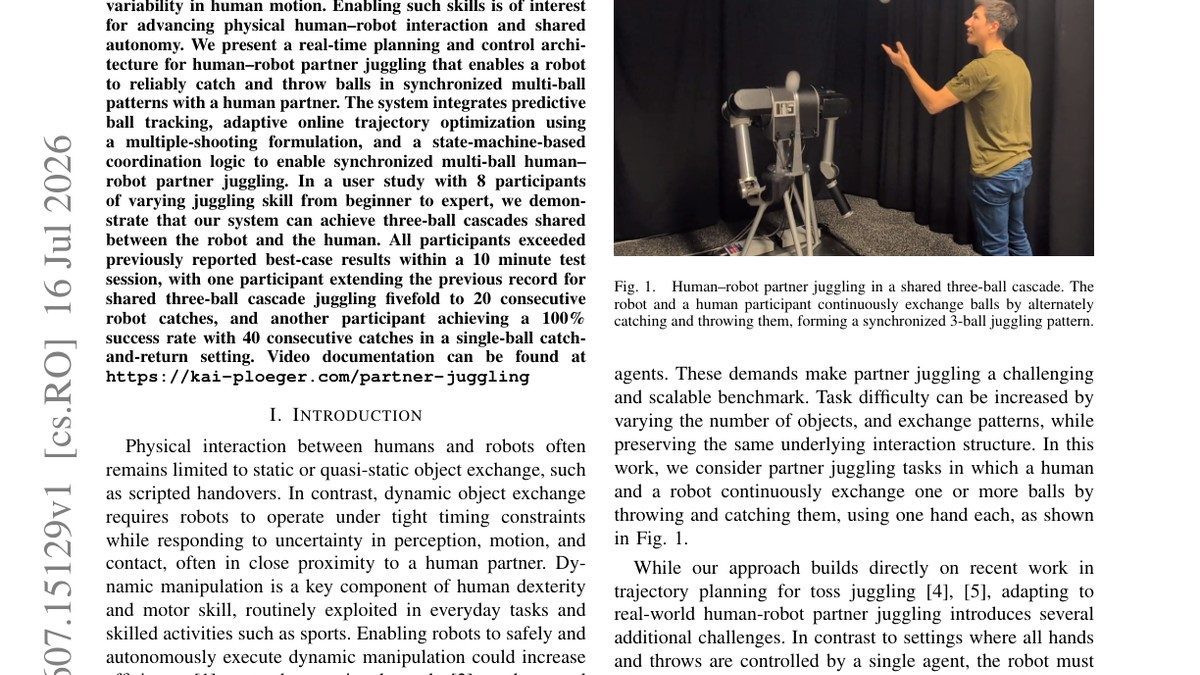
Catch, Throw, Repeat: Planning for Human-Robot Partner Juggling
Jonathan Rainer Lippert, Kai Ploeger, Abir Chowdhury et al. · arXiv preprint · Jul 2026
Dynamic object exchange between humans and robots remains a challenging problem due to uncertainty in perception, timing, and contact-rich interaction. Human-robot juggling represents a particularly demanding instance of this problem, requiring precise real-time coordination, predictive motion pl...