
Unitree Go2: Learning Vision-Based Quadrupedal Locomotion End-to-End
FeaturedNikita Rudin, Fabian Jenelten, Timon Homberger, Marco Hutter · ETH Zurich, Robotic Systems Lab · 2024
Framework
PyTorch + ROS
License
BSD-3-Clause
Stars
1,391
Summary
Unitree Go2 uses cross-modal vision + proprioception transformers trained in Isaac Gym to achieve agile navigation over rough terrain with minimal sim-to-real gap.
Abstract Summary
Key Points
- Cross-modal transformer fuses depth vision with proprioception using attention.
- Trained end-to-end in Isaac Gym with thousands of parallel agents.
- Zero-shot sim-to-real transfer to Unitree Go2 on rough outdoor terrain.
- Runs at 50 Hz onboard with only a depth camera and IMU — no explicit mapping.
- Training configs and URDF released based on RSL-RL + Legged Gym stack.
Related Papers
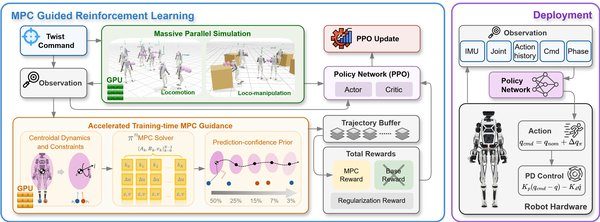
Accelerating and Scaling MPC-Guided Reinforcement Learning for Humanoid Locomotion and Manipulation
Junheng Li, Liang Wu, Sergio A. Esteban et al. · arXiv preprint · Jun 2026
In humanoid motion control, model predictive control (MPC) offers physically grounded prediction and constraint handling, while reinforcement learning (RL) enables robust whole-body skills through large-scale simulation. However, using MPC inside RL often requires time-consuming problem construction or excessive training overhead, making such frameworks difficult to justify in practice. This work studies efficient training-time MPC guidance for humanoid locomotion and manipulation, termed MPC-RL. We introduce a centroidal-dynamics MPC reward formulation that leverages guidance from MPC trajectories in training time. To make this practical in massively parallel RL, we develop π^nMPC, a parallel-in-horizon and construction-free batched GPU MPC solver that operates directly on time-varying dynamics to avoid high memory usage and pre-compilation. Through a variety of comparative studies and hardware validations, we have found that MPC-RL achieves superior performance in locomotion and manipulation skills.
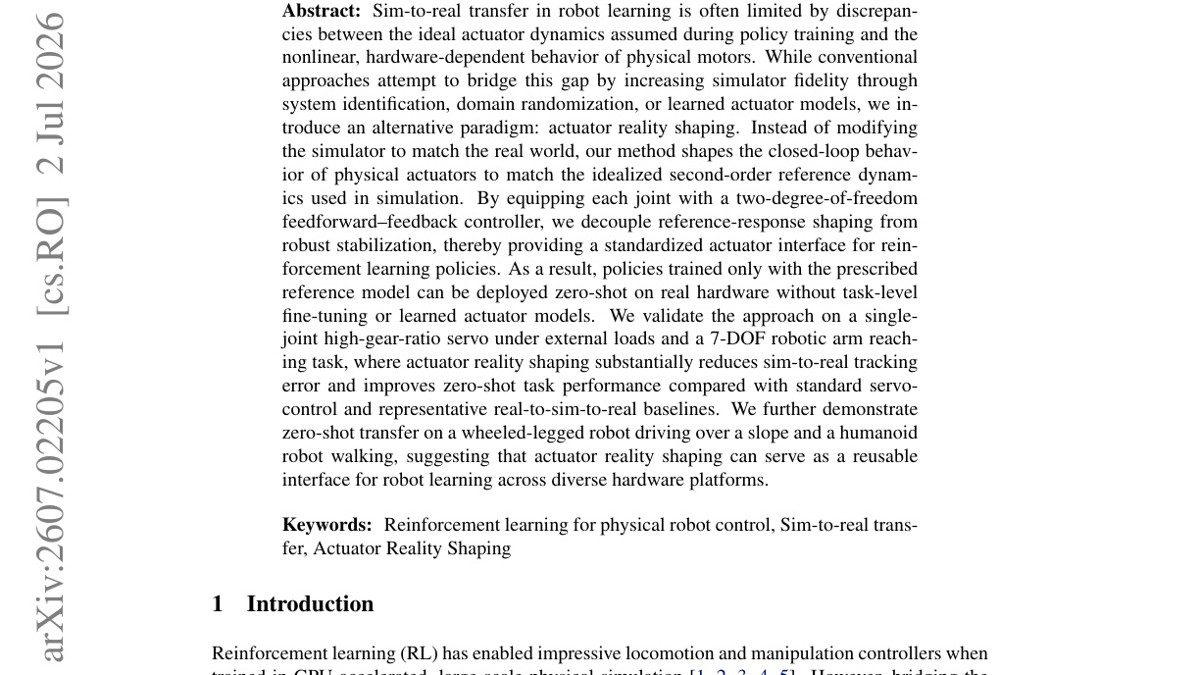
Actuator Reality Shaping for Zero-Shot Sim-to-Real Robot Learning
Satoshi Yamamori, Koji Ishihara, Kentaro Minamikawa et al. · arXiv preprint · Jul 2026
Sim-to-real transfer in robot learning is often limited by discrepancies between the ideal actuator dynamics assumed during policy training and the nonlinear, hardware-dependent be...
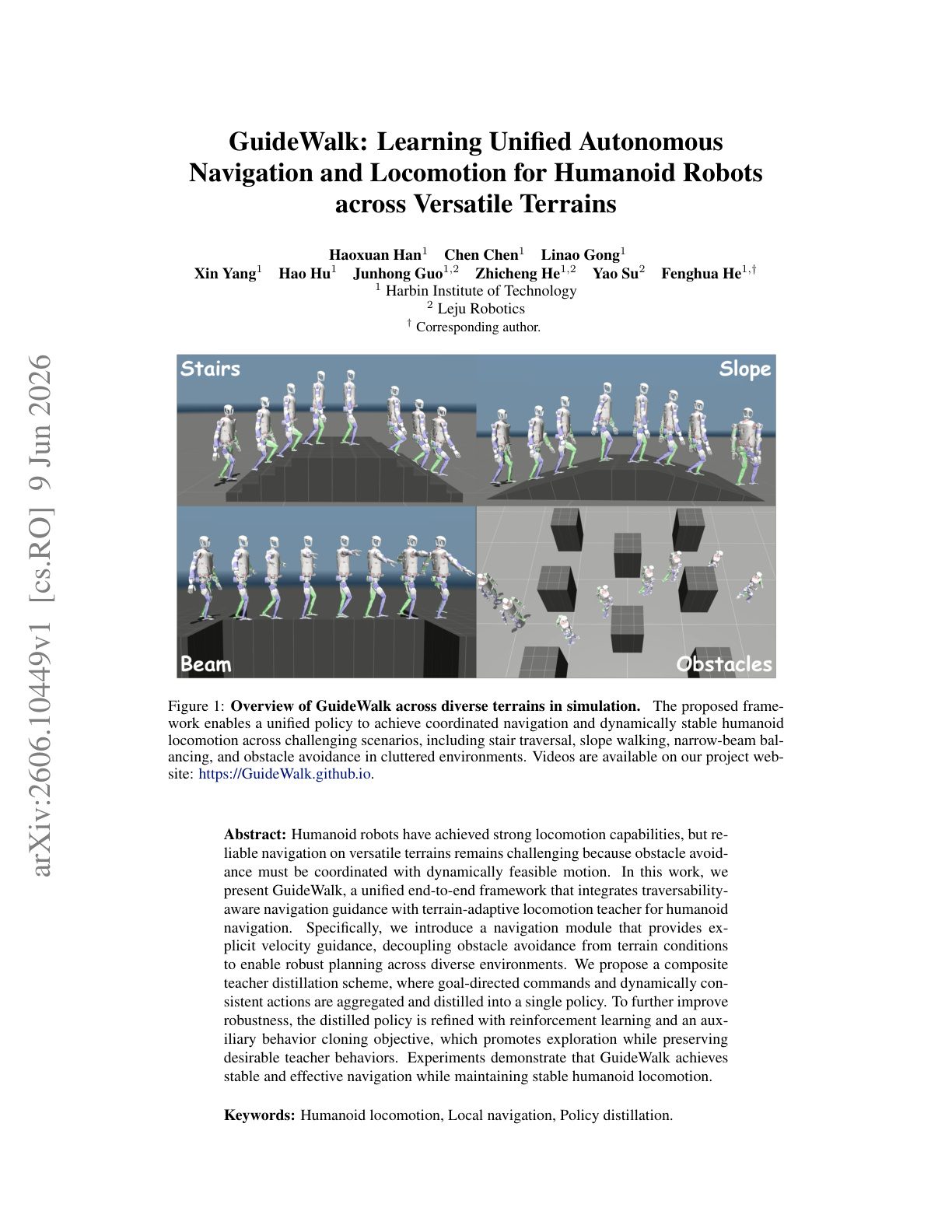
GuideWalk: Learning Unified Autonomous Navigation and Locomotion for Humanoid Robots across Versatile Terrains
Haoxuan Han, Chen Chen, Linao Gong et al. · arXiv preprint · Jun 2026
Humanoid robots have achieved strong locomotion capabilities, but reliable navigation on versatile terrains remains challenging because obstacle avoidance must be coordinated with dynamically feasible motion. In this work, we present GuideWalk, a unified end-to-end framework that integrates traversa...
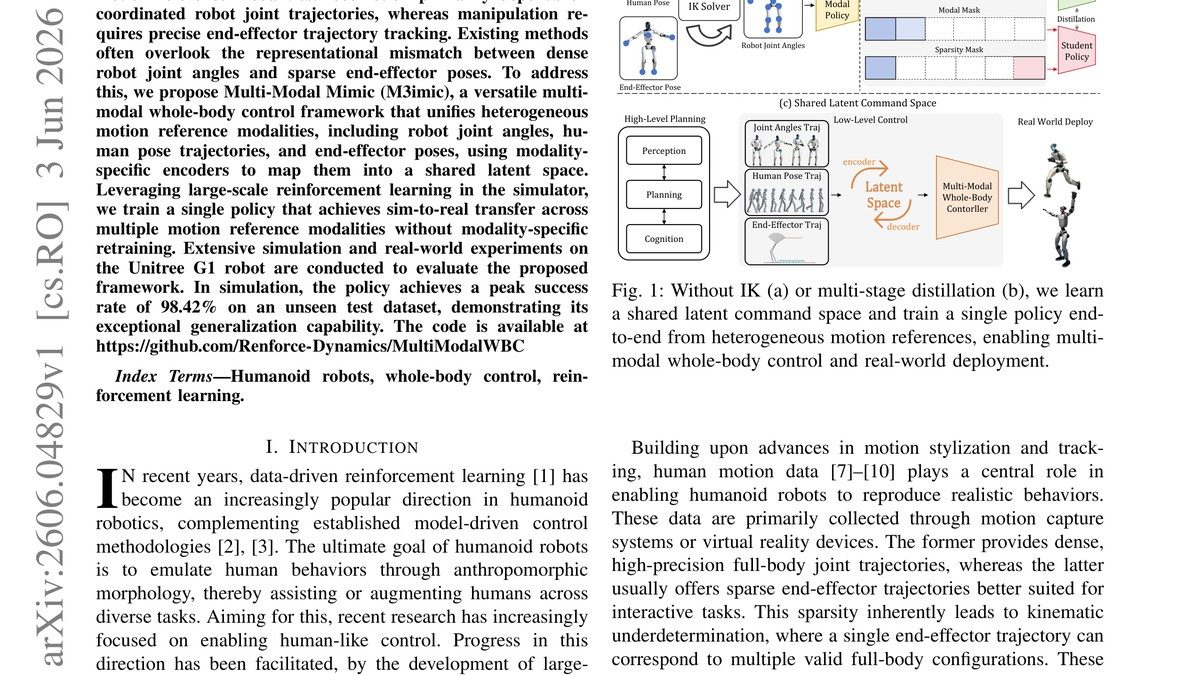
M3imic: Learning a Versatile Whole-Body Controller for Multimodal Motion Mimicking
Zuxing Lu, Ziang Zheng, Yao Lyu et al. · arXiv preprint · Jun 2026
Building a general-purpose whole-body controller is essential for enabling diverse motion capabilities in humanoid robots across a wide range of downstream tasks, including locomotion and loco-manipulation. Different tasks rely on distinct motion reference modalities: locomotion primarily depends on...