
UniMPA: A Unified Memory-Prediction-Action Model via Action-Grounded Transition Modeling
Wei Li, Rui Shao, Jie He, Lingsen Zhang, Ziwei Liu, Liqiang Nie · N/A · 2026
Framework
N/A
License
N/A
Stars
N/A
Summary
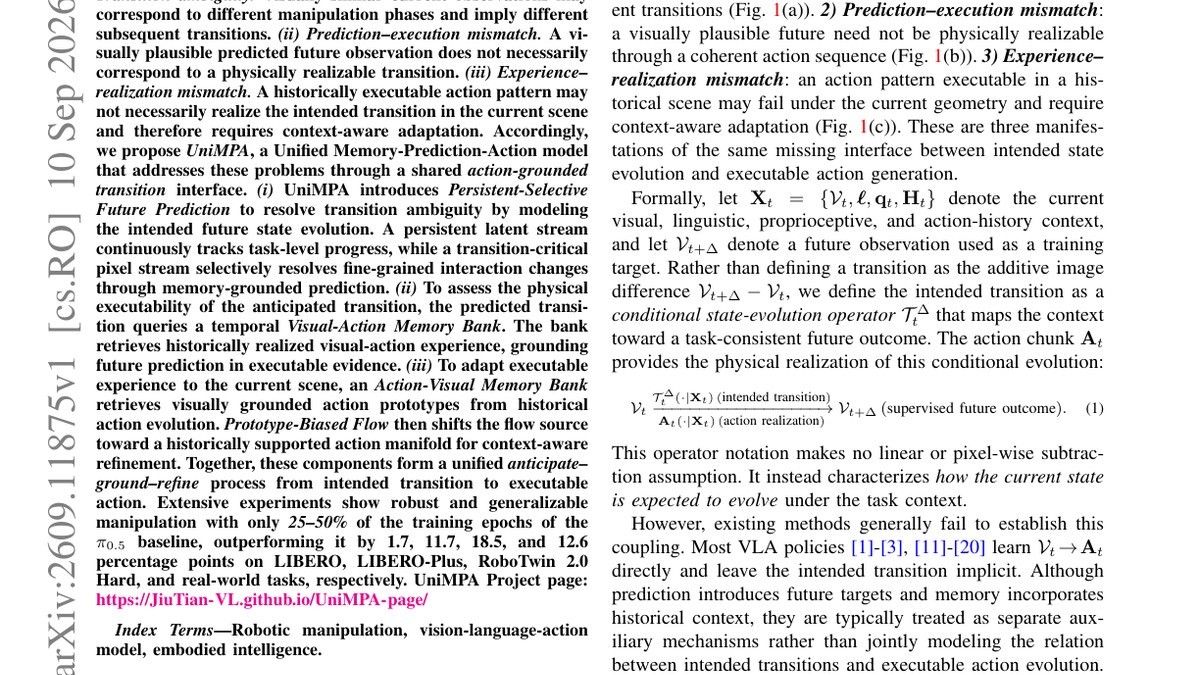
Recent advances in Vision-Language-Action (VLA) models have improved robotic manipulation, yet observation-to-action learning remains limited by a fundamental transition realizability gap, manifested in three tightly coupled problems: (i) Transition ambiguity. Visually similar current observation...
Abstract Summary
Key Points
- Recent advances in Vision-Language-Action (VLA) models have improved robotic manipulation, yet ob...
- Visually similar current observations may correspond to different manipulation phases and imply d...
- (ii) Prediction--execution mismatch
- A visually plausible predicted future observation does not necessarily correspond to a physically...
- (iii) Experience--realization mismatch
UniMPA: A Unified Memory-Prediction-Action Model via Action-Grounded Transition Modeling
|Authors: Wei Li, Rui Shao, Jie He, Lingsen Zhang, Ziwei Liu, Liqiang Nie
|Venue: arXiv preprint | Year: 2026
|arXiv: 2609.11875v1
Abstract
Recent advances in Vision-Language-Action (VLA) models have improved robotic manipulation, yet observation-to-action learning remains limited by a fundamental transition realizability gap, manifested in three tightly coupled problems: (i) Transition ambiguity. Visually similar current observations may correspond to different manipulation phases and imply different subsequent transitions. (ii) Prediction—execution mismatch. A visually plausible predicted future observation does not necessarily correspond to a physically realizable transition. (iii) Experience—realization mismatch. A historically executable action pattern may not necessarily realize the intended transition in the current scene and therefore requires context-aware adaptation. Accordingly, we propose UniMPA, a Unified Memory-Prediction-Action model that addresses these problems through a shared action-grounded transition interface. (i) UniMPA introduces Persistent-Selective Future Prediction to resolve transition ambiguity by modeling the intended future state evolution. A persistent latent stream continuously tracks task-level progress, while a transition-critical pixel stream selectively resolves fine-grained interaction changes through memory-grounded prediction. (ii) To assess the physical executability of the anticipated transition, the predicted transition queries a temporal Visual-Action Memory Bank. The bank retrieves historically realized visual-action experience, grounding future prediction in executable evidence. (iii) To adapt executable experience to the current scene, an Action-Visual Memory Bank retrieves visually grounded action prototypes from historical action evolution. Prototype-Biased Flow then shifts the flow source toward a historically supported action manifold for context-aware refinement.
Key Contributions
- Recent advances in Vision-Language-Action (VLA) models have improved robotic manipulation, yet ob…
- Visually similar current observations may correspond to different manipulation phases and imply d…
- (ii) Prediction—execution mismatch
- A visually plausible predicted future observation does not necessarily correspond to a physically…
- (iii) Experience—realization mismatch
Topics
- manipulation
- vision
- vla
- reinforcement-learning
Code & Data
- GitHub repository: https://github.com/JiuTian-VL/UniMPA
BibTeX
@article{Li2026_260911875v1,
  title     = {UniMPA: A Unified Memory-Prediction-Action Model via Action-Grounded Transition Modeling},
  author    = {Wei Li and Rui Shao and Jie He and Lingsen Zhang and Ziwei Liu and Liqiang Nie},
  year      = {2026},
  eprint    = {2609.11875v1},
  archivePrefix = {arXiv},
  primaryClass  = {cs.RO},
  url       = {https://arxiv.org/abs/2609.11875v1}
}
Related Papers
3DThinkVLA: Endowing Vision-Language-Action Models with Latent 3D Priors via 3D-Thinking-Guided Co-training
Jiaxin Shi, Xidong Zhang, Fucai Zhu et al. · arXiv preprint · Jun 2026
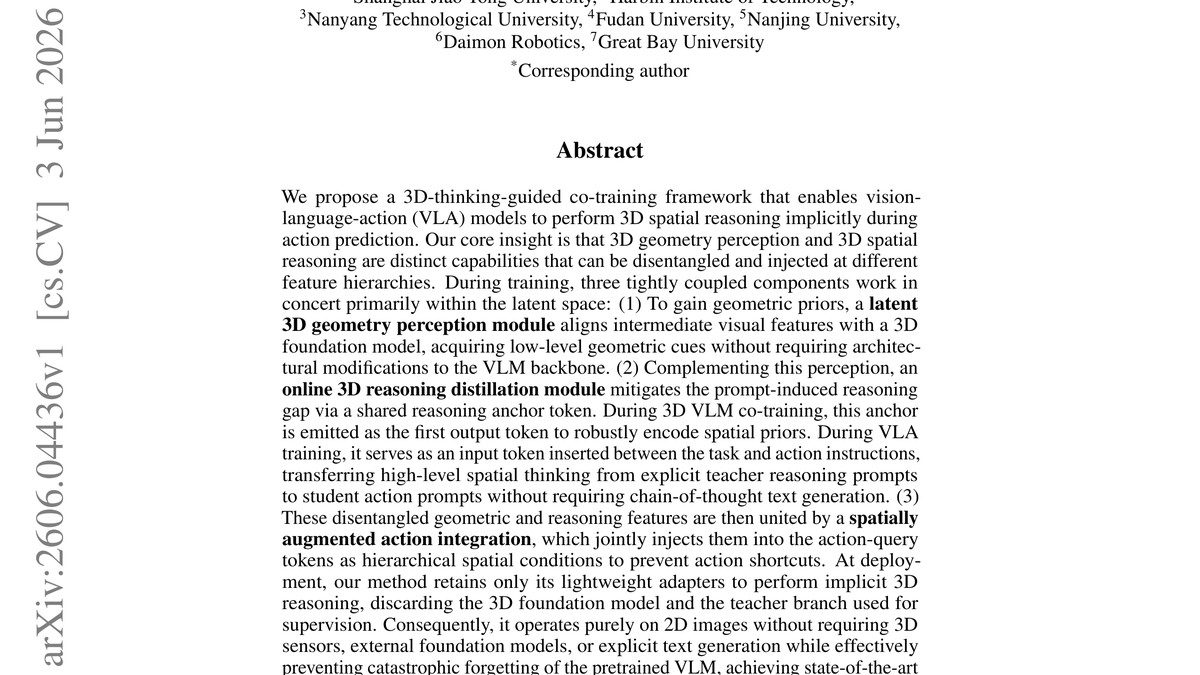
We propose a 3D-thinking-guided co-training framework that enables vision-language-action (VLA) models to perform 3D spatial reasoning implicitly during action prediction. Our core insight is that 3D geometry perception and 3D spatial reasoning are distinct capabilities that can be disentangled and ...
Decoding Task Progress from VLA Representations
Atiksh Bhardwaj, Edward Weiyi Duan, Prithwish Dan et al. · arXiv preprint · Aug 2026
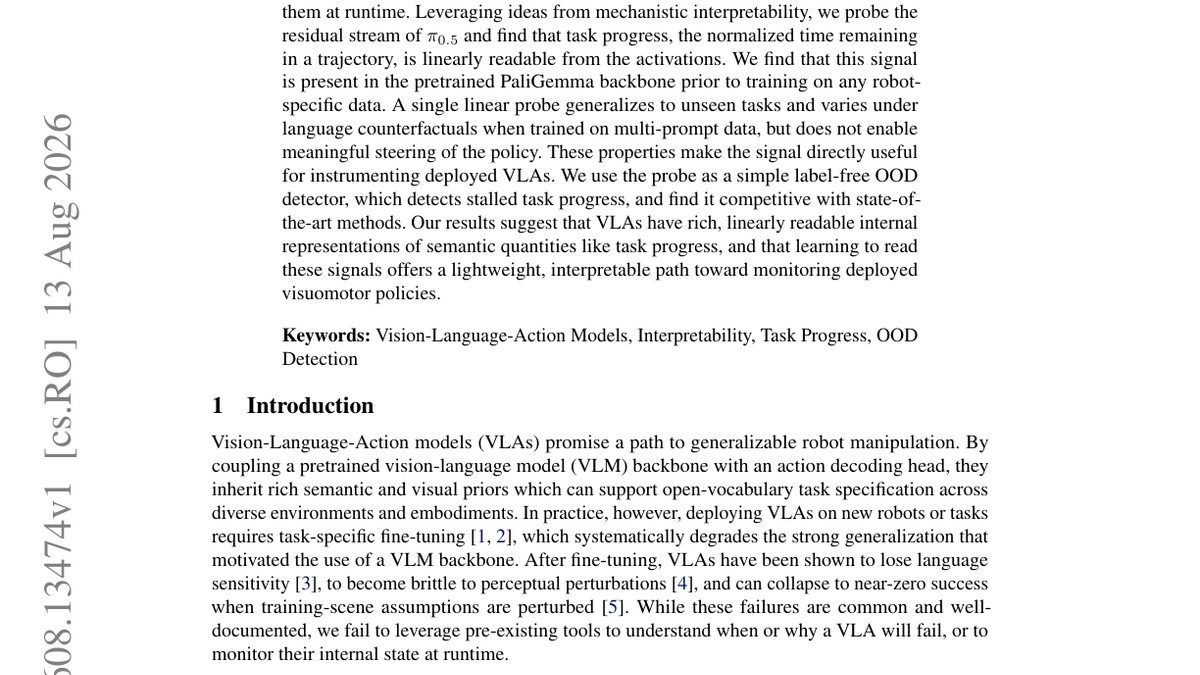
Vision-language-action models (VLAs) are moving rapidly towards deployment as general-purpose manipulation policies, but we currently lack basic tools for understanding what these models represent internally or for monitoring them at runtime. Leveraging ideas from mechanistic interpretability, we...
Development of a Humanoid Robot Prototype for Multimodal Human-Robot Interaction
Thang Tran Viet, Thanh Nguyen Canh, Huy Uong Gia et al. · arXiv preprint · Sep 2026
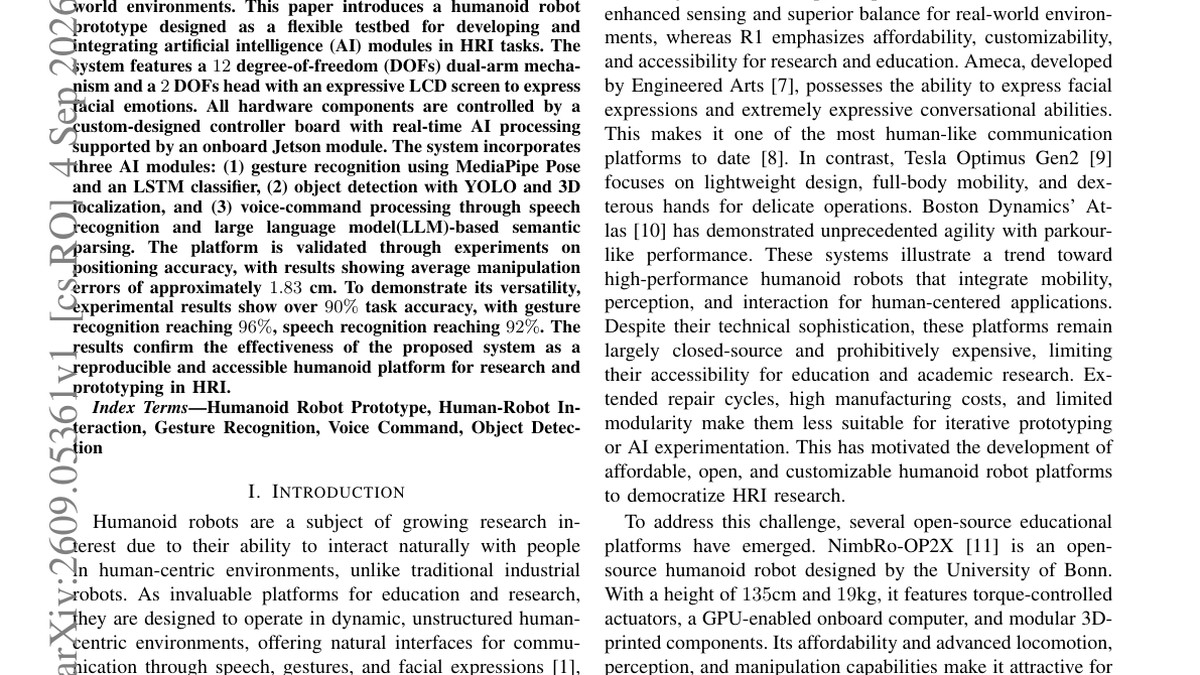
Human-robot interaction (HRI) enables intuitive and intelligent collaboration between humans and robots in real-world environments. This paper introduces a humanoid robot prototype designed as a flexible testbed for developing and integrating artificial intelligence (AI) modules in HRI tasks. The...
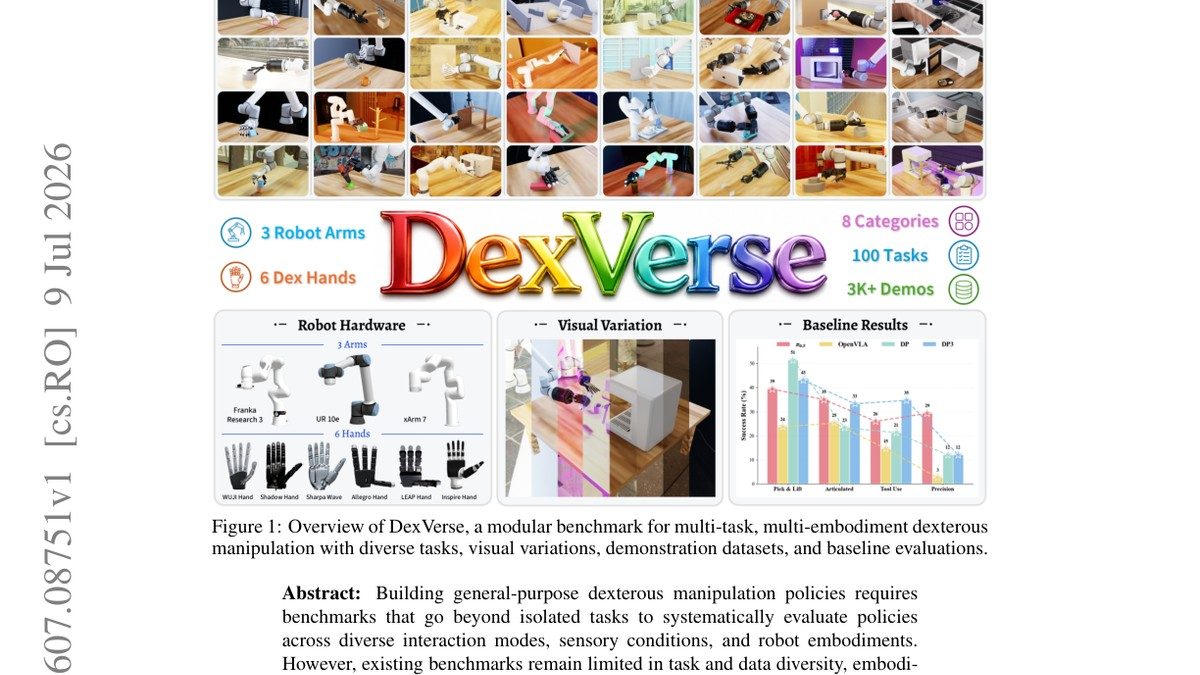
DexVerse: A Modular Benchmark for Multi-Task, Multi-Embodiment Dexterous Manipulation
Yunchao Yao, Zhuxiu Xu, Tianqi Zhang et al. · arXiv preprint · Jul 2026
Building general-purpose dexterous manipulation policies requires benchmarks that go beyond isolated tasks to systematically evaluate policies across diverse interaction modes, sensory conditions, and robot embodiments. However, existing benchmarks remain limited in task and data diversity, embod...