
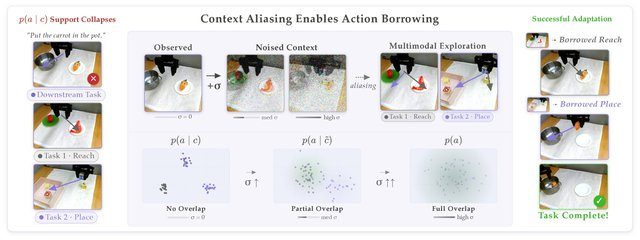
TMRL: Diffusion Timestep-Modulated Pretraining Enables Exploration for Efficient Policy Finetuning
Matthew M. Hong, Jesse Zhang, Anusha Nagabandi, Abhishek Gupta · · 2026
Framework
N/A
License
N/A
Stars
0
Summary
Fine-tuning pre-trained robot policies with reinforcement learning (RL) often inherits the bottlenecks introduced by pre-training with behavioral cloning (BC), which produces narrow action distributions that lack the coverage necessary for...
Abstract Summary
Key Points
- Introduces TMRL, advancing rl research.
- Detailed evaluation demonstrates effectiveness on benchmarks and real-world scenarios.
- Provides insights into methodology and architectural choices.
Abstract
Fine-tuning pre-trained robot policies with reinforcement learning (RL) often inherits the bottlenecks introduced by pre-training with behavioral cloning (BC), which produces narrow action distributions that lack the coverage necessary for downstream exploration. We present a unified framework that enables the exploration necessary to enable efficient robot policy finetuning by bridging BC pre-training and RL fine-tuning. Our pre-training method, Context-Smoothed Pre-training (CSP), injects forward-diffusion noise into policy inputs, creating a continuum between precise imitation and broad action coverage. We then fine-tune pre-trained policies via Timestep-Modulated Reinforcement Learning (TMRL), which trains the agent to dynamically adjust this conditioning during fine-tuning by modulating the diffusion timestep, granting explicit control over exploration. Integrating seamlessly with arbitrary policy inputs, e.g., states, 3D point clouds, or image-based VLA policies, we show that TMRL improves RL fine-tuning sample efficiency. Notably, TMRL enables successful real-world fine-tuning on complex manipulation tasks in under one hour. Videos and code available at https://weirdlabuw.github.io/tmrl/.
Links
- Paper (PDF): 2605.12236
- arXiv: 2605.12236
Related Papers
LeRobot: A Library for Real-World Robot Learning
Remi Cadene, Simon Alibert, Alexander Soare et al. · NeurIPS 2024 Workshop · Jun 2024
Hugging Face's LeRobot is an open-source PyTorch framework providing pretrained models, datasets, and training scripts for imitation and reinforcement learning on real robots, lowering the entry barrier to robot learning.
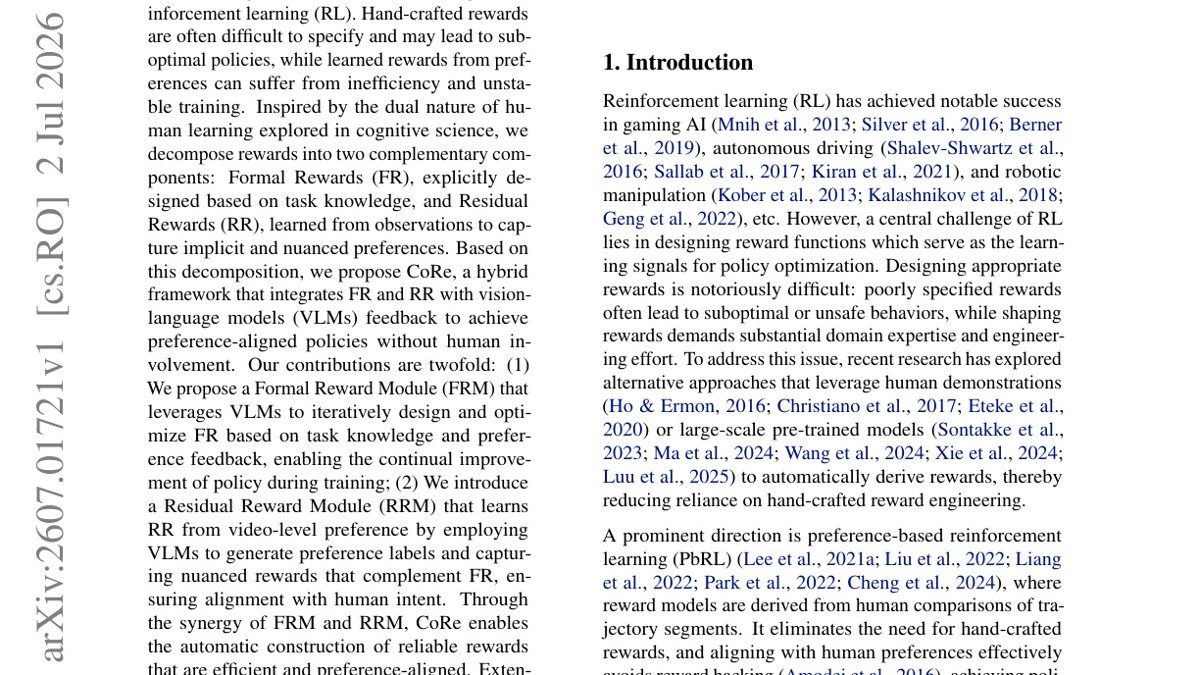
CoRe: Combined Rewards with Vision-Language Model Feedback for Preference-Aligned Reinforcement Learning
Hexian Ni, Tao Lu, Yinghao Cai · ICML 2026 · Jul 2026
Reward design remains a central challenge in reinforcement learning (RL). Hand-crafted rewards are often difficult to specify and may lead to suboptimal policies, while learned rew...
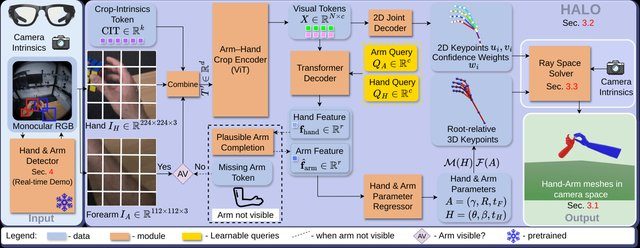
EgoForce: Forearm-Guided Camera-Space 3D Hand Pose from a Monocular Egocentric Camera
Christen Millerdurai, Shaoxiang Wang, Yaxu Xie et al. · SIGGRAPH 2026 · May 2026
Reconstructing the absolute 3D pose and shape of the hands from the user's viewpoint using a single head-mounted camera is crucial for practical egocentric interaction in AR/VR, telepresence, and hand-centric manipulation tasks, where sensing must...

Aligning Flow Map Policies with Optimal Q-Guidance
Christos Ziakas, Alessandra Russo, Avishek Joey Bose · arXiv · May 2026
Generative policies based on expressive model classes, such as diffusion-models and flow matching, are well-suited to complex control problems with highly multimodal action distributions. Their expressivity, however, comes at a significant inference cost:...