
THRIVE: Therapeutic Humanoid Robot In Virtual Environment
Jin Xu, Yu-Ping Chen, Ayanna Howard · N/A · 2026
Framework
N/A
License
N/A
Stars
N/A
Summary
This paper presents THRIVE (Therapeutic Humanoid Robot In Virtual Environment), an at-home rehabilitation platform that integrates a suite of virtual-reality upper-body rehabilitation games, a real-time camera-based motion-tracking system, and a socially interactive robot therapist. The system is...
Abstract Summary
Key Points
- This paper presents THRIVE (Therapeutic Humanoid Robot In Virtual Environment), an at-home rehabi...
- The system is designed for therapy and intervention in children with upper-limb motor impairments...
- THRIVE features a set of newly designed, engaging games that target functional reaching, grasping...
- A robot therapist - deployable either as a physical robotic coach or as a remote-presence virtual...
- THRIVE decouples the therapeutic games from the robot embodiment, extending the platform to suppo...
THRIVE: Therapeutic Humanoid Robot In Virtual Environment
|Authors: Jin Xu, Yu-Ping Chen, Ayanna Howard
|Venue: arXiv preprint | Year: 2026
|arXiv: 2608.14462v1
Abstract
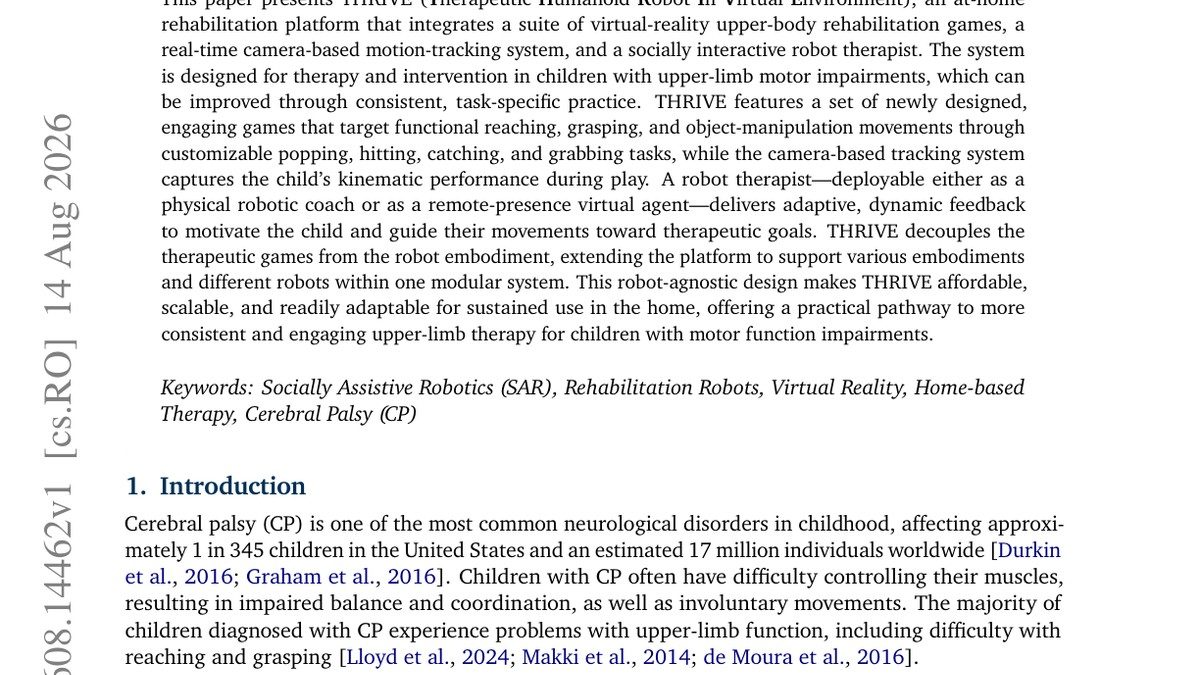
This paper presents THRIVE (Therapeutic Humanoid Robot In Virtual Environment), an at-home rehabilitation platform that integrates a suite of virtual-reality upper-body rehabilitation games, a real-time camera-based motion-tracking system, and a socially interactive robot therapist. The system is designed for therapy and intervention in children with upper-limb motor impairments, which can be improved through consistent, task-specific practice. THRIVE features a set of newly designed, engaging games that target functional reaching, grasping, and object-manipulation movements through customizable popping, hitting, catching, and grabbing tasks, while the camera-based tracking system captures the child’s kinematic performance during play. A robot therapist - deployable either as a physical robotic coach or as a remote-presence virtual agent - delivers adaptive, dynamic feedback to motivate the child and guide their movements toward therapeutic goals. THRIVE decouples the therapeutic games from the robot embodiment, extending the platform to support various embodiments and different robots within one modular system. This robot-agnostic design makes THRIVE affordable, scalable, and readily adaptable for sustained use in the home, offering a practical pathway to more consistent and engaging upper-limb therapy for children with motor function impairments.
Key Contributions
- This paper presents THRIVE (Therapeutic Humanoid Robot In Virtual Environment), an at-home rehabi…
- The system is designed for therapy and intervention in children with upper-limb motor impairments…
- THRIVE features a set of newly designed, engaging games that target functional reaching, grasping…
- A robot therapist - deployable either as a physical robotic coach or as a remote-presence virtual…
- THRIVE decouples the therapeutic games from the robot embodiment, extending the platform to suppo…
Topics
- manipulation
- vision
- reinforcement-learning
- human-robot-interaction
Code & Data
No code repository linked in paper metadata.
BibTeX
@article{Xu2026_260814462v1,
  title     = {THRIVE: Therapeutic Humanoid Robot In Virtual Environment},
  author    = {Jin Xu and Yu-Ping Chen and Ayanna Howard},
  year      = {2026},
  eprint    = {2608.14462v1},
  archivePrefix = {arXiv},
  primaryClass  = {cs.RO},
  url       = {https://arxiv.org/abs/2608.14462v1}
}
Related Papers
Development of a Humanoid Robot Prototype for Multimodal Human-Robot Interaction
Thang Tran Viet, Thanh Nguyen Canh, Huy Uong Gia et al. · arXiv preprint · Sep 2026
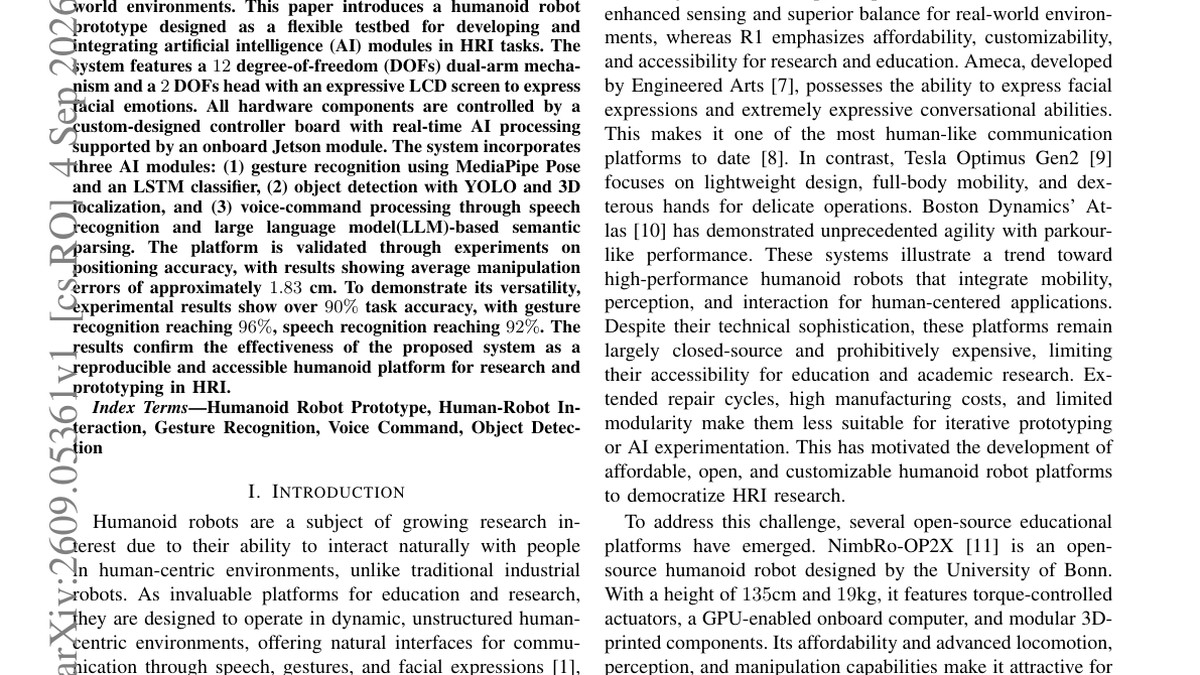
Human-robot interaction (HRI) enables intuitive and intelligent collaboration between humans and robots in real-world environments. This paper introduces a humanoid robot prototype designed as a flexible testbed for developing and integrating artificial intelligence (AI) modules in HRI tasks. The...
3DThinkVLA: Endowing Vision-Language-Action Models with Latent 3D Priors via 3D-Thinking-Guided Co-training
Jiaxin Shi, Xidong Zhang, Fucai Zhu et al. · arXiv preprint · Jun 2026
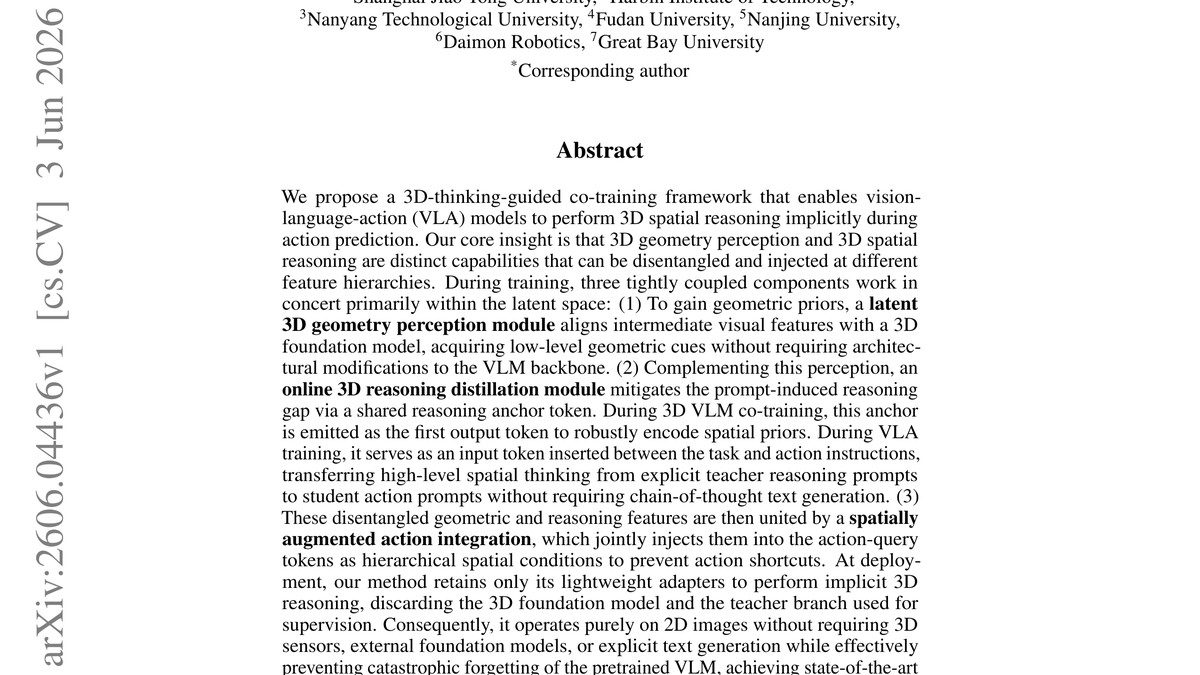
We propose a 3D-thinking-guided co-training framework that enables vision-language-action (VLA) models to perform 3D spatial reasoning implicitly during action prediction. Our core insight is that 3D geometry perception and 3D spatial reasoning are distinct capabilities that can be disentangled and ...
Adaptive Vision-Language Grasping via Composable Foundation Priors and Generalizable Grasp Synthesis
Sixu Yan, Shikang Wang, Binhua Huang et al. · arXiv preprint · Sep 2026
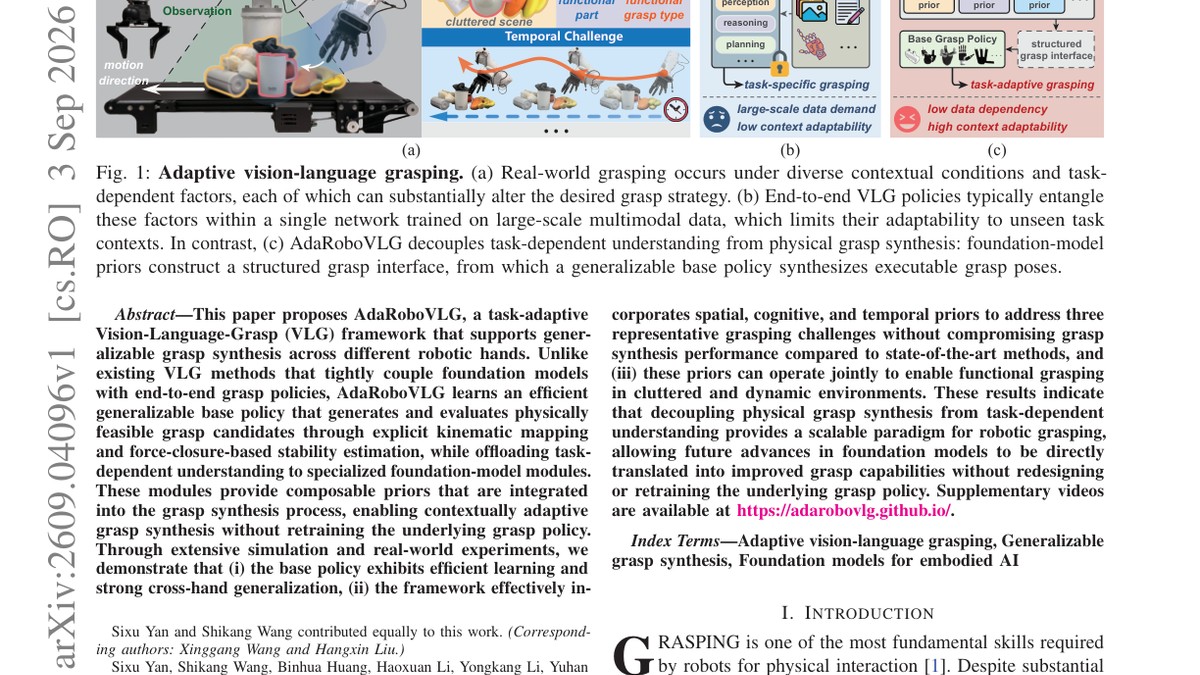
This paper proposes AdaRoboVLG, a task-adaptive Vision-Language-Grasp (VLG) framework that supports generalizable grasp synthesis across different robotic hands. Unlike existing VLG methods that tightly couple foundation models with end-to-end grasp policies, AdaRoboVLG learns an efficient genera...
Assessing Physical Frailty and Fall-Risk Indicators with Social Robots: An in situ Evaluation with Older Adults
Aniol Civit, Antonio Andriella, Alba Martínez et al. · arXiv preprint · Jul 2026
Frailty assessments are crucial to evaluate the risk of adverse events and the health and social care needs of older adults, yet their administration remains resource-intensive and typically relies on coarse clinical outcomes, such as task completion times, which may overlook biomechanical indica...