
Tensegrity Continuum Robots Enable Task-Adaptive Morphologies for Cooperative Behaviors
Mahmud Hasan Saikot, Sydney Spiegel, Sudheera Akalanka Kariyawasam, Andrew Stefka, Josh Chrisler, Jianguo Zhao · N/A · 2026
Framework
N/A
License
N/A
Stars
N/A
Summary
Robots that can change their morphologies and behaviors for different tasks and environments hold great promise for adaptable, multifunctional systems. Modular reconfigurable robots (MRRs) can achieve such functionalities by docking and rearranging individual units, but most rely on rigid modules...
Abstract Summary
Key Points
- Robots that can change their morphologies and behaviors for different tasks and environments hold...
- Modular reconfigurable robots (MRRs) can achieve such functionalities by docking and rearranging ...
- Continuum robots offer compliance through flexible backbones, yet they cannot self-reconfigure in...
- Here, we introduce an MRR that unifies the advantages of both architectures by combining a tenseg...
- Each robot can manipulate and locomote independently, and multiple robots can self-reconfigure in...
Tensegrity Continuum Robots Enable Task-Adaptive Morphologies for Cooperative Behaviors
|Authors: Mahmud Hasan Saikot, Sydney Spiegel, Sudheera Akalanka Kariyawasam, Andrew Stefka, Josh Chrisler, Jianguo Zhao
|Venue: arXiv preprint | Year: 2026
|arXiv: 2608.27221v1
Abstract
Robots that can change their morphologies and behaviors for different tasks and environments hold great promise for adaptable, multifunctional systems. Modular reconfigurable robots (MRRs) can achieve such functionalities by docking and rearranging individual units, but most rely on rigid modules that lack structural compliance, resulting in limited capabilities. Continuum robots offer compliance through flexible backbones, yet they cannot self-reconfigure into task-adaptive multi-robot configurations. Here, we introduce an MRR that unifies the advantages of both architectures by combining a tensegrity-based compliant body with claw-based connection mechanisms. Each robot can manipulate and locomote independently, and multiple robots can self-reconfigure into different morphologies (e.g., chains, loops, branches) for cooperative manipulation and locomotion. We demonstrate the robots’ capability across diverse tasks and environments, including coordinated object manipulation and transport, multimodal locomotion, and loco-manipulation in real-world scenarios. These results lay a foundation for adaptable and multifunctional robotic collectives, with broad potential applications in manufacturing, space exploration, and search-and-rescue operations.
Key Contributions
- Robots that can change their morphologies and behaviors for different tasks and environments hold…
- Modular reconfigurable robots (MRRs) can achieve such functionalities by docking and rearranging …
- Continuum robots offer compliance through flexible backbones, yet they cannot self-reconfigure in…
- Here, we introduce an MRR that unifies the advantages of both architectures by combining a tenseg…
- Each robot can manipulate and locomote independently, and multiple robots can self-reconfigure in…
Topics
- manipulation
- locomotion
- reinforcement-learning
Code & Data
No code repository linked in paper metadata.
BibTeX
@article{Saikot2026_260827221v1,
  title     = {Tensegrity Continuum Robots Enable Task-Adaptive Morphologies for Cooperative Behaviors},
  author    = {Mahmud Hasan Saikot and Sydney Spiegel and Sudheera Akalanka Kariyawasam and Andrew Stefka and Josh Chrisler and Jianguo Zhao},
  year      = {2026},
  eprint    = {2608.27221v1},
  archivePrefix = {arXiv},
  primaryClass  = {cs.RO},
  url       = {https://arxiv.org/abs/2608.27221v1}
}
Related Papers
Accelerating and Scaling MPC-Guided Reinforcement Learning for Humanoid Locomotion and Manipulation
Junheng Li, Liang Wu, Sergio A. Esteban et al. · arXiv preprint · Jun 2026
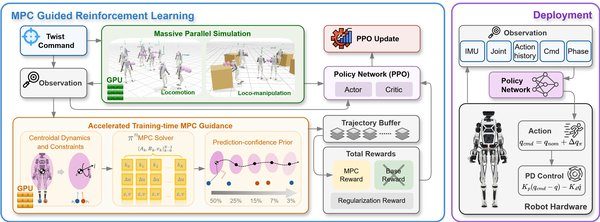
In humanoid motion control, model predictive control (MPC) offers physically grounded prediction and constraint handling, while reinforcement learning (RL) enables robust whole-body skills through large-scale simulation. However, using MPC inside RL often requires time-consuming problem construction or excessive training overhead, making such frameworks difficult to justify in practice. This work studies efficient training-time MPC guidance for humanoid locomotion and manipulation, termed MPC-RL. We introduce a centroidal-dynamics MPC reward formulation that leverages guidance from MPC trajectories in training time. To make this practical in massively parallel RL, we develop π^nMPC, a parallel-in-horizon and construction-free batched GPU MPC solver that operates directly on time-varying dynamics to avoid high memory usage and pre-compilation. Through a variety of comparative studies and hardware validations, we have found that MPC-RL achieves superior performance in locomotion and manipulation skills.
DECOWAM: Decoupled Whole-Body World-Action Model for Legged Mobile Manipulation
Siyuan Ma, Boshi Zhang, Yutian Zhang et al. · arXiv preprint · Aug 2026
Mobile manipulation requires a robot to predict how locomotion and arm motion jointly alter future observations and control. Existing world-action models, developed largely for fixed-base platforms, do not explicitly distinguish camera ego-motion from base and arm actions. Here we introduce DECOW...
Dual Advantage Fields
Alexey Zemtsov, Maxim Bobrin, Alexander Nikulin et al. · ICML 2026 · Jun 2026
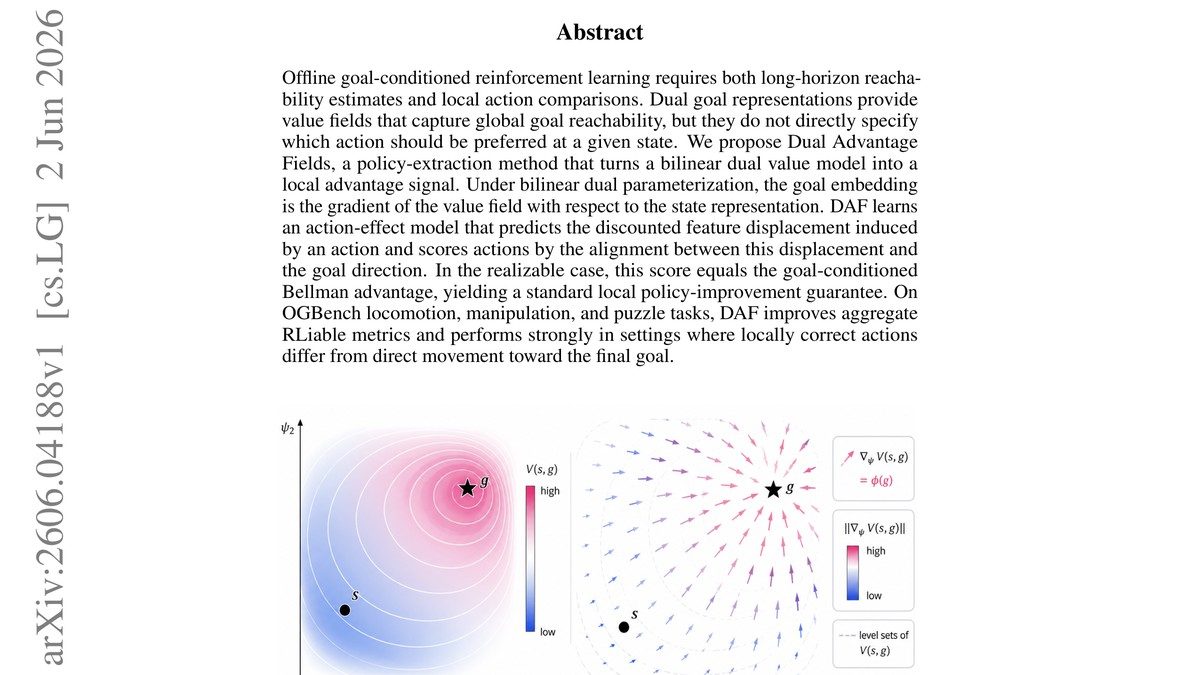
Offline goal-conditioned reinforcement learning requires both long-horizon reachability estimates and local action comparisons. Dual goal representations provide value fields that capture global goal reachability, but they do not directly specify which action should be preferred at a given state. We...
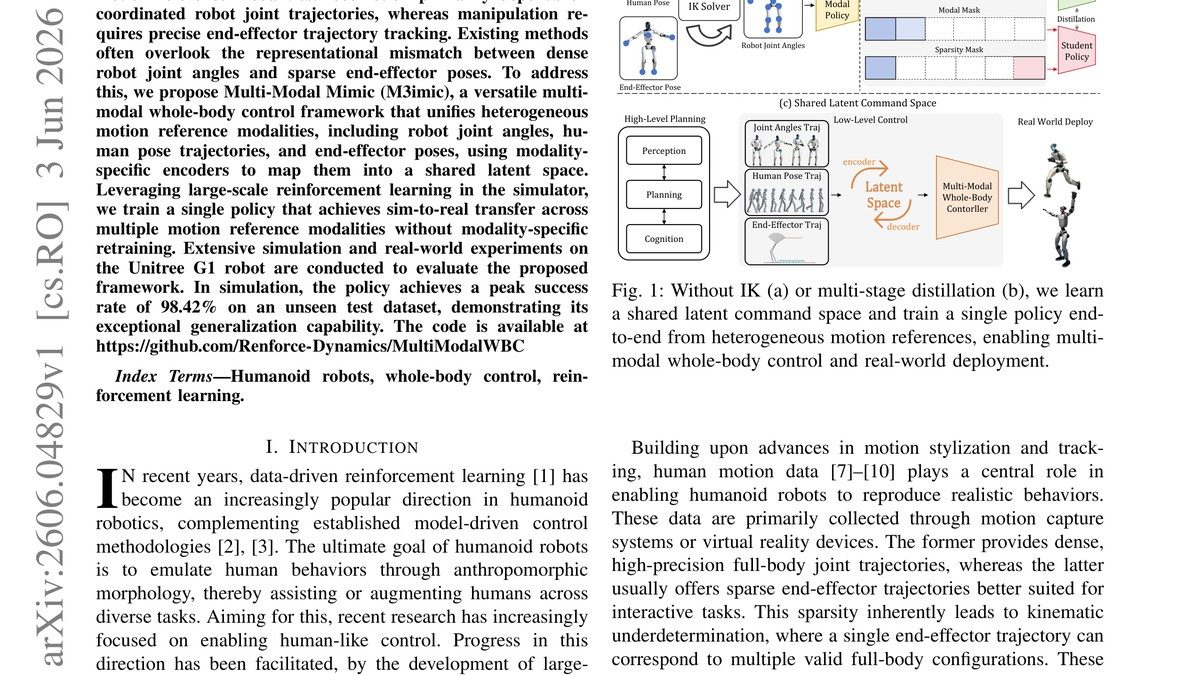
M3imic: Learning a Versatile Whole-Body Controller for Multimodal Motion Mimicking
Zuxing Lu, Ziang Zheng, Yao Lyu et al. · arXiv preprint · Jun 2026
Building a general-purpose whole-body controller is essential for enabling diverse motion capabilities in humanoid robots across a wide range of downstream tasks, including locomotion and loco-manipulation. Different tasks rely on distinct motion reference modalities: locomotion primarily depends on...