
TEA-AgriVLN: Traversability Estimation Alarm for Agricultural Vision-and-Language Navigation
Xiaobei Zhao, Xingqi Lyu, Xin Chen, Xiang Li · N/A · 2026
Framework
N/A
License
N/A
Stars
N/A
Summary
Vision-and-Language Navigation in Continuous Environments (VLN-CE) requires an agent to follow a natural language instruction, predicting a sequence of low-level actions to navigate a robot from a starting point to a target location. The A2A benchmark and the AgriVLN method pioneeringly extended ...
Abstract Summary
Key Points
- Vision-and-Language Navigation in Continuous Environments (VLN-CE) requires an agent to follow a ...
- The A2A benchmark and the AgriVLN method pioneeringly extended VLN-CE from indoor scenes to agric...
- In agricultural scenes, however, this issue tends to be ambiguous, such as an unripe cornfield mi...
- To address this issue, we propose the TEA module, which estimates the traversability of the camer...
- We integrate it into the AgriVLN backbone to build our TEA-AgriVLN method
TEA-AgriVLN: Traversability Estimation Alarm for Agricultural Vision-and-Language Navigation
|Authors: Xiaobei Zhao, Xingqi Lyu, Xin Chen, Xiang Li
|Venue: arXiv preprint | Year: 2026
|arXiv: 2607.28474v1
Abstract
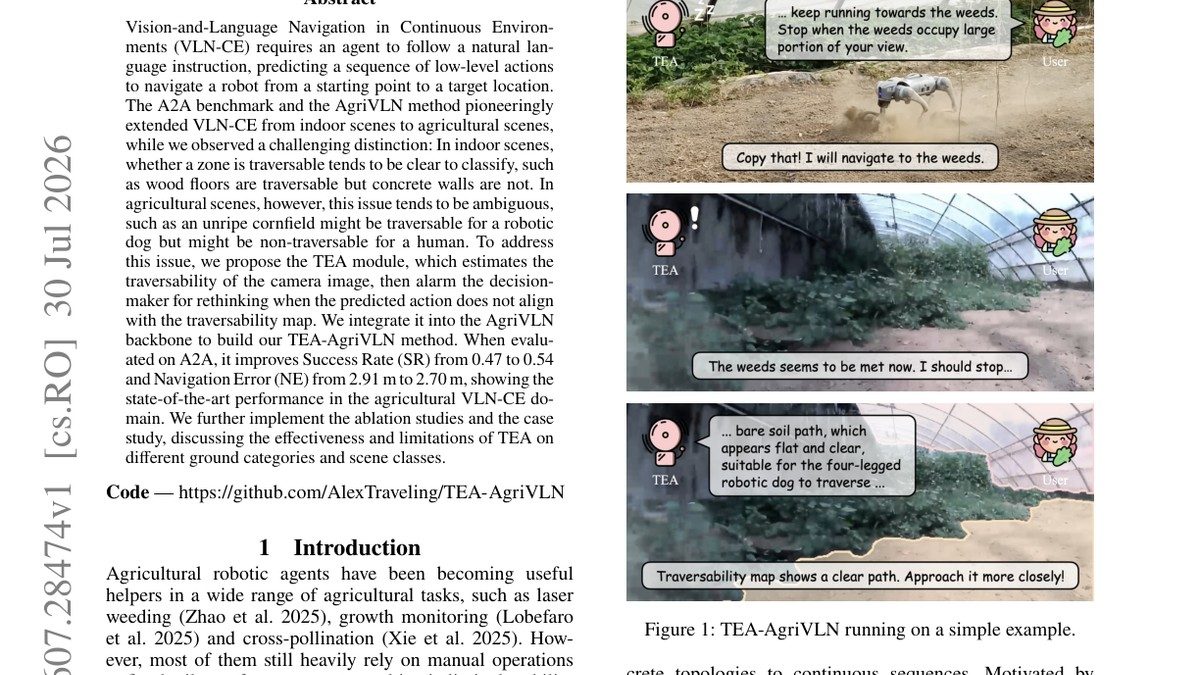
Vision-and-Language Navigation in Continuous Environments (VLN-CE) requires an agent to follow a natural language instruction, predicting a sequence of low-level actions to navigate a robot from a starting point to a target location. The A2A benchmark and the AgriVLN method pioneeringly extended VLN-CE from indoor scenes to agricultural scenes, while we observed a challenging distinction: In indoor scenes, whether a zone is traversable tends to be clear to classify, such as wood floors are traversable but concrete walls are not. In agricultural scenes, however, this issue tends to be ambiguous, such as an unripe cornfield might be traversable for a robotic dog but might be non-traversable for a human. To address this issue, we propose the TEA module, which estimates the traversability of the camera image, then alarm the decision-maker for rethinking when the predicted action does not align with the traversability map. We integrate it into the AgriVLN backbone to build our TEA-AgriVLN method. When evaluated on A2A, it improves Success Rate (SR) from 0.47 to 0.54 and Navigation Error (NE) from 2.91 m to 2.70 m, showing the state-of-the-art performance in the agricultural VLN-CE domain. We further implement the ablation studies and the case study, discussing the effectiveness and limitations of TEA on different ground categories and scene classes. Code: https://github.com/AlexTraveling/TEA-AgriVLN.
Key Contributions
- Vision-and-Language Navigation in Continuous Environments (VLN-CE) requires an agent to follow a …
- The A2A benchmark and the AgriVLN method pioneeringly extended VLN-CE from indoor scenes to agric…
- In agricultural scenes, however, this issue tends to be ambiguous, such as an unripe cornfield mi…
- To address this issue, we propose the TEA module, which estimates the traversability of the camer…
- We integrate it into the AgriVLN backbone to build our TEA-AgriVLN method
Topics
- vision
- planning
- benchmark
Code & Data
- GitHub repository: https://github.com/AlexTraveling/TEA-AgriVLN
BibTeX
@article{Zhao2026_260728474v1,
  title     = {TEA-AgriVLN: Traversability Estimation Alarm for Agricultural Vision-and-Language Navigation},
  author    = {Xiaobei Zhao and Xingqi Lyu and Xin Chen and Xiang Li},
  year      = {2026},
  eprint    = {2607.28474v1},
  archivePrefix = {arXiv},
  primaryClass  = {cs.RO},
  url       = {https://arxiv.org/abs/2607.28474v1}
}
Related Papers
Beyond Episodic Evaluation: Memory Architectural Bottlenecks in Sequential Embodied Question Answering
Zikui Cai, Kaushal Janga, Tan Dat Dao et al. · arXiv preprint · Jul 2026
Embodied question answering (EQA) is traditionally evaluated under an episodic formulation, where agents solve each task independently and reset internal state between episodes. However, real-world robots operate continuously and must accumulate, retain, and selectively reuse information acquired...
Continuous Actions from Discrete Minds: Latent-Aligned Planning for End-to-End Autonomous Driving
Ruoyu Yao, Yusen Xie, Qingzhao Liu et al. · arXiv preprint · Sep 2026
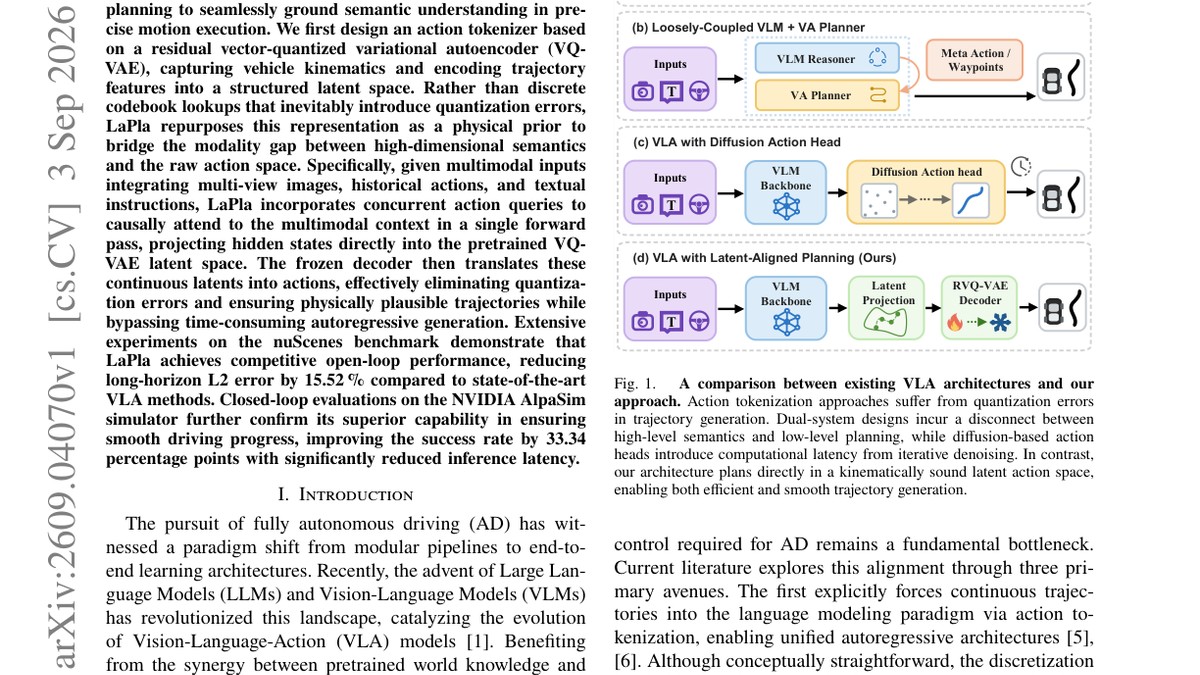
Bridging the gap between the discrete reasoning of Vision-Language Models and the continuous, physics-constrained nature of autonomous driving remains a significant challenge. In this work, we introduce LaPla, a unified Vision-Language-Action (VLA) framework featuring latent-aligned planning to s...
Embodied Scene Rearrangement Planning
Canzhi Chen, Zan Wang, Siqi Zhu et al. · arXiv preprint · Aug 2026
This paper introduces Embodied Scene Rearrangement Planning (ESRP), a novel task requiring embodied agents to rearrange furniture in 3D scenes to match a target configuration using only egocentric observations and a top-down target layout. Unlike prior rearrangement tasks, ESRP precludes global s...
Planning-Oriented End-to-End Autonomous Driving: Architectures, Evaluation, and Emerging Paradigms
Yanchen Guan, Xingcheng Liu, Bin Rao et al. · arXiv preprint · Aug 2026
End-to-end autonomous driving has evolved from camera-to-control regression toward planning-oriented systems that use structured representations, trajectory-level outputs, and increasingly realistic evaluation protocols. This survey reviews this transition across behavior cloning, conditional imi...