
TADP: Task-Aware Deformable Prediction for Single-Stage 3D Object Detection
Su Wang, Yaochen Li, Min Yang, Jiaohao Nie, Chang Liu, Yuehu Liu · N/A · 2026
Framework
N/A
License
N/A
Stars
N/A
Summary
Most single-stage 3D object detectors complete different tasks with the same extracted features. Nevertheless, it is impossible to project features into a common space that is adaptive for all the tasks. We present a novel task-aware deformable prediction (TADP) method for single-stage 3D object ...
Abstract Summary
Key Points
- Most single-stage 3D object detectors complete different tasks with the same extracted features
- Nevertheless, it is impossible to project features into a common space that is adaptive for all t...
- We present a novel task-aware deformable prediction (TADP) method for single-stage 3D object dete...
- Firstly, a triple feature refinement aggregation module is designed to extract three-level featur...
- Additionally, we design the multi-scale feature aggregation block to fuse multi-scale features in...
TADP: Task-Aware Deformable Prediction for Single-Stage 3D Object Detection
|Authors: Su Wang, Yaochen Li, Min Yang, Jiaohao Nie, Chang Liu, Yuehu Liu
|Venue: arXiv preprint | Year: 2026
|arXiv: 2608.27282v1
Abstract
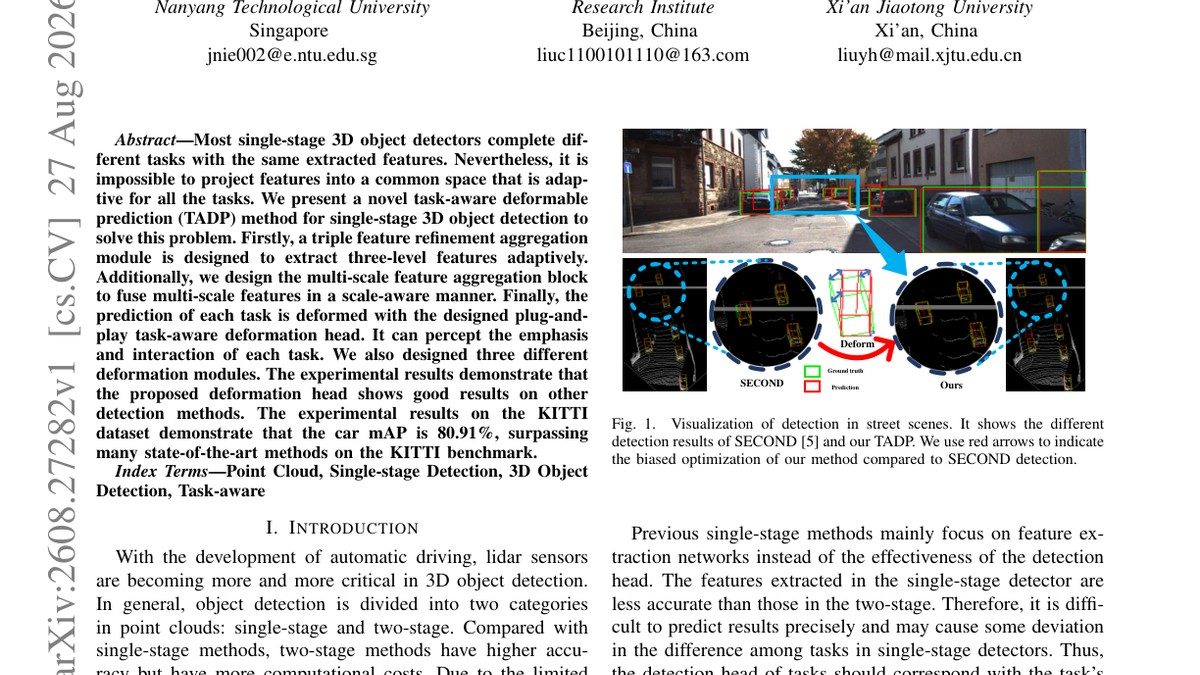
Most single-stage 3D object detectors complete different tasks with the same extracted features. Nevertheless, it is impossible to project features into a common space that is adaptive for all the tasks. We present a novel task-aware deformable prediction (TADP) method for single-stage 3D object detection to solve this problem. Firstly, a triple feature refinement aggregation module is designed to extract three-level features adaptively. Additionally, we design the multi-scale feature aggregation block to fuse multi-scale features in a scale-aware manner. Finally, the prediction of each task is deformed with the designed plug-and-play task-aware deformation head. It can percept the emphasis and interaction of each task. We also designed three different deformation modules. The experimental results demonstrate that the proposed deformation head shows good results on other detection methods. The experimental results on the KITTI dataset demonstrate that the car mAP is 80.91%, surpassing many state-of-the-art methods on the KITTI benchmark.
Key Contributions
- Most single-stage 3D object detectors complete different tasks with the same extracted features
- Nevertheless, it is impossible to project features into a common space that is adaptive for all t…
- We present a novel task-aware deformable prediction (TADP) method for single-stage 3D object dete…
- Firstly, a triple feature refinement aggregation module is designed to extract three-level featur…
- Additionally, we design the multi-scale feature aggregation block to fuse multi-scale features in…
Topics
- vision
- benchmark
Code & Data
No code repository linked in paper metadata.
BibTeX
@article{Wang2026_260827282v1,
  title     = {TADP: Task-Aware Deformable Prediction for Single-Stage 3D Object Detection},
  author    = {Su Wang and Yaochen Li and Min Yang and Jiaohao Nie and Chang Liu and Yuehu Liu},
  year      = {2026},
  eprint    = {2608.27282v1},
  archivePrefix = {arXiv},
  primaryClass  = {cs.CV},
  url       = {https://arxiv.org/abs/2608.27282v1}
}
Related Papers
Assessing Physical Frailty and Fall-Risk Indicators with Social Robots: An in situ Evaluation with Older Adults
Aniol Civit, Antonio Andriella, Alba Martínez et al. · arXiv preprint · Jul 2026
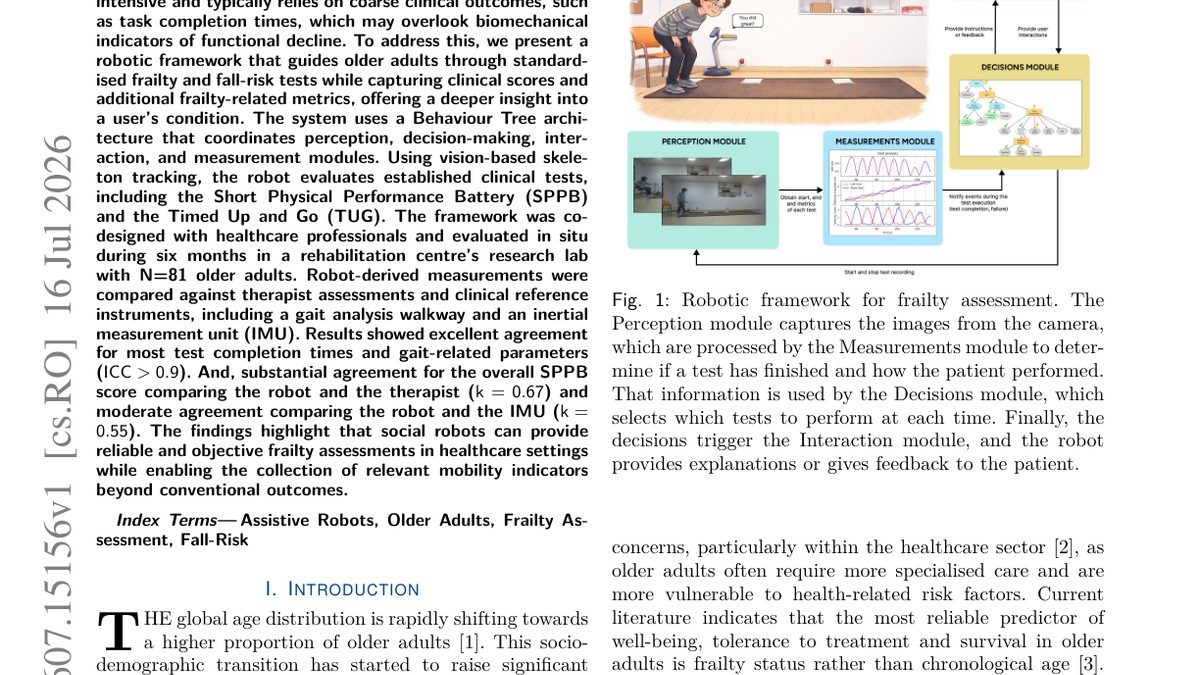
Frailty assessments are crucial to evaluate the risk of adverse events and the health and social care needs of older adults, yet their administration remains resource-intensive and typically relies on coarse clinical outcomes, such as task completion times, which may overlook biomechanical indica...

AXIS: A Growable Community-Driven Data Engine for Scalable Robot Manipulation
Mengfei Zhao, Dihong Huang, Yikai Tang et al. · arXiv preprint · Jul 2026
Learning effective robot manipulation policies requires diverse, high-quality demonstrations, yet existing data pipelines are often difficult to scale because they rely on specialized hardware, centralized operators, or fixed task suites. We present AXIS, a growable community-driven data engine a...
Beyond Episodic Evaluation: Memory Architectural Bottlenecks in Sequential Embodied Question Answering
Zikui Cai, Kaushal Janga, Tan Dat Dao et al. · arXiv preprint · Jul 2026
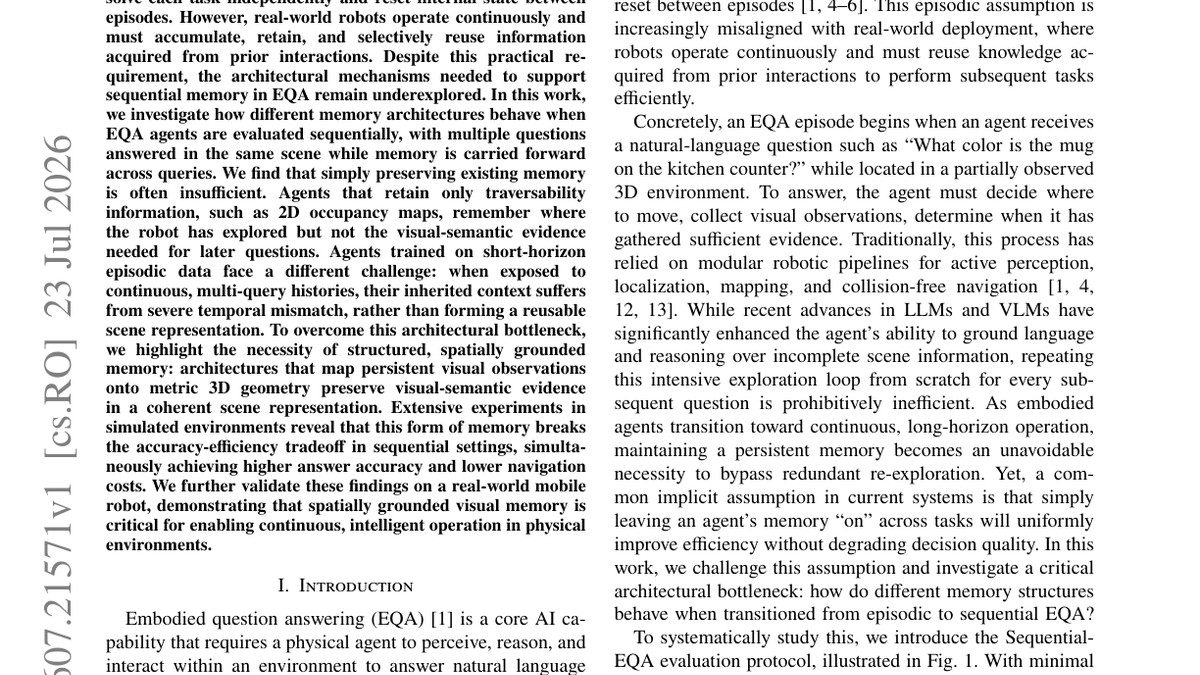
Embodied question answering (EQA) is traditionally evaluated under an episodic formulation, where agents solve each task independently and reset internal state between episodes. However, real-world robots operate continuously and must accumulate, retain, and selectively reuse information acquired...
Catalogue Photography as a Cold Start: Toward Deployable Carbide Burr Recognition
Abilash Philip Madavath, Chandra Yuvesh Aubeeluck, Augustin Raju et al. · arXiv preprint · Sep 2026
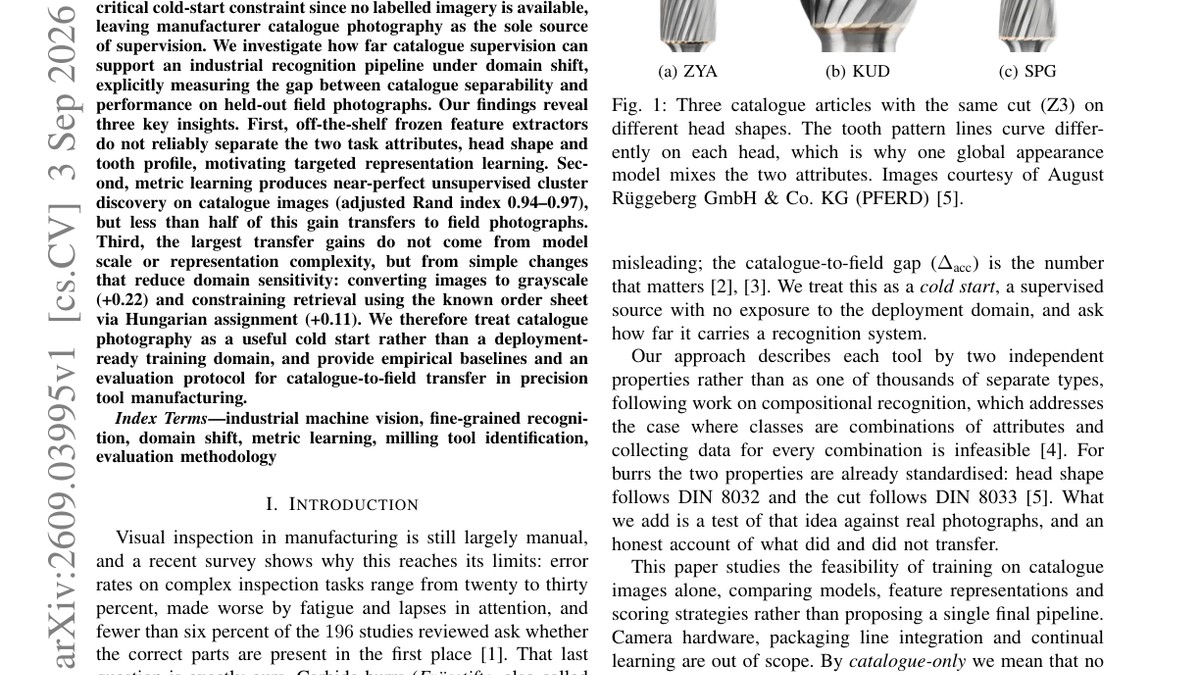
Verifying that manufactured batches of milling tools or carbide rotary burrs conform to production order sheets remains a largely manual and error-prone quality assurance task. Automating this process with computer vision faces a critical cold-start constraint since no labelled imagery is availab...