
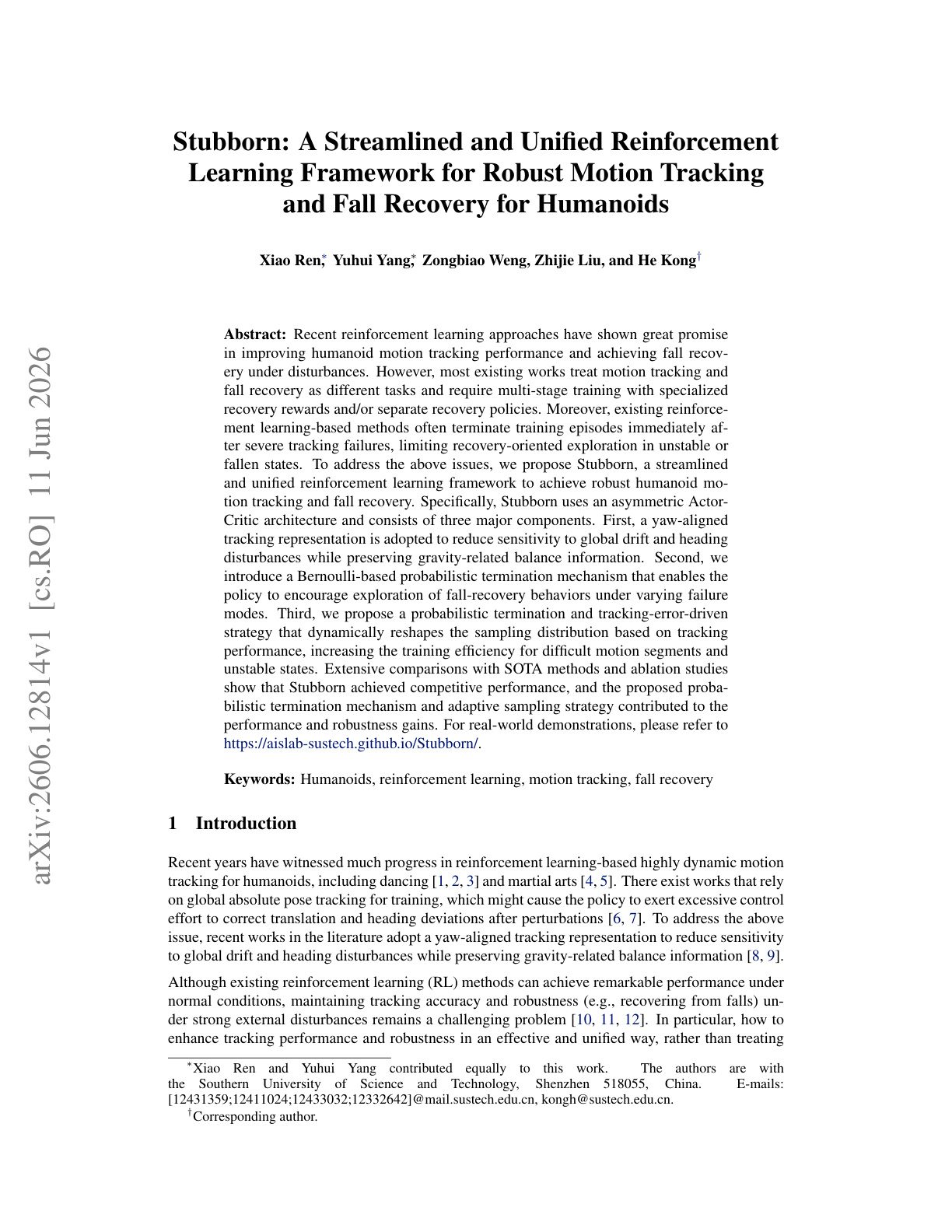
Stubborn: A Streamlined and Unified Reinforcement Learning Framework for Robust Motion Tracking and Fall Recovery for Humanoids
Xiao Ren, Yuhui Yang, Zongbiao Weng, Zhijie Liu, He Kong · N/A · 2026
Framework
N/A
License
N/A
Stars
N/A
Summary
Recent reinforcement learning approaches have shown great promise in improving humanoid motion tracking performance and achieving fall recovery under disturbances. However, most existing works treat motion tracking and fall recovery as different tasks and require multi-stage training with specialize...
Abstract Summary
Key Points
- Unifies motion tracking and fall recovery in a single RL framework without multi-stage training.
- Introduces a Bernoulli-based probabilistic termination mechanism to encourage fall-recovery exploration.
- Proposes an adaptive sampling strategy that reshapes the distribution based on tracking errors.
- Uses a yaw-aligned tracking representation to reduce sensitivity to global drift while preserving balance cues.
Related Papers
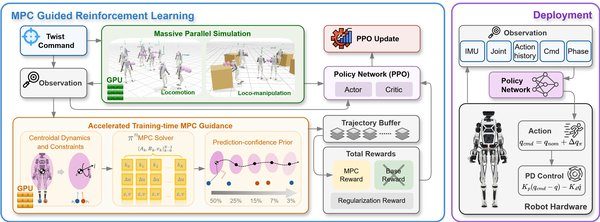
Accelerating and Scaling MPC-Guided Reinforcement Learning for Humanoid Locomotion and Manipulation
Junheng Li, Liang Wu, Sergio A. Esteban et al. · arXiv preprint · Jun 2026
In humanoid motion control, model predictive control (MPC) offers physically grounded prediction and constraint handling, while reinforcement learning (RL) enables robust whole-body skills through large-scale simulation. However, using MPC inside RL often requires time-consuming problem construction or excessive training overhead, making such frameworks difficult to justify in practice. This work studies efficient training-time MPC guidance for humanoid locomotion and manipulation, termed MPC-RL. We introduce a centroidal-dynamics MPC reward formulation that leverages guidance from MPC trajectories in training time. To make this practical in massively parallel RL, we develop π^nMPC, a parallel-in-horizon and construction-free batched GPU MPC solver that operates directly on time-varying dynamics to avoid high memory usage and pre-compilation. Through a variety of comparative studies and hardware validations, we have found that MPC-RL achieves superior performance in locomotion and manipulation skills.
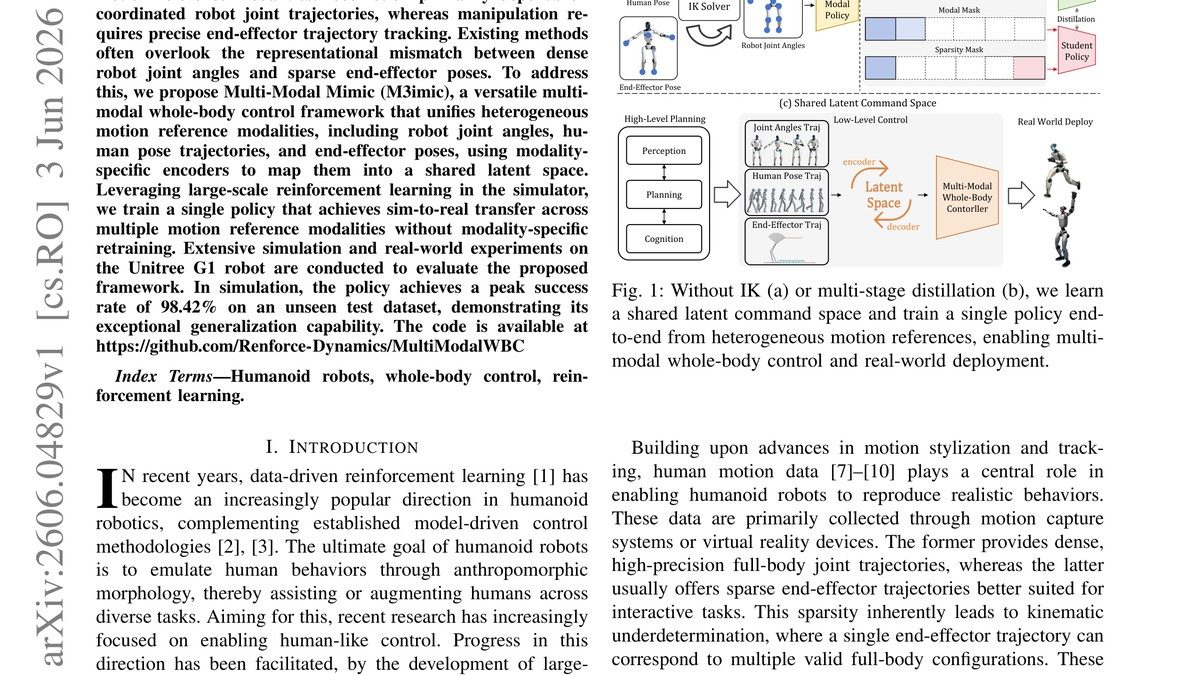
M3imic: Learning a Versatile Whole-Body Controller for Multimodal Motion Mimicking
Zuxing Lu, Ziang Zheng, Yao Lyu et al. · arXiv preprint · Jun 2026
Building a general-purpose whole-body controller is essential for enabling diverse motion capabilities in humanoid robots across a wide range of downstream tasks, including locomotion and loco-manipulation. Different tasks rely on distinct motion reference modalities: locomotion primarily depends on...
A Heterogeneous Architecture for Robot RL Beyond GPU-Dominant Paradigms
Yufei Jia, Zhanxiang Cao, Mingrui Yu et al. · arXiv preprint · May 2026
Simulation-based RL for contemporary robot control is increasingly organized around GPU-resident simulation: physics, rollout collection, and learning are placed on a single GPU-centric execution path
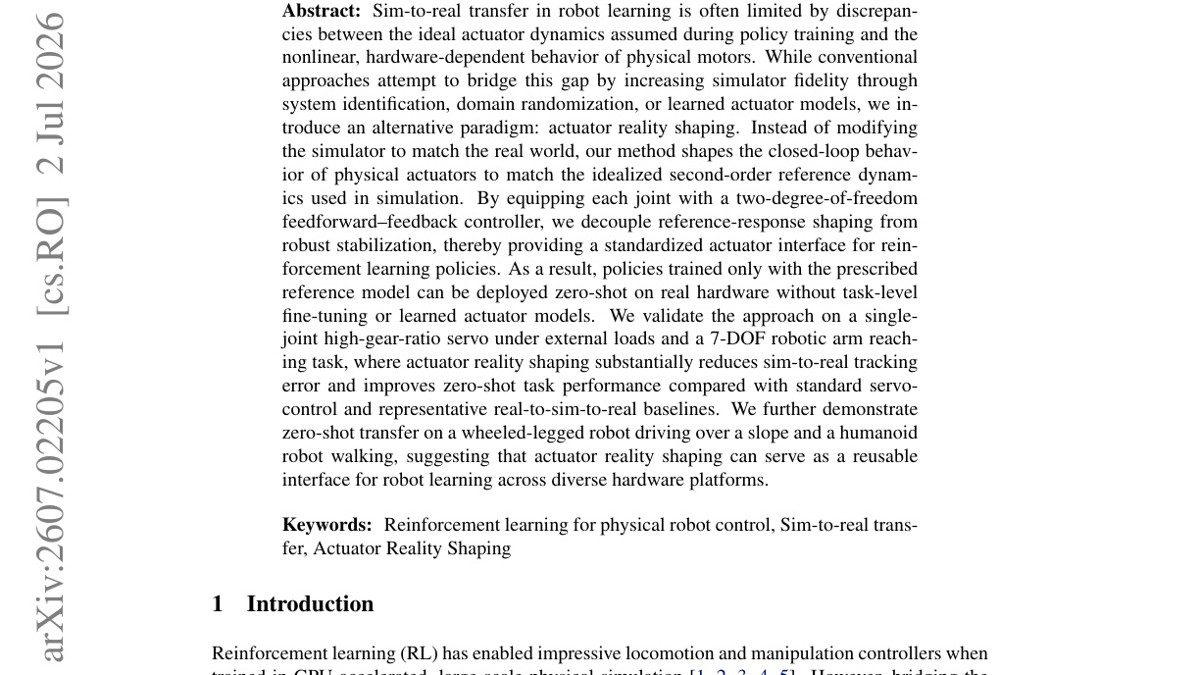
Actuator Reality Shaping for Zero-Shot Sim-to-Real Robot Learning
Satoshi Yamamori, Koji Ishihara, Kentaro Minamikawa et al. · arXiv preprint · Jul 2026
Sim-to-real transfer in robot learning is often limited by discrepancies between the ideal actuator dynamics assumed during policy training and the nonlinear, hardware-dependent be...