
STEP: State-Aware Task Estimation and Planning with Multi-Modal LLMs for Human-Robot Collaboration
Maitrey Gramopadhye, Prakash Baskaran, Xiao Liu, Songpo Li, Soshi Iba · N/A · 2026
Framework
N/A
License
N/A
Stars
N/A
Summary
Effective human-robot collaboration in industrial settings requires robots to understand human intentions and assist with task planning, reducing workload. Recent works have explored the use of Multi-modal Large Language Models (MM-LLMs) for task planning in such data-scarce scenarios, leveraging...
Abstract Summary
Key Points
- Effective human-robot collaboration in industrial settings requires robots to understand human in...
- Recent works have explored the use of Multi-modal Large Language Models (MM-LLMs) for task planni...
- However, MM-LLMs inherently lack an understanding of system states and do not track state transit...
- Additionally, generating action plans in natural language tends to limit the generated plans to a...
- To address these limitations, we propose the State-aware Task Estimator and Planner (STEP), which...
STEP: State-Aware Task Estimation and Planning with Multi-Modal LLMs for Human-Robot Collaboration
|Authors: Maitrey Gramopadhye, Prakash Baskaran, Xiao Liu, Songpo Li, Soshi Iba
|Venue: arXiv preprint | Year: 2026
|arXiv: 2608.27225v1
Abstract
Effective human-robot collaboration in industrial settings requires robots to understand human intentions and assist with task planning, reducing workload. Recent works have explored the use of Multi-modal Large Language Models (MM-LLMs) for task planning in such data-scarce scenarios, leveraging in-context learning to interpret user actions and generate long-horizon action plans in natural language. However, MM-LLMs inherently lack an understanding of system states and do not track state transitions, often leading to hallucinated actions that deviate from the intended goal. Additionally, generating action plans in natural language tends to limit the generated plans to a high level, introducing ambiguity in action execution. To address these limitations, we propose the State-aware Task Estimator and Planner (STEP), which prompts a MM-LLM to explicitly estimate the state of the system and predict the state transitions resulting from executed actions. By forecasting future states alongside actions, STEP ensures task-convergent planning while also providing additional assistance parameters necessary for executing the predicted actions. We evaluate STEP in a simulated environment using a robot assembly task. Our approach outperforms the state-of-the-art by 32.8% in action executability and 14.8% in final-state error.
Key Contributions
- Effective human-robot collaboration in industrial settings requires robots to understand human in…
- Recent works have explored the use of Multi-modal Large Language Models (MM-LLMs) for task planni…
- However, MM-LLMs inherently lack an understanding of system states and do not track state transit…
- Additionally, generating action plans in natural language tends to limit the generated plans to a…
- To address these limitations, we propose the State-aware Task Estimator and Planner (STEP), which…
Topics
- vla
- planning
Code & Data
No code repository linked in paper metadata.
BibTeX
@article{Gramopadhye2026_260827225v1,
  title     = {STEP: State-Aware Task Estimation and Planning with Multi-Modal LLMs for Human-Robot Collaboration},
  author    = {Maitrey Gramopadhye and Prakash Baskaran and Xiao Liu and Songpo Li and Soshi Iba},
  year      = {2026},
  eprint    = {2608.27225v1},
  archivePrefix = {arXiv},
  primaryClass  = {cs.RO},
  url       = {https://arxiv.org/abs/2608.27225v1}
}
Related Papers
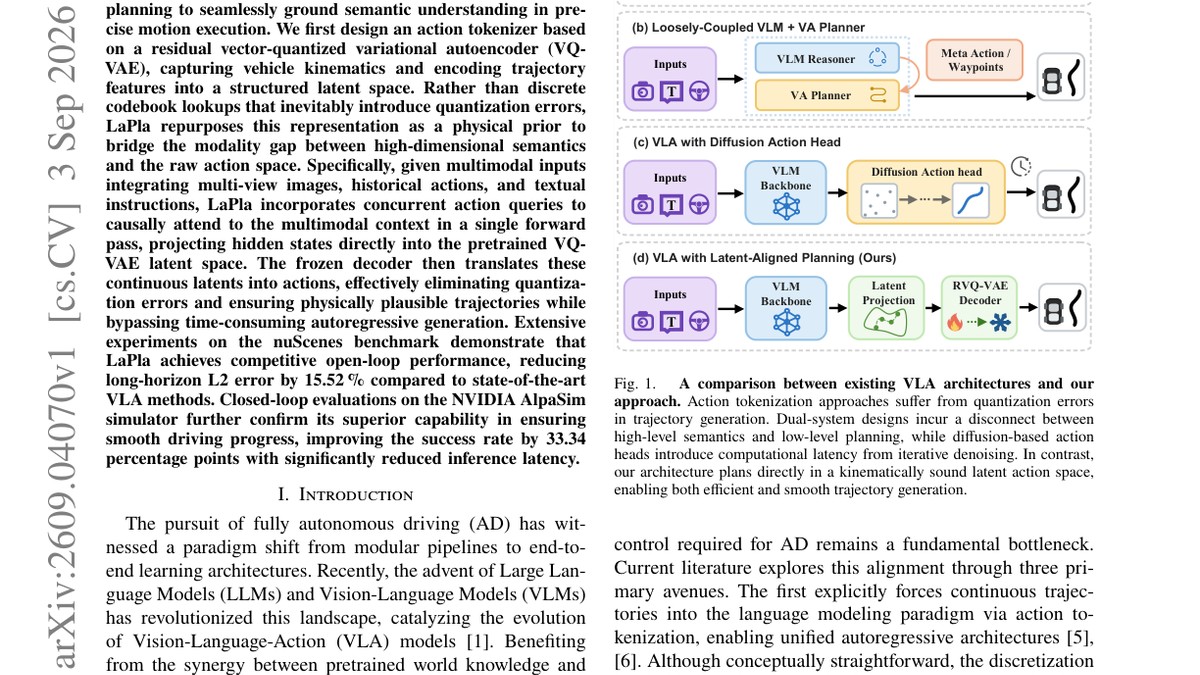
Continuous Actions from Discrete Minds: Latent-Aligned Planning for End-to-End Autonomous Driving
Ruoyu Yao, Yusen Xie, Qingzhao Liu et al. · arXiv preprint · Sep 2026
Bridging the gap between the discrete reasoning of Vision-Language Models and the continuous, physics-constrained nature of autonomous driving remains a significant challenge. In this work, we introduce LaPla, a unified Vision-Language-Action (VLA) framework featuring latent-aligned planning to s...
Evidence-Gated Task and Motion Planning with Vision-Language Models
Tsunehiko Tanaka, Matthew Stephenson, Alistair Macvicar et al. · arXiv preprint · Aug 2026
Robots executing long-horizon manipulation tasks from natural-language instructions must reason about both semantic task structure and geometric feasibility. However, under partial observability, the availability of goal-relevant objects may be uncertain. In such cases, approaches that combine Vi...
Planning-Oriented End-to-End Autonomous Driving: Architectures, Evaluation, and Emerging Paradigms
Yanchen Guan, Xingcheng Liu, Bin Rao et al. · arXiv preprint · Aug 2026
End-to-end autonomous driving has evolved from camera-to-control regression toward planning-oriented systems that use structured representations, trajectory-level outputs, and increasingly realistic evaluation protocols. This survey reviews this transition across behavior cloning, conditional imi...
RoboSPA: Can VLA Models Go Beyond Simple Scenes and Short-Horizon Tasks?
Zhenxuan Fan, Bo Zhang, Yutong Lin et al. · arXiv preprint · Sep 2026
Vision-Language-Action (VLA) models have shown promising progress in language-conditioned robotic manipulation. However, existing datasets and benchmarks mainly evaluate task completion under predefined settings, offering limited insight into model reasoning under increasing spatial and procedura...