
Evidence-Gated Task and Motion Planning with Vision-Language Models
Tsunehiko Tanaka, Matthew Stephenson, Alistair Macvicar, Edgar Simo-Serra · N/A · 2026
Framework
N/A
License
N/A
Stars
N/A
Summary
Robots executing long-horizon manipulation tasks from natural-language instructions must reason about both semantic task structure and geometric feasibility. However, under partial observability, the availability of goal-relevant objects may be uncertain. In such cases, approaches that combine Vi...
Abstract Summary
Key Points
- Robots executing long-horizon manipulation tasks from natural-language instructions must reason a...
- However, under partial observability, the availability of goal-relevant objects may be uncertain
- In such cases, approaches that combine Vision-Language Models (VLMs) with Task and Motion Plannin...
- We propose Evidence Acquisition and Feasibility Gating (EAFG), a framework that acquires visual e...
- EAFG then applies a feasibility gate to decide whether to proceed with task planning, acquire fur...
Evidence-Gated Task and Motion Planning with Vision-Language Models
|Authors: Tsunehiko Tanaka, Matthew Stephenson, Alistair Macvicar, Edgar Simo-Serra
|Venue: arXiv preprint | Year: 2026
|arXiv: 2608.20084v1
Abstract
Robots executing long-horizon manipulation tasks from natural-language instructions must reason about both semantic task structure and geometric feasibility. However, under partial observability, the availability of goal-relevant objects may be uncertain. In such cases, approaches that combine Vision-Language Models (VLMs) with Task and Motion Planning (TAMP) may generate subgoals that rely on the VLM’s prior knowledge without observational support, leading to execution failures or unintended outcomes. We propose Evidence Acquisition and Feasibility Gating (EAFG), a framework that acquires visual evidence through VLM-generated exploratory subgoals and TAMP-based execution. EAFG then applies a feasibility gate to decide whether to proceed with task planning, acquire further evidence, or halt. Our experiments show that, in cooking tasks with ambiguous object use, EAFG improves recipe completion by discovering task-relevant objects before planning. For instructions requiring an absent object, EAFG promotes appropriate halt decisions and reduces repeated attempts to manipulate that object.
Key Contributions
- Robots executing long-horizon manipulation tasks from natural-language instructions must reason a…
- However, under partial observability, the availability of goal-relevant objects may be uncertain
- In such cases, approaches that combine Vision-Language Models (VLMs) with Task and Motion Plannin…
- We propose Evidence Acquisition and Feasibility Gating (EAFG), a framework that acquires visual e…
- EAFG then applies a feasibility gate to decide whether to proceed with task planning, acquire fur…
Topics
- manipulation
- vision
- vla
- reinforcement-learning
- planning
Code & Data
No code repository linked in paper metadata.
BibTeX
@article{Tanaka2026_260820084v1,
  title     = {Evidence-Gated Task and Motion Planning with Vision-Language Models},
  author    = {Tsunehiko Tanaka and Matthew Stephenson and Alistair Macvicar and Edgar Simo-Serra},
  year      = {2026},
  eprint    = {2608.20084v1},
  archivePrefix = {arXiv},
  primaryClass  = {cs.RO},
  url       = {https://arxiv.org/abs/2608.20084v1}
}
Related Papers
3DThinkVLA: Endowing Vision-Language-Action Models with Latent 3D Priors via 3D-Thinking-Guided Co-training
Jiaxin Shi, Xidong Zhang, Fucai Zhu et al. · arXiv preprint · Jun 2026
We propose a 3D-thinking-guided co-training framework that enables vision-language-action (VLA) models to perform 3D spatial reasoning implicitly during action prediction. Our core insight is that 3D geometry perception and 3D spatial reasoning are distinct capabilities that can be disentangled and ...
Decoding Task Progress from VLA Representations
Atiksh Bhardwaj, Edward Weiyi Duan, Prithwish Dan et al. · arXiv preprint · Aug 2026
Vision-language-action models (VLAs) are moving rapidly towards deployment as general-purpose manipulation policies, but we currently lack basic tools for understanding what these models represent internally or for monitoring them at runtime. Leveraging ideas from mechanistic interpretability, we...
Development of a Humanoid Robot Prototype for Multimodal Human-Robot Interaction
Thang Tran Viet, Thanh Nguyen Canh, Huy Uong Gia et al. · arXiv preprint · Sep 2026
Human-robot interaction (HRI) enables intuitive and intelligent collaboration between humans and robots in real-world environments. This paper introduces a humanoid robot prototype designed as a flexible testbed for developing and integrating artificial intelligence (AI) modules in HRI tasks. The...
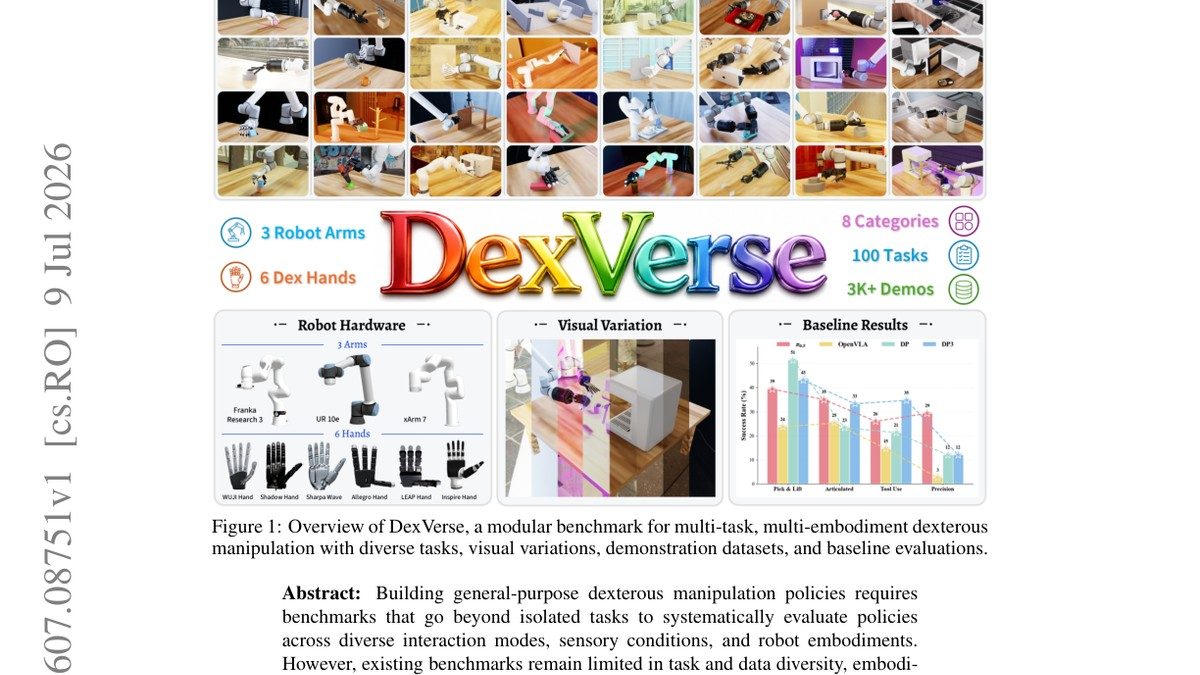
DexVerse: A Modular Benchmark for Multi-Task, Multi-Embodiment Dexterous Manipulation
Yunchao Yao, Zhuxiu Xu, Tianqi Zhang et al. · arXiv preprint · Jul 2026
Building general-purpose dexterous manipulation policies requires benchmarks that go beyond isolated tasks to systematically evaluate policies across diverse interaction modes, sensory conditions, and robot embodiments. However, existing benchmarks remain limited in task and data diversity, embod...