
SimplerEnv: Simulated Manipulation Policy Evaluation with Real-World Video Prompts
FeaturedXuanlin Li, Kyle Hsu, Jiayuan Gu, Karl Pertsch, Qiang Liu, Chuyuan Fu, Igor Mordatch, Jiajun Wu, Yan Zhao, Zhenyu Jiang · UC Berkeley, Stanford, Google DeepMind · 2024
Framework
PyTorch
License
MIT
Stars
1,068
Summary
A benchmark environment for evaluating real-world robot manipulation policies in simulation using real-world video prompts, enabling zero-shot sim-to-real transfer evaluation without physical hardware.
Abstract Summary
Key Points
- Evaluates real-world manipulation policies in simulation using real-world video prompts.
- Reconstructs interactive sim scenes from video via NeRF/Gaussian Splatting/depth meshing.
- 50+ tasks with standardized metrics; validated against real-world policy success rates.
- Supports counterfactual scene editing for controlled ablation studies.
- Built on SAPIEN + ManiSkill; ideal for labs with limited physical robot access.
Related Papers
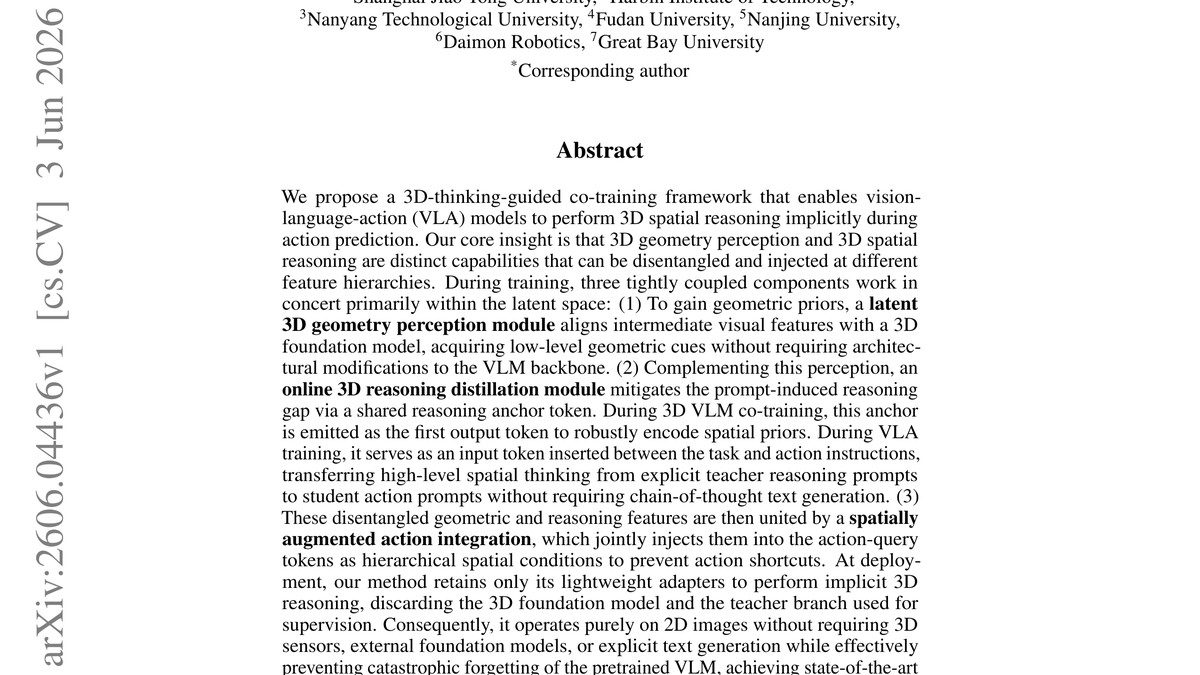
3DThinkVLA: Endowing Vision-Language-Action Models with Latent 3D Priors via 3D-Thinking-Guided Co-training
Jiaxin Shi, Xidong Zhang, Fucai Zhu et al. · arXiv preprint · Jun 2026
We propose a 3D-thinking-guided co-training framework that enables vision-language-action (VLA) models to perform 3D spatial reasoning implicitly during action prediction. Our core insight is that 3D geometry perception and 3D spatial reasoning are distinct capabilities that can be disentangled and ...
Beyond Binary: Sim-to-Real Dexterous Manipulation with Physics-Grounded Contact Representation
Jiahe Pan, Stelian Coros, Jitendra Malik et al. · arXiv preprint · May 2026
A primary bottleneck in contact-rich manipulation is the difficulty of collecting real-world data. Sim-to-real reinforcement learning offers a scalable alternative, but the simulation-reality gap prev
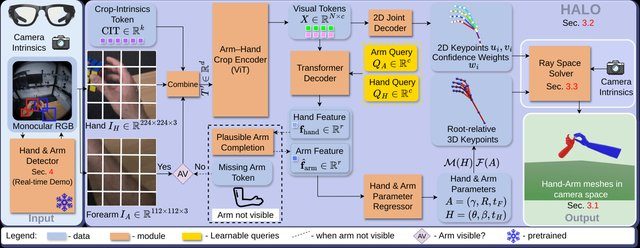
EgoForce: Forearm-Guided Camera-Space 3D Hand Pose from a Monocular Egocentric Camera
Christen Millerdurai, Shaoxiang Wang, Yaxu Xie et al. · SIGGRAPH 2026 · May 2026
Reconstructing the absolute 3D pose and shape of the hands from the user's viewpoint using a single head-mounted camera is crucial for practical egocentric interaction in AR/VR, telepresence, and hand-centric manipulation tasks, where sensing must...
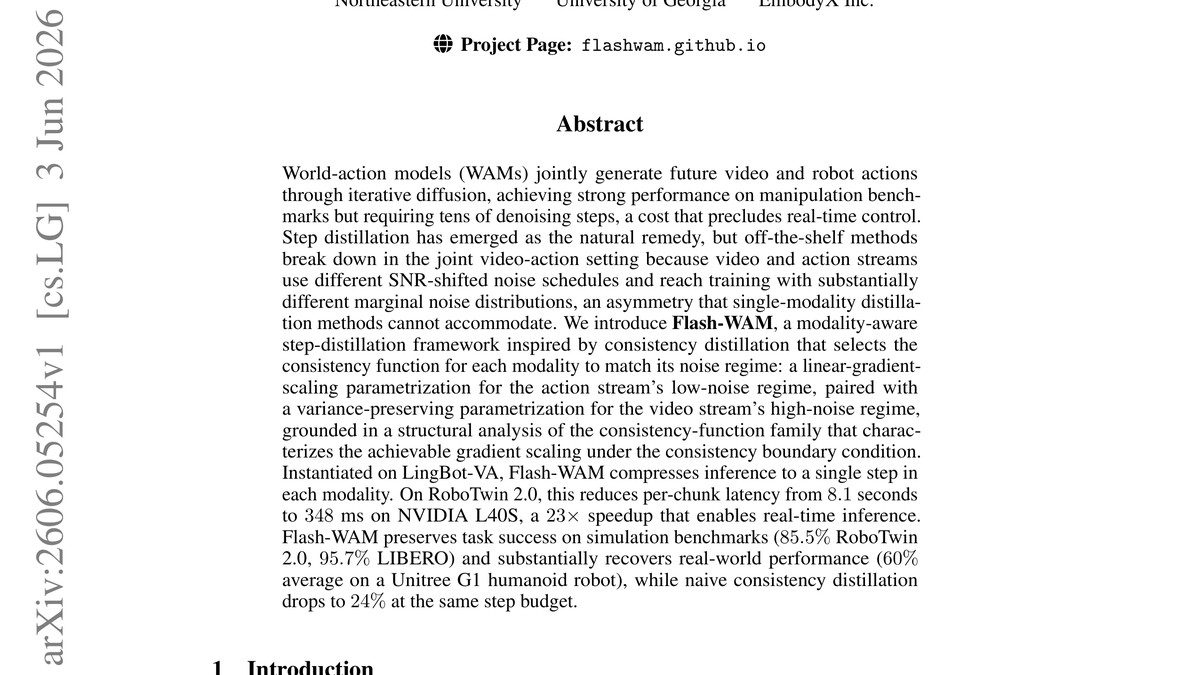
Flash-WAM: Modality-Aware Distillation for World Action Models
Arman Akbari, Ci Zhang, Arash Akbari et al. · arXiv preprint · Jun 2026
World-action models (WAMs) jointly generate future video and robot actions through iterative diffusion, achieving strong performance on manipulation benchmarks but requiring tens of denoising steps, a cost that precludes real-time control. Step distillation has emerged as the natural remedy, but off...