
Sample-Efficient Diffusion-based Reinforcement Learning with Critic Guidance
FeaturedShutong Ding, Zejia Zhong, Zhongyi Wang, Ke Hu, Bikang Pan, Jingya Wang, Ye Shi · · 2026
Framework
N/A
License
N/A
Stars
0
Summary
Recent advances in reinforcement learning (RL) have achieved great successes by leveraging the multimodality and exploration capability of diffusion policies. Among these approaches, one representativ
Abstract Summary
Key Points
- Proposes CGPO, a critic-guided diffusion policy optimization method.
- Balances exploration and exploitation using training-free guidance during denoising.
- Achieves SOTA on 5 MuJoCo locomotion tasks.
- First diffusion policy applied to real-world RL on Franka robot grasping.
- Uses guided actions as regression objectives for faster policy convergence.
Related Papers
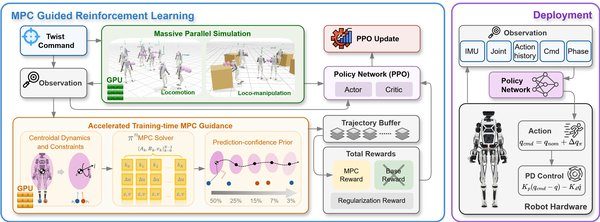
Accelerating and Scaling MPC-Guided Reinforcement Learning for Humanoid Locomotion and Manipulation
Junheng Li, Liang Wu, Sergio A. Esteban et al. · arXiv preprint · Jun 2026
In humanoid motion control, model predictive control (MPC) offers physically grounded prediction and constraint handling, while reinforcement learning (RL) enables robust whole-body skills through large-scale simulation. However, using MPC inside RL often requires time-consuming problem construction or excessive training overhead, making such frameworks difficult to justify in practice. This work studies efficient training-time MPC guidance for humanoid locomotion and manipulation, termed MPC-RL. We introduce a centroidal-dynamics MPC reward formulation that leverages guidance from MPC trajectories in training time. To make this practical in massively parallel RL, we develop π^nMPC, a parallel-in-horizon and construction-free batched GPU MPC solver that operates directly on time-varying dynamics to avoid high memory usage and pre-compilation. Through a variety of comparative studies and hardware validations, we have found that MPC-RL achieves superior performance in locomotion and manipulation skills.
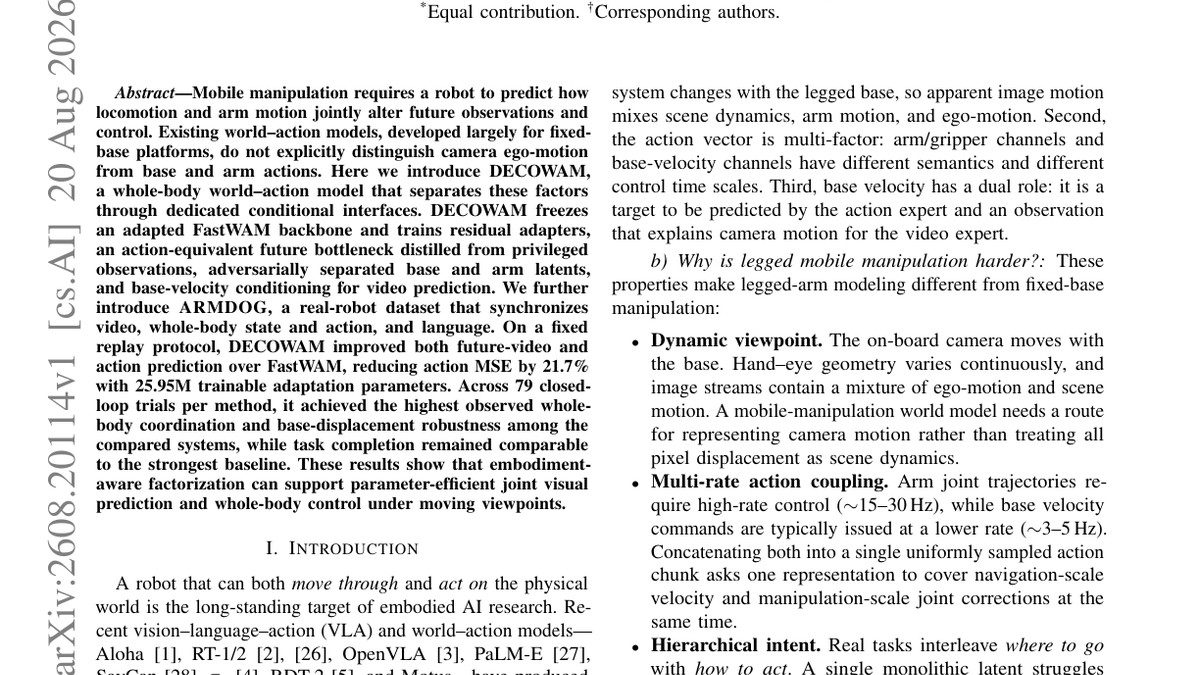
DECOWAM: Decoupled Whole-Body World-Action Model for Legged Mobile Manipulation
Siyuan Ma, Boshi Zhang, Yutian Zhang et al. · arXiv preprint · Aug 2026
Mobile manipulation requires a robot to predict how locomotion and arm motion jointly alter future observations and control. Existing world-action models, developed largely for fixed-base platforms, do not explicitly distinguish camera ego-motion from base and arm actions. Here we introduce DECOW...
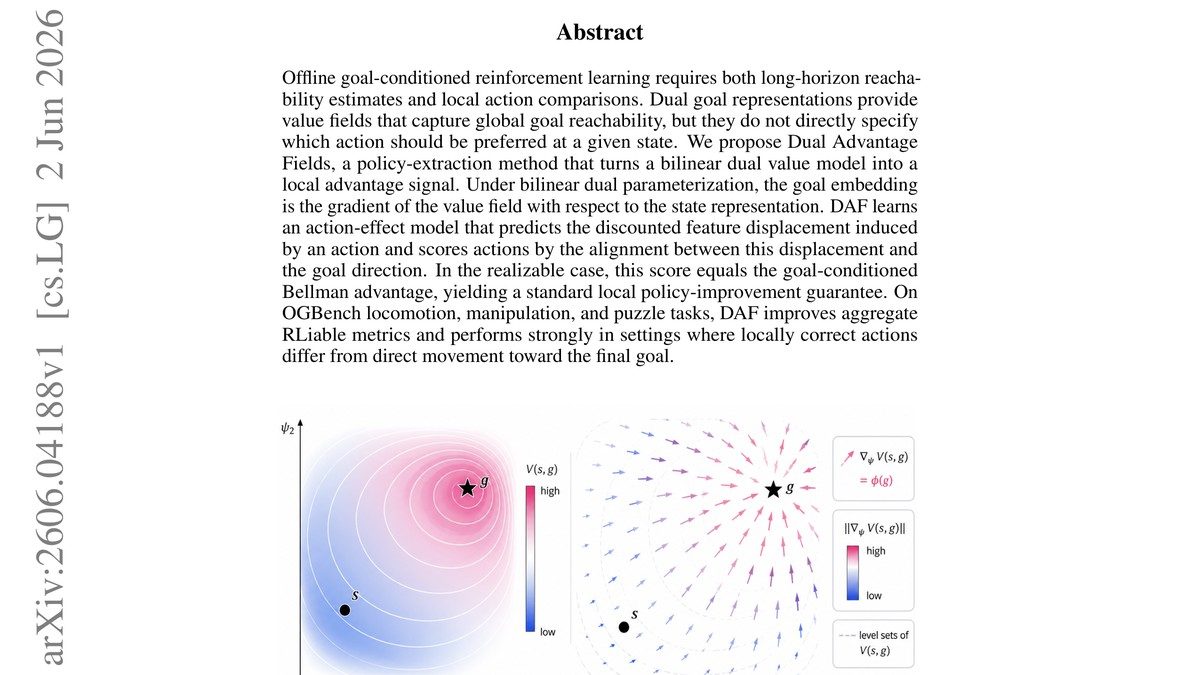
Dual Advantage Fields
Alexey Zemtsov, Maxim Bobrin, Alexander Nikulin et al. · ICML 2026 · Jun 2026
Offline goal-conditioned reinforcement learning requires both long-horizon reachability estimates and local action comparisons. Dual goal representations provide value fields that capture global goal reachability, but they do not directly specify which action should be preferred at a given state. We...
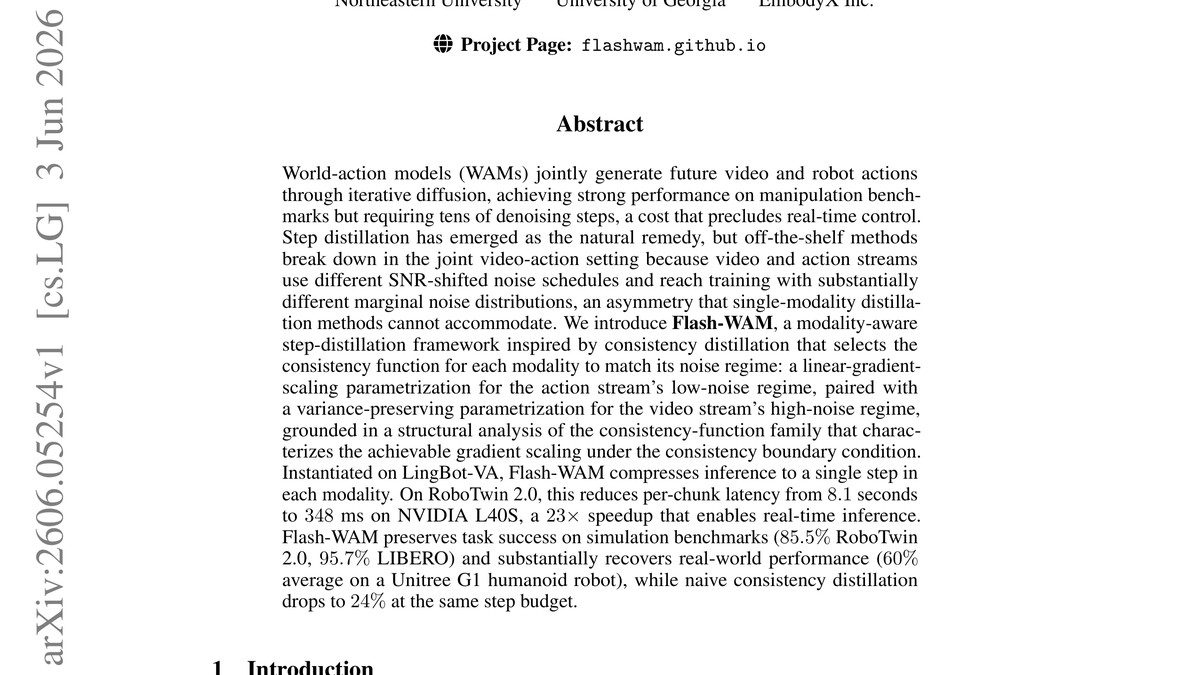
Flash-WAM: Modality-Aware Distillation for World Action Models
Arman Akbari, Ci Zhang, Arash Akbari et al. · arXiv preprint · Jun 2026
World-action models (WAMs) jointly generate future video and robot actions through iterative diffusion, achieving strong performance on manipulation benchmarks but requiring tens of denoising steps, a cost that precludes real-time control. Step distillation has emerged as the natural remedy, but off...