
Mind the Context: Continual Learning of Socially Appropriate Robot Actions via Environmental-Social Disentanglement
Rafal Robert Karpinski, Fethiye Irmak Dogan, Nikhil Churamani, Yiming Luo, Maartje M. A. de Graaf, Davide Dell'Anna, Hatice Gunes · N/A · 2026
Framework
N/A
License
N/A
Stars
N/A
Summary
Social robots are expected to operate across diverse environments, where similar arrangements can imply different socially appropriate actions, e.g., starting a conversation may be acceptable in a crowded home but disruptive in an office meeting. Because such norms and environments cannot all be ...
Abstract Summary
Key Points
- Social robots are expected to operate across diverse environments, where similar arrangements can...
- Because such norms and environments cannot all be anticipated in advance, robots require continua...
- Prior work has studied CL for generating socially appropriate robot actions, but it has not addre...
- We address this gap with the Explicit Disentanglement Dual-Branch (EDD) framework
- EDD explicitly separates environmental and social-agent related knowledge and uses replay-based r...
Mind the Context: Continual Learning of Socially Appropriate Robot Actions via Environmental-Social Disentanglement
|Authors: Rafal Robert Karpinski, Fethiye Irmak Dogan, Nikhil Churamani, Yiming Luo, Maartje M. A. de Graaf, Davide Dell’Anna, Hatice Gunes
|Venue: arXiv preprint | Year: 2026
|arXiv: 2608.13448v1
Abstract
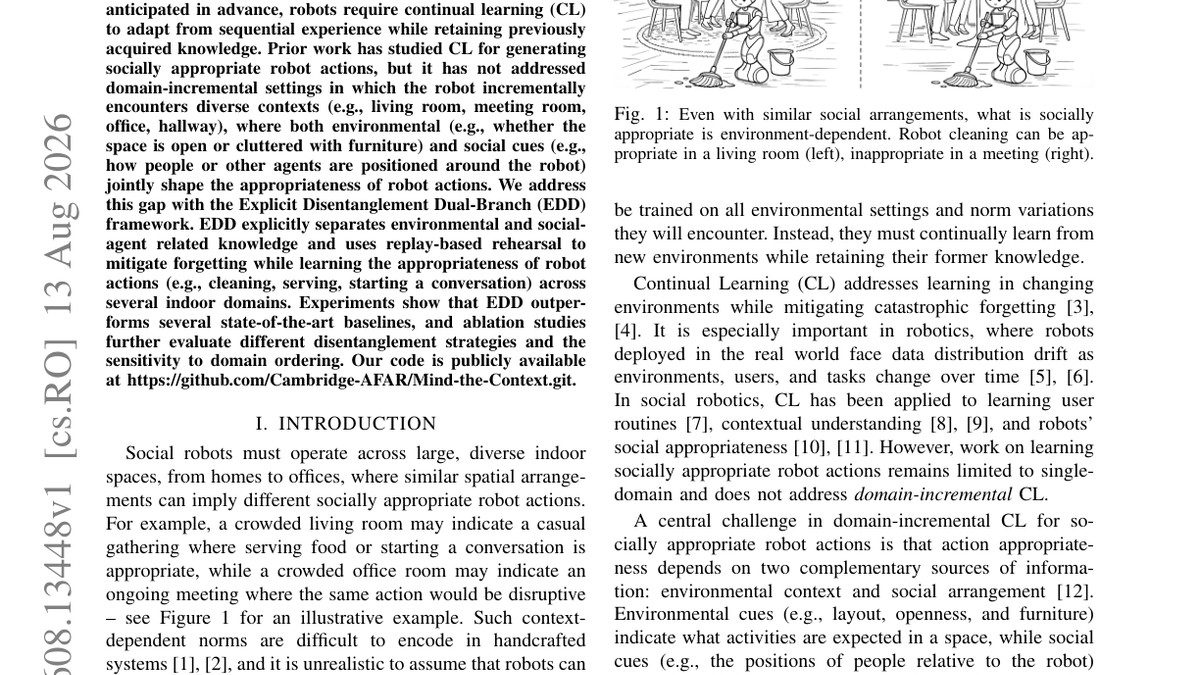
Social robots are expected to operate across diverse environments, where similar arrangements can imply different socially appropriate actions, e.g., starting a conversation may be acceptable in a crowded home but disruptive in an office meeting. Because such norms and environments cannot all be anticipated in advance, robots require continual learning (CL) to adapt from sequential experience while retaining previously acquired knowledge. Prior work has studied CL for generating socially appropriate robot actions, but it has not addressed domain-incremental settings in which the robot incrementally encounters diverse contexts (e.g., living room, meeting room, office, hallway), where both environmental (e.g., whether the space is open or cluttered with furniture) and social cues (e.g., how people or other agents are positioned around the robot) jointly shape the appropriateness of robot actions. We address this gap with the Explicit Disentanglement Dual-Branch (EDD) framework. EDD explicitly separates environmental and social-agent related knowledge and uses replay-based rehearsal to mitigate forgetting while learning the appropriateness of robot actions (e.g., cleaning, serving, starting a conversation) across several indoor domains. Experiments show that EDD outperforms several state-of-the-art baselines, and ablation studies further evaluate different disentanglement strategies and the sensitivity to domain ordering. Our code is publicly available at https://github.com/Cambridge-AFAR/Mind-the-Context.git.
Key Contributions
- Social robots are expected to operate across diverse environments, where similar arrangements can…
- Because such norms and environments cannot all be anticipated in advance, robots require continua…
- Prior work has studied CL for generating socially appropriate robot actions, but it has not addre…
- We address this gap with the Explicit Disentanglement Dual-Branch (EDD) framework
- EDD explicitly separates environmental and social-agent related knowledge and uses replay-based r…
Topics
- human-robot-interaction
Code & Data
- GitHub repository: https://github.com/Cambridge-AFAR/Mind-the-Context.git
BibTeX
@article{Karpinski2026_260813448v1,
  title     = {Mind the Context: Continual Learning of Socially Appropriate Robot Actions via Environmental-Social Disentanglement},
  author    = {Rafal Robert Karpinski and Fethiye Irmak Dogan and Nikhil Churamani and Yiming Luo and Maartje M. A. de Graaf and Davide Dell'Anna and Hatice Gunes},
  year      = {2026},
  eprint    = {2608.13448v1},
  archivePrefix = {arXiv},
  primaryClass  = {cs.RO},
  url       = {https://arxiv.org/abs/2608.13448v1}
}
Related Papers

A Confidence-Aware Multimodal Fusion Framework for Industrial Human-Robot Collaboration
Xinyu Liu, Qiqi Dong, Boya Jia et al. · arXiv preprint · Sep 2026
A confidence-aware multimodal fusion framework (CAMF) is proposed to realize reliable human intention prediction for industrial human-robot collaboration. This framework fuses four heterogeneous modalities including object 6D pose, gaze, skeletal motion and IMU-based hand motion. It embeds a conf...
A New Human-Likeness and Comfort Index for Robot Movements Along Prescribed Paths
Rosanna Coccaro, Enrico Ferrentino, Antonio Parziale et al. · arXiv preprint · Jul 2026
As human-robot interaction rapidly spreads in numerous fields, the subject of robot acceptance gains increasing importance. Visual similarity to the human body, as occurs for humanoids, is generally not enough to ensure acceptance in physical interaction, as acceptance directly links to comfort a...
Assessing Physical Frailty and Fall-Risk Indicators with Social Robots: An in situ Evaluation with Older Adults
Aniol Civit, Antonio Andriella, Alba Martínez et al. · arXiv preprint · Jul 2026
Frailty assessments are crucial to evaluate the risk of adverse events and the health and social care needs of older adults, yet their administration remains resource-intensive and typically relies on coarse clinical outcomes, such as task completion times, which may overlook biomechanical indica...
Catch, Throw, Repeat: Planning for Human-Robot Partner Juggling
Jonathan Rainer Lippert, Kai Ploeger, Abir Chowdhury et al. · arXiv preprint · Jul 2026
Dynamic object exchange between humans and robots remains a challenging problem due to uncertainty in perception, timing, and contact-rich interaction. Human-robot juggling represents a particularly demanding instance of this problem, requiring precise real-time coordination, predictive motion pl...