
A New Human-Likeness and Comfort Index for Robot Movements Along Prescribed Paths
Rosanna Coccaro, Enrico Ferrentino, Antonio Parziale, Angelo Marcelli, Pasquale Chiacchio · N/A · 2026
Framework
N/A
License
N/A
Stars
N/A
Summary
As human-robot interaction rapidly spreads in numerous fields, the subject of robot acceptance gains increasing importance. Visual similarity to the human body, as occurs for humanoids, is generally not enough to ensure acceptance in physical interaction, as acceptance directly links to comfort a...
Abstract Summary
Key Points
- As human-robot interaction rapidly spreads in numerous fields, the subject of robot acceptance ga...
- Visual similarity to the human body, as occurs for humanoids, is generally not enough to ensure a...
- This paper discusses the connection between comfort and similarity of the robot movement to the h...
- By considering the kinematic characterization of human movement, this paper focuses on the time l...
- Based on the lognormality principle for modeling human movements, a human-likeness index is defin...
A New Human-Likeness and Comfort Index for Robot Movements Along Prescribed Paths
|Authors: Rosanna Coccaro, Enrico Ferrentino, Antonio Parziale, Angelo Marcelli, Pasquale Chiacchio
|Venue: arXiv preprint | Year: 2026
|arXiv: 2607.08620v1
Abstract
As human-robot interaction rapidly spreads in numerous fields, the subject of robot acceptance gains increasing importance. Visual similarity to the human body, as occurs for humanoids, is generally not enough to ensure acceptance in physical interaction, as acceptance directly links to comfort and ergonomics, which are measured in terms of the quality of the robot movement perceived by the human. This paper discusses the connection between comfort and similarity of the robot movement to the human one. By considering the kinematic characterization of human movement, this paper focuses on the time laws of such movements, wherein the end-effector path is prescribed. Based on the lognormality principle for modeling human movements, a human-likeness index is defined and used to provide an a priori characterization of trajectories. Such an index can be used to evaluate the performance of trajectory generation algorithms in producing human-like movements before they are actually executed. For validation purposes, 68 subjects are required to judge their comfort. The results of three experimental campaigns involving a physical interaction with a robot demonstrate a globally consistent trend between the preference in terms of perceived comfort and the distribution of the suggested human-likeness index.
Key Contributions
- As human-robot interaction rapidly spreads in numerous fields, the subject of robot acceptance ga…
- Visual similarity to the human body, as occurs for humanoids, is generally not enough to ensure a…
- This paper discusses the connection between comfort and similarity of the robot movement to the h…
- By considering the kinematic characterization of human movement, this paper focuses on the time l…
- Based on the lognormality principle for modeling human movements, a human-likeness index is defin…
Topics
- vision
- control
- human-robot-interaction
Code & Data
No code repository linked in paper metadata.
BibTeX
@article{Coccaro2026_260708620v1,
  title     = {A New Human-Likeness and Comfort Index for Robot Movements Along Prescribed Paths},
  author    = {Rosanna Coccaro and Enrico Ferrentino and Antonio Parziale and Angelo Marcelli and Pasquale Chiacchio},
  year      = {2026},
  eprint    = {2607.08620v1},
  archivePrefix = {arXiv},
  primaryClass  = {cs.RO},
  url       = {https://arxiv.org/abs/2607.08620v1}
}
Related Papers
Catch, Throw, Repeat: Planning for Human-Robot Partner Juggling
Jonathan Rainer Lippert, Kai Ploeger, Abir Chowdhury et al. · arXiv preprint · Jul 2026
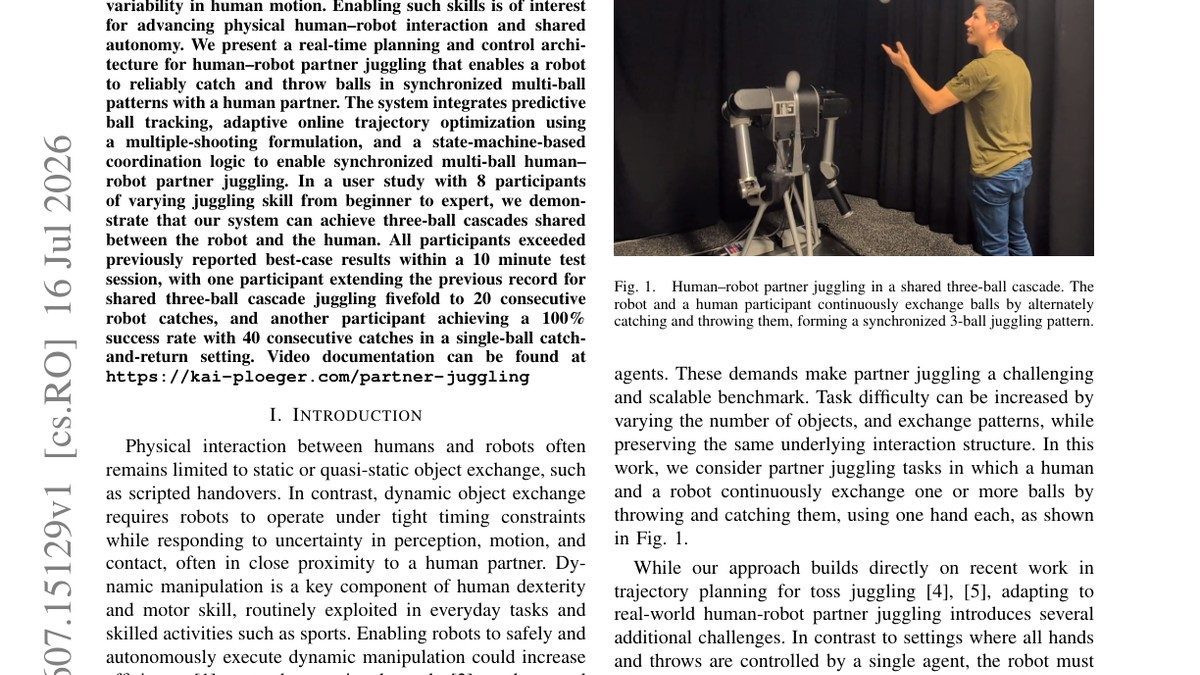
Dynamic object exchange between humans and robots remains a challenging problem due to uncertainty in perception, timing, and contact-rich interaction. Human-robot juggling represents a particularly demanding instance of this problem, requiring precise real-time coordination, predictive motion pl...
Development of a Humanoid Robot Prototype for Multimodal Human-Robot Interaction
Thang Tran Viet, Thanh Nguyen Canh, Huy Uong Gia et al. · arXiv preprint · Sep 2026
Human-robot interaction (HRI) enables intuitive and intelligent collaboration between humans and robots in real-world environments. This paper introduces a humanoid robot prototype designed as a flexible testbed for developing and integrating artificial intelligence (AI) modules in HRI tasks. The...
A Low-Cost, Open Platform for End-to-End Autonomous Driving on a Miniature Ackermann Vehicle
Gustavo Claudio Karl Couto, Eric Aislan Antonelo, Gabriel George Zipperer · arXiv preprint · Sep 2026
This paper presents a low-cost, open experimental platform for research in end-to-end autonomous driving with miniature Ackermann vehicles. The platform combines a physical vehicle, a printed urban track, data collection tools, trajectory registration, and a Webots digital twin, enabling controll...
Adaptation Needs in Robotic Systems: Assessing Behavior Trees and Their Enhancement
Mehran Rostamnia, Gianluca Filippone, Ricardo Caldas et al. · arXiv preprint · Sep 2026
Robotic systems increasingly operate in dynamic, uncertain, and open-ended environments, where design-time assumptions may no longer hold, and adaptation becomes necessary to maintain effective and safe operation. Behavior Trees (BTs) are widely used in robotic control architectures due to their ...