
Learning Adaptive Solvers for Distributed Factor Graph Optimization on Matrix Lie Groups
Jaeho Shin, Maani Ghaffari, Yulun Tian · N/A · 2026
Framework
N/A
License
N/A
Stars
N/A
Summary
Modern robotic perception increasingly involves large-scale geometric optimization problems distributed across multiple robots or sessions. However, existing distributed solvers often depend on brittle hand tuning and primarily target rigid body pose graphs. To address this, we present DeepCORD, ...
Abstract Summary
Key Points
- Modern robotic perception increasingly involves large-scale geometric optimization problems distr...
- However, existing distributed solvers often depend on brittle hand tuning and primarily target ri...
- To address this, we present DeepCORD, a learning-augmented framework for distributed factor graph...
- By unfolding a parallel and accelerated Riemannian optimizer into differentiable iterations, Deep...
- The resulting method enables adaptive distributed optimization over matrix Lie groups under both ...
Learning Adaptive Solvers for Distributed Factor Graph Optimization on Matrix Lie Groups
|Authors: Jaeho Shin, Maani Ghaffari, Yulun Tian
|Venue: arXiv preprint | Year: 2026
|arXiv: 2607.08735v1
Abstract
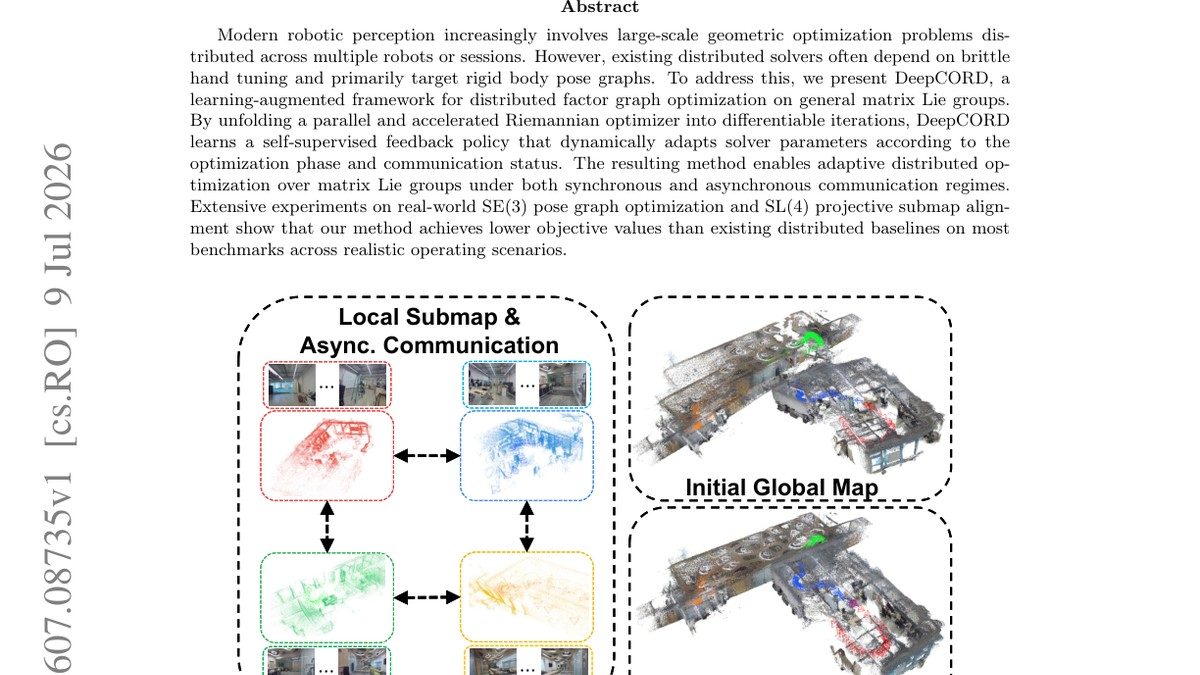
Modern robotic perception increasingly involves large-scale geometric optimization problems distributed across multiple robots or sessions. However, existing distributed solvers often depend on brittle hand tuning and primarily target rigid body pose graphs. To address this, we present DeepCORD, a learning-augmented framework for distributed factor graph optimization on general matrix Lie groups. By unfolding a parallel and accelerated Riemannian optimizer into differentiable iterations, DeepCORD learns a self-supervised feedback policy that dynamically adapts solver parameters according to the optimization phase and communication status. The resulting method enables adaptive distributed optimization over matrix Lie groups under both synchronous and asynchronous communication regimes. Extensive experiments on real-world $\mathrm{SE}$(3) pose graph optimization and $\mathrm{SL}$(4) projective submap alignment show that our method achieves lower objective values than existing distributed baselines on most benchmarks across realistic operating scenarios.
Key Contributions
- Modern robotic perception increasingly involves large-scale geometric optimization problems distr…
- However, existing distributed solvers often depend on brittle hand tuning and primarily target ri…
- To address this, we present DeepCORD, a learning-augmented framework for distributed factor graph…
- By unfolding a parallel and accelerated Riemannian optimizer into differentiable iterations, Deep…
- The resulting method enables adaptive distributed optimization over matrix Lie groups under both …
Topics
- vision
- reinforcement-learning
- benchmark
Code & Data
No code repository linked in paper metadata.
BibTeX
@article{Shin2026_260708735v1,
  title     = {Learning Adaptive Solvers for Distributed Factor Graph Optimization on Matrix Lie Groups},
  author    = {Jaeho Shin and Maani Ghaffari and Yulun Tian},
  year      = {2026},
  eprint    = {2607.08735v1},
  archivePrefix = {arXiv},
  primaryClass  = {cs.RO},
  url       = {https://arxiv.org/abs/2607.08735v1}
}
Related Papers
Assessing Physical Frailty and Fall-Risk Indicators with Social Robots: An in situ Evaluation with Older Adults
Aniol Civit, Antonio Andriella, Alba Martínez et al. · arXiv preprint · Jul 2026
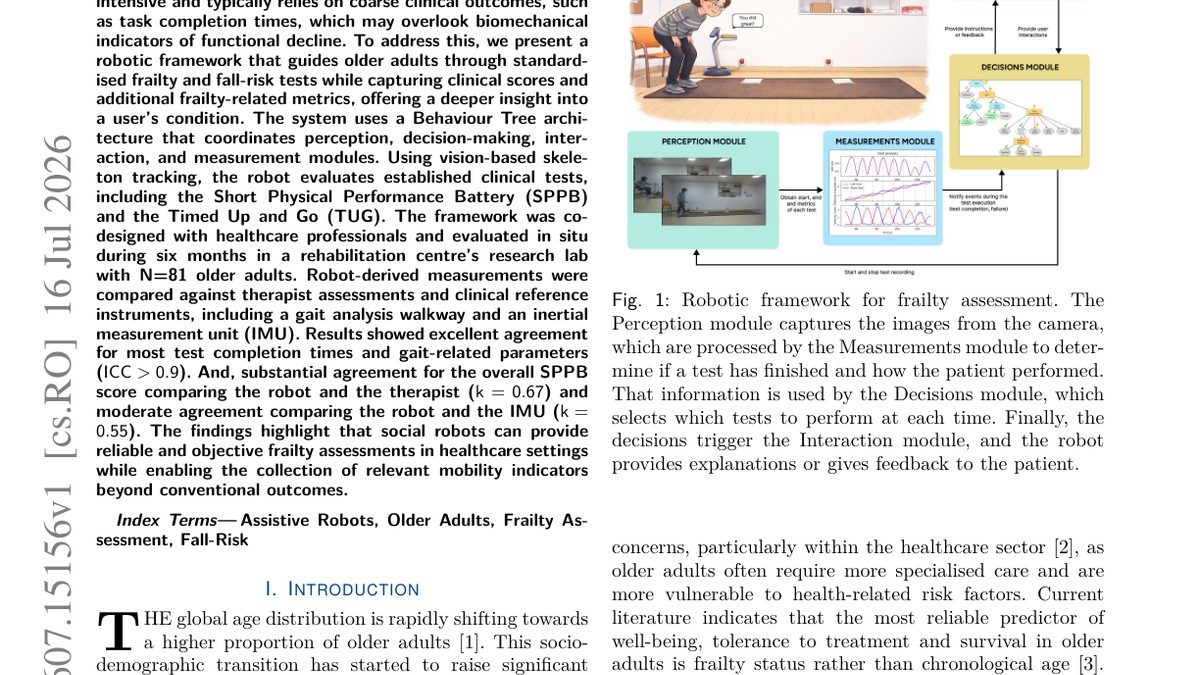
Frailty assessments are crucial to evaluate the risk of adverse events and the health and social care needs of older adults, yet their administration remains resource-intensive and typically relies on coarse clinical outcomes, such as task completion times, which may overlook biomechanical indica...
Beyond Episodic Evaluation: Memory Architectural Bottlenecks in Sequential Embodied Question Answering
Zikui Cai, Kaushal Janga, Tan Dat Dao et al. · arXiv preprint · Jul 2026
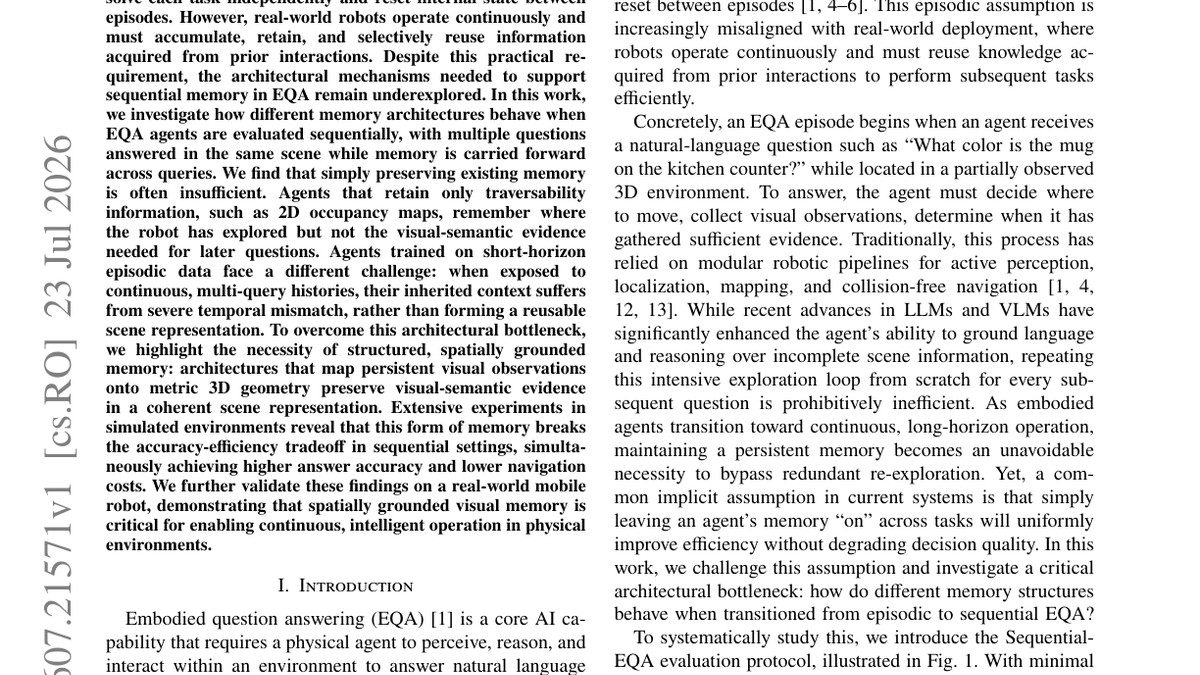
Embodied question answering (EQA) is traditionally evaluated under an episodic formulation, where agents solve each task independently and reset internal state between episodes. However, real-world robots operate continuously and must accumulate, retain, and selectively reuse information acquired...
Catalogue Photography as a Cold Start: Toward Deployable Carbide Burr Recognition
Abilash Philip Madavath, Chandra Yuvesh Aubeeluck, Augustin Raju et al. · arXiv preprint · Sep 2026
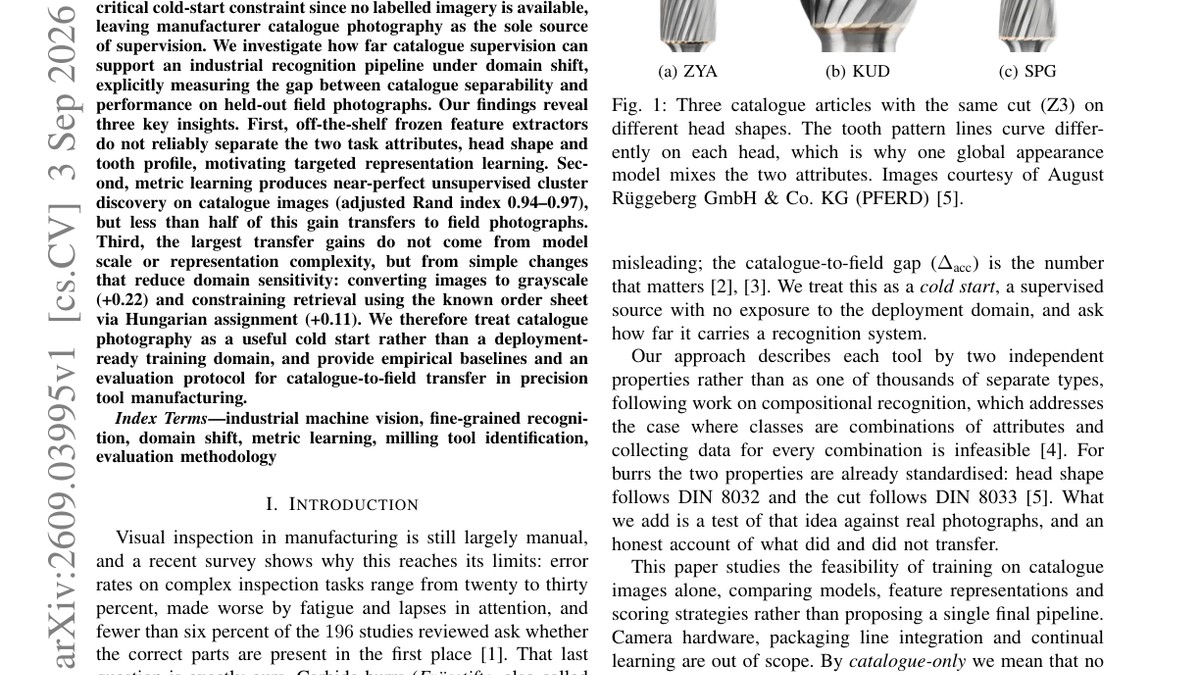
Verifying that manufactured batches of milling tools or carbide rotary burrs conform to production order sheets remains a largely manual and error-prone quality assurance task. Automating this process with computer vision faces a critical cold-start constraint since no labelled imagery is availab...

CrossDepth: Geometry-Constrained Attention for Generalizable Multi-View Surround Depth Estimation
Samer Abualhanud, Max Mehltretter · arXiv preprint · Sep 2026
Reliable 3D understanding of the surrounding environment is a core requirement for autonomous driving. Multi-view surround camera rigs provide broad scene coverage, but the spatially adjacent images typically overlap only minimally. Consequently, the depth of most pixels must be inferred from mon...