
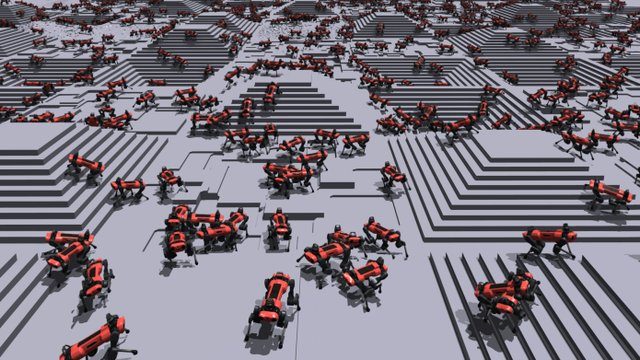
Isaac Gym: High Performance GPU-Based Physics Simulation for Robot Learning
FeaturedViktor Makoviychuk, Lukasz Wawrzyniak, Yunrong Guo, Michelle Lu, Kier Storey, Miles Macklin, David Hoeller, Nikhil Rudin, Arthur Allshire, Ankur Handa, Gavriel State · NVIDIA · 2021
Framework
PyTorch
License
BSD-3-Clause
Stars
2,934
Summary
A GPU-accelerated physics simulation framework that enables thousands of RL environments to run in parallel on a single GPU, eliminating CPU-GPU transfer bottlenecks.
Abstract Summary
Key Points
- End-to-end GPU physics simulation using PhysX, eliminating CPU-GPU transfer bottlenecks.
- Scales to 100,000+ parallel environments on a single GPU.
- Unified tensor API (PyTorch) for observations, actions, and rewards.
- Compatible with PPO, SAC, and other standard RL algorithms.
- Enabled a new generation of large-scale RL benchmarks (Legged Gym, etc.).
Additional Notes
Setup Tips
- Isaac Gym is now superseded by Isaac Sim (Omniverse-based); however Isaac Gym Envs still works standalone.
- Install the NVIDIA-provided PyTorch wheel bundled with Isaac Gym to avoid CUDA version mismatches.
- For large env counts, monitor GPU VRAM; physics bodies and contact meshes are the dominant memory consumers.
Related Papers
- Isaac Sim / Omniverse (NVIDIA, 2022+)
- Legged Gym (Rudin et al., 2022)
- MuJoCo (Todorov et al., 2012)
Related Papers

SafeManip: A Property-Driven Benchmark for Temporal Safety Evaluation in Robotic Manipulation
Chengyue Huang, Khang Vo Huynh, Sebastian Elbaum et al. · arXiv · May 2026
Robotic manipulation is typically evaluated by task success, but successful completion does not guarantee safe execution. Many rl failures are temporal: a robot may touch a clean surface after contamination or release an object before it is...

Berkeley Humanoid: A Low-Cost 3D-Printed Humanoid for Research
Zachary Kousik, Shanpu Fang, Rohan Thakker et al. · arXiv · 2024
An open-source 3D-printed humanoid robot platform designed for reinforcement-learning based locomotion research with affordable hardware.

Humanoid-Gym: Reinforcement Learning for Humanoid Robot with Zero-Shot Sim2Real Transfer
Wang J., Xiao B., Wang J., Heider P., Li H., Zhang Y. · arXiv · 2024
An Isaac-Gym-based training framework for humanoid locomotion that enables zero-shot sim-to-real transfer on XBot-L/XBot-S robots via domain randomization.

Legged Gym: A Framework for Massively Parallel Reinforcement Learning of Legged Locomotion
Nikita Rudin, David Hoeller, Philipp Reist et al. · RSS 2022 Workshop / arXiv 2109.11978 · Jun 2022
Legged Gym is an open-source training framework built on NVIDIA Isaac Gym that enables massively parallel deep RL for legged robot locomotion, achieving policy training times of minutes rather than days.