

Legged Gym: A Framework for Massively Parallel Reinforcement Learning of Legged Locomotion
FeaturedNikita Rudin, David Hoeller, Philipp Reist, Marco Hutter · ETH Zurich, Robotic Systems Lab · 2022
Framework
PyTorch / Isaac Gym
License
Other (NOASSERTION)
Stars
2,971
Summary
Legged Gym is an open-source training framework built on NVIDIA Isaac Gym that enables massively parallel deep RL for legged robot locomotion, achieving policy training times of minutes rather than days.
Abstract Summary
Key Points
- High-level wrapper around Isaac Gym enabling thousands of parallel legged robot environments on a single GPU.
- Built-in terrain curriculum inspired by game design for progressively harder locomotion challenges.
- Pre-configured environments for Unitree A1/Go1, ANYmal, and Cassie with tuned reward functions.
- Training times reduced from days to minutes: flat terrain in under 4 minutes on an RTX 3090.
- Sim-to-real transfer validated on physical ANYmal and A1 robots without extensive domain randomization.
Additional Notes
Training Tips
- Start with the default terrain curriculum; do not flatten terrain until the policy converges on flat ground.
- Reward tuning is critical for emergent gait styles; small changes in velocity tracking weight yield dramatically different behaviors.
- For sim-to-real transfer, add joint angle and motor model domain randomization in the final training stages.
Related Papers
- RSL-RL (Rudin & Hoeller, open-source library)
- Isaac Gym (Makoviychuk et al., 2021)
- DribbleBot (Ji et al., 2023)
Related Papers
RSL-RL: A Fast and Flexible Reinforcement Learning Library for Legged Robots
Nikita Rudin, David Hoeller, Marco Hutter · Open Source Library · Jun 2022
RSL-RL is a lightweight, high-performance PyTorch library implementing PPO tailored for locomotion. Used as the default RL backend in Legged Gym, it enables training thousands of agents in parallel on GPU.
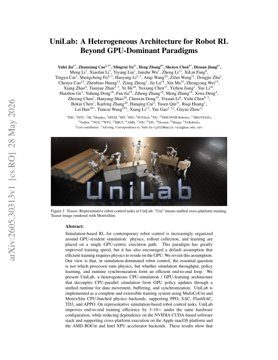
A Heterogeneous Architecture for Robot RL Beyond GPU-Dominant Paradigms
Yufei Jia, Zhanxiang Cao, Mingrui Yu et al. · arXiv preprint · May 2026
Simulation-based RL for contemporary robot control is increasingly organized around GPU-resident simulation: physics, rollout collection, and learning are placed on a single GPU-centric execution path

SafeManip: A Property-Driven Benchmark for Temporal Safety Evaluation in Robotic Manipulation
Chengyue Huang, Khang Vo Huynh, Sebastian Elbaum et al. · arXiv · May 2026
Robotic manipulation is typically evaluated by task success, but successful completion does not guarantee safe execution. Many rl failures are temporal: a robot may touch a clean surface after contamination or release an object before it is...

Berkeley Humanoid: A Low-Cost 3D-Printed Humanoid for Research
Zachary Kousik, Shanpu Fang, Rohan Thakker et al. · arXiv · 2024
An open-source 3D-printed humanoid robot platform designed for reinforcement-learning based locomotion research with affordable hardware.