
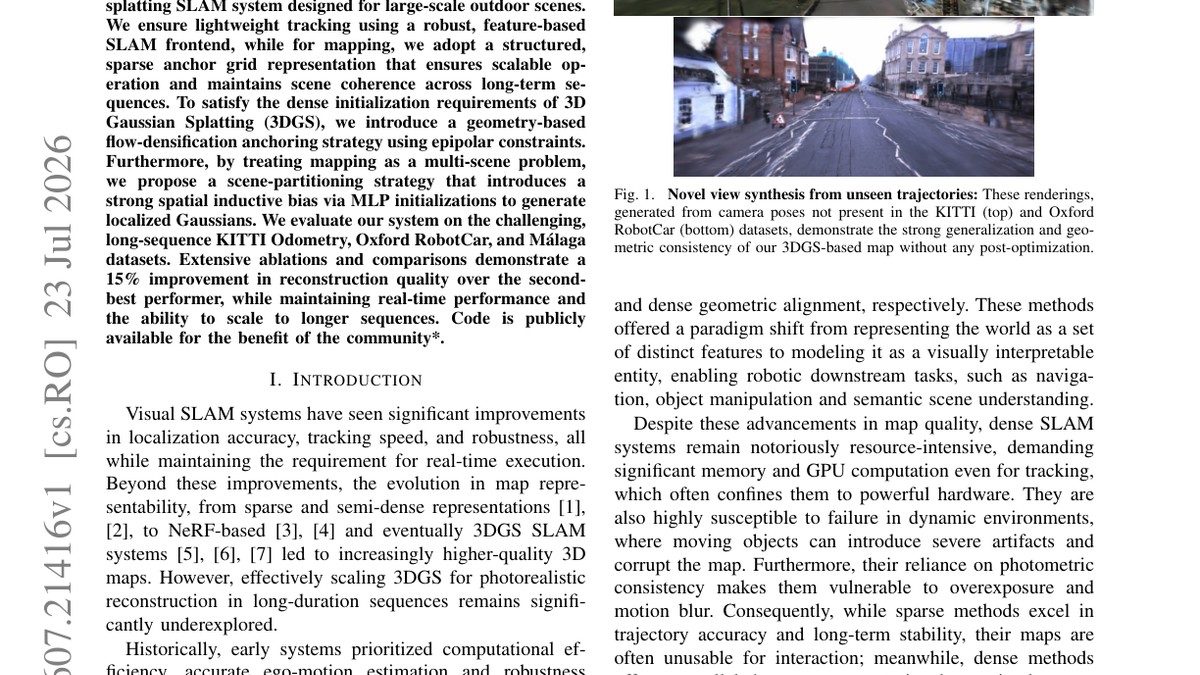
GLAM-SLAM: Real-time Gaussian Large-scale Mapping via Flow Densification and Spatial Decomposition
Panagiotis Mermigkas, Argyris Manetas, Petros Maragos · N/A · 2026
Framework
N/A
License
N/A
Stars
N/A
Summary
Existing Gaussian-splatting-based monocular Simultaneous Localization and Mapping (SLAM) systems are either tailored to short sequences, are not real-time, or suffer from prohibitive GPU memory requirements, limiting their applicability in realistic, long-horizon scenarios. To address this, we pr...
Abstract Summary
Key Points
- Existing Gaussian-splatting-based monocular Simultaneous Localization and Mapping (SLAM) systems ...
- To address this, we present GLAM-SLAM, a real-time, decoupled Gaussian-splatting SLAM system desi...
- We ensure lightweight tracking using a robust, feature-based SLAM frontend, while for mapping, we...
- To satisfy the dense initialization requirements of 3D Gaussian Splatting (3DGS), we introduce a ...
- Furthermore, by treating mapping as a multi-scene problem, we propose a scene-partitioning strate...
GLAM-SLAM: Real-time Gaussian Large-scale Mapping via Flow Densification and Spatial Decomposition
|Authors: Panagiotis Mermigkas, Argyris Manetas, Petros Maragos
|Venue: arXiv preprint | Year: 2026
|arXiv: 2607.21416v1
Abstract
Existing Gaussian-splatting-based monocular Simultaneous Localization and Mapping (SLAM) systems are either tailored to short sequences, are not real-time, or suffer from prohibitive GPU memory requirements, limiting their applicability in realistic, long-horizon scenarios. To address this, we present GLAM-SLAM, a real-time, decoupled Gaussian-splatting SLAM system designed for large-scale outdoor scenes. We ensure lightweight tracking using a robust, feature-based SLAM frontend, while for mapping, we adopt a structured, sparse anchor grid representation that ensures scalable operation and maintains scene coherence across long-term sequences. To satisfy the dense initialization requirements of 3D Gaussian Splatting (3DGS), we introduce a geometry-based flow-densification anchoring strategy using epipolar constraints. Furthermore, by treating mapping as a multi-scene problem, we propose a scene-partitioning strategy that introduces a strong spatial inductive bias via MLP initializations to generate localized Gaussians. We evaluate our system on the challenging, long-sequence KITTI Odometry, Oxford RobotCar, and M’alaga datasets. Extensive ablations and comparisons demonstrate a 15% improvement in reconstruction quality over the second-best performer, while maintaining real-time performance and the ability to scale to longer sequences. Code is publicly available for the benefit of the community.
Key Contributions
- Existing Gaussian-splatting-based monocular Simultaneous Localization and Mapping (SLAM) systems …
- To address this, we present GLAM-SLAM, a real-time, decoupled Gaussian-splatting SLAM system desi…
- We ensure lightweight tracking using a robust, feature-based SLAM frontend, while for mapping, we…
- To satisfy the dense initialization requirements of 3D Gaussian Splatting (3DGS), we introduce a …
- Furthermore, by treating mapping as a multi-scene problem, we propose a scene-partitioning strate…
Topics
- planning
- benchmark
Code & Data
- GitHub repository: https://github.com/pmermigkas/GLAM-SLAM
BibTeX
@article{Mermigkas2026_260721416v1,
  title     = {GLAM-SLAM: Real-time Gaussian Large-scale Mapping via Flow Densification and Spatial Decomposition},
  author    = {Panagiotis Mermigkas and Argyris Manetas and Petros Maragos},
  year      = {2026},
  eprint    = {2607.21416v1},
  archivePrefix = {arXiv},
  primaryClass  = {cs.RO},
  url       = {https://arxiv.org/abs/2607.21416v1}
}
Related Papers
A Browser-Native Digital Test Range for Benchmarking 4D Ocean-Glider Planning Algorithms
Edward Holmberg, Elias Ioup, Mahdi Abdelguerfi · arXiv preprint · Aug 2026
Repeated in-situ evaluation of ocean-glider planners requires scarce vehicles, operators, deployment and recovery resources, and ocean conditions that cannot be reset for competing algorithms. We present a guided, installation-free browser-native digital test range that transforms a selected regi...
Beyond Episodic Evaluation: Memory Architectural Bottlenecks in Sequential Embodied Question Answering
Zikui Cai, Kaushal Janga, Tan Dat Dao et al. · arXiv preprint · Jul 2026
Embodied question answering (EQA) is traditionally evaluated under an episodic formulation, where agents solve each task independently and reset internal state between episodes. However, real-world robots operate continuously and must accumulate, retain, and selectively reuse information acquired...
Compact Latent Coordination for Autonomous Vehicles at Unsignalized Intersections
Gil Lifshits, Igal Bilik, Gilad Katz · arXiv preprint · Jul 2026
Coordinating autonomous vehicles at unsignalized intersections remains a critical challenge for multi-agent reinforcement learning (MARL) systems, which typically struggle with combinatorial action spaces, reliance on privileged information, or rigid agent designs. We propose Master-Agent Proto-p...
Continuous Actions from Discrete Minds: Latent-Aligned Planning for End-to-End Autonomous Driving
Ruoyu Yao, Yusen Xie, Qingzhao Liu et al. · arXiv preprint · Sep 2026
Bridging the gap between the discrete reasoning of Vision-Language Models and the continuous, physics-constrained nature of autonomous driving remains a significant challenge. In this work, we introduce LaPla, a unified Vision-Language-Action (VLA) framework featuring latent-aligned planning to s...