
At a glance
- The force-guided module infers contact-related latents from onboard signals without external force sensors. Source
- The policy transfers zero-shot to a physical Unitree G1 under a 30 kg payload. Source
- Route evaluation measures cross-track error, heading error, completion time, and success rate. Source
Evaluation scope ForPC is a two-stage whole-body controller for a humanoid pushing a wheeled cart through bimanual contact. Source
How it works
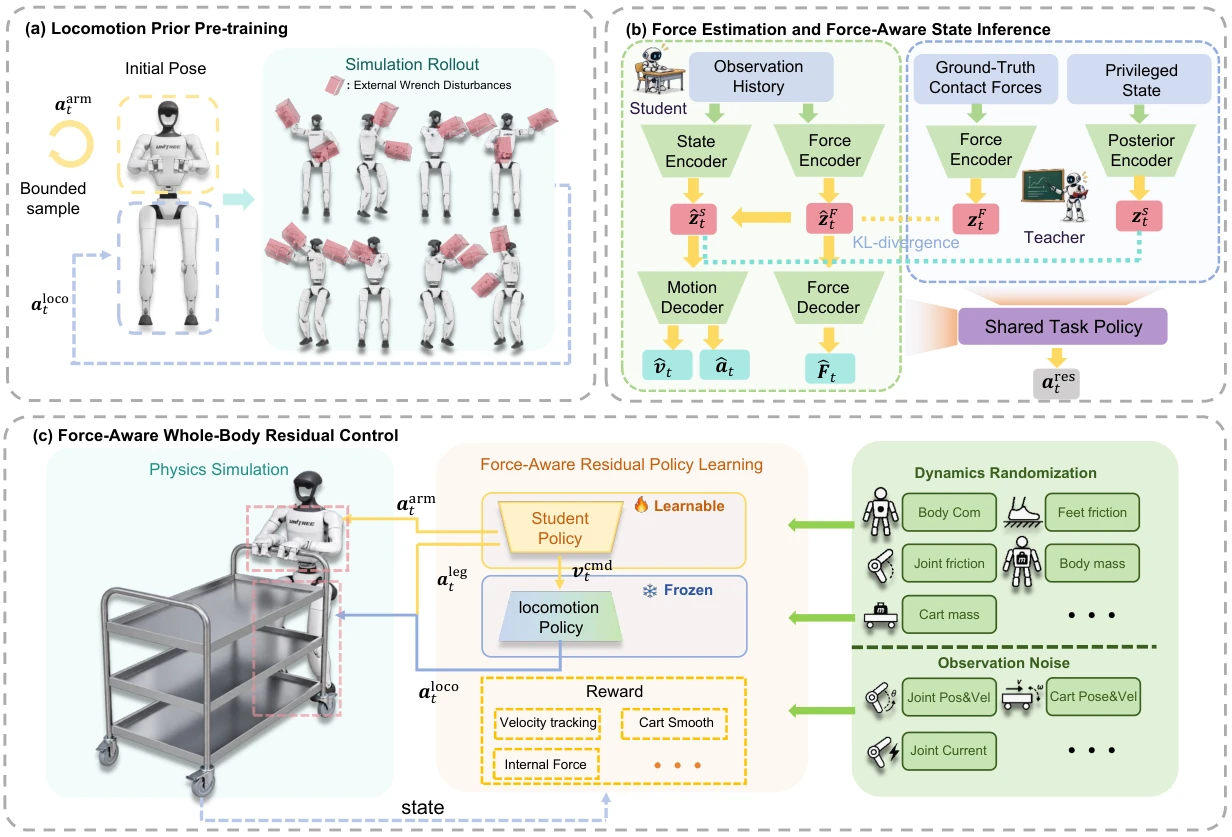
- Stage I pretrains a locomotion prior under randomized external hand disturbances and bounded posture offsets, then freezes it. Source
- A teacher-student architecture uses privileged simulation forces during training while the student reconstructs force and motion latents from observation history. Source
- The task policy uses the inferred latents to coordinate base-velocity adjustments and bounded joint residuals for cart-motion regulation. Source
Evidence & results
- In simulation, ForPC achieves the lowest tracking error across the reported simulator, payload, and motion combinations, reducing RMSE by up to 68.2% relative to Loco-only. Evidence
- For route tracking, ForPC reduces cross-track RMSE by up to 74.2%, heading RMSE by up to 76.7%, and succeeds in every reported trial at both payloads. Evidence
- Route success is measured over 640 trials per configuration and payload; losing balance or hand contact, or missing the target pose within the time limit, counts as failure. Evidence
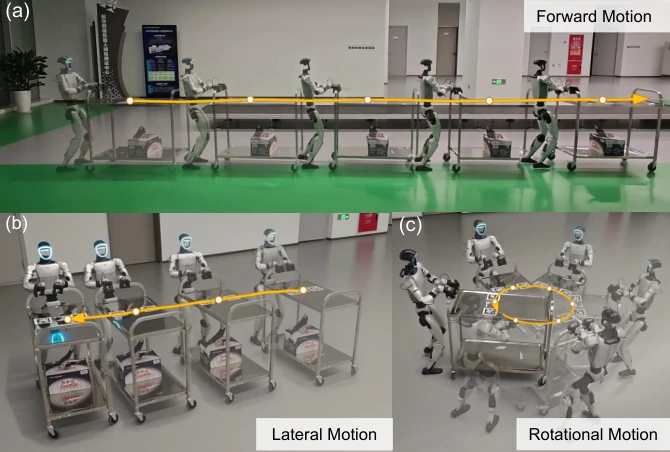
- On hardware, the simulation-trained policy performs forward, lateral, and rotational pushing without real-world fine-tuning and transports up to 30 kg at 0.5 m/s. Evidence
Limitations & boundaries
- The hardware deployment is demonstrated on a physical Unitree G1 in a flat indoor setting, so the reported transfer does not establish performance across other humanoid platforms or broader terrain conditions. Source
Takeaway
ForPC combines a disturbance-trained locomotion prior with force-guided latent estimation and residual whole-body control. Source
Resources
Figures: the paper's authors. Editorial source and image review: 2026-11-12. Findings are author-reported, not independently reproduced by Robotics Research Hub.
Original abstract
Humanoid robots are expected to take over strenuous material handling in manufacturing, logistics, and healthcare, where operating existing wheeled carts would let them move heavy loads without modifying the workplace. However, humanoid cart pushing remains challenging because the bimanual grasp closes a force-coupled loop in which the contact wrenches that drive the cart also disturb the robot's balance, and payload changes alter the coupled dynamics. We propose ForPC, a force-aware whole-body control framework that regulates cart velocity through two-stage reinforcement learning. A locomotion prior is first trained under varied hand loads and upper-body postures to provide balance support. A force latent and a state latent are then inferred from onboard observations, without external force sensors, and fed to a residual policy that coordinates bounded arm, waist, and leg adjustments with base-velocity commands. Multi-objective rewards penalize bimanual internal opposition, grasp slip, and actuator saturation, encouraging the policy to apply contact force on demand without human demonstrations. Sim-to-sim experiments show that ForPC reduces cart-velocity RMSE by up to 68.2% relative to a locomotion-only baseline (Loco-only) and cross-track RMSE by up to 74.2% on the multi-bend route. Trained solely in simulation, the policy also transfers to a physical Unitree G1 without real-world training or fine-tuning and, with no payload-specific adjustment, pushes a cart carrying up to 30 kg at 0.5 m/s. These results suggest that humanoid robots could eventually replace humans for efficient material handling in daily life.
Citation
@article{Zou2026_261108664,
  title     = {ForPC: Force-Aware Whole-Body Control for Precise Humanoid Cart Pushing},
  author    = {ZhenYu Zou and Xing Liu and ShiChuang Wang and YunLong Dong and LiNan Deng and Feng Hua and Jun Wan and Cheng Cheng},
  year      = {2026},
  eprint    = {2611.08664},
  archivePrefix = {arXiv},
  primaryClass  = {cs.RO},
  url       = {https://arxiv.org/abs/2611.08664}
}