
Expected Free Energy-based Informative Path Planning for Robotic Mars Exploration
Ajith Anil Meera, Pablo Lanillos, Wouter Kouw · N/A · 2026
Framework
N/A
License
N/A
Stars
N/A
Summary
An autonomous robot efficiently exploring an unknown environment, such as looking for water sources on Mars, faces two simultaneous demands: building an accurate information map while quickly finding the regions of greatest value, and paying for every meter of travel and the cost of every measure...
Abstract Summary
Key Points
- An autonomous robot efficiently exploring an unknown environment, such as looking for water sourc...
- Classical information-seeking and reward-seeking criteria address only one of these objectives at...
- Here, we propose Expected Free Energy (EFE), the principled action-selection objective from activ...
- Maintaining a Gaussian-process belief over the information field, our agent plans continuous traj...
- The results from multiple realizations show that EFE-based planning yields accurate posterior map...
Expected Free Energy-based Informative Path Planning for Robotic Mars Exploration
|Authors: Ajith Anil Meera, Pablo Lanillos, Wouter Kouw
|Venue: arXiv preprint | Year: 2026
|arXiv: 2608.14466v1
Abstract
An autonomous robot efficiently exploring an unknown environment, such as looking for water sources on Mars, faces two simultaneous demands: building an accurate information map while quickly finding the regions of greatest value, and paying for every meter of travel and the cost of every measurement it takes. Classical information-seeking and reward-seeking criteria address only one of these objectives at a time. Here, we propose Expected Free Energy (EFE), the principled action-selection objective from active inference, as a unifying criterion for budgeted robotic informative path planning. Maintaining a Gaussian-process belief over the information field, our agent plans continuous trajectories that minimize expected free energy under hard path-length constraints. The results from multiple realizations show that EFE-based planning yields accurate posterior maps and locates the highest-value regions simultaneously, outperforming information-theoretic baselines under the same settings. In robotic exploration, these unified, easy-to-tune principled information-gathering strategies facilitate autonomous deployment while enforcing efficiency and resource constraints.
Key Contributions
- An autonomous robot efficiently exploring an unknown environment, such as looking for water sourc…
- Classical information-seeking and reward-seeking criteria address only one of these objectives at…
- Here, we propose Expected Free Energy (EFE), the principled action-selection objective from activ…
- Maintaining a Gaussian-process belief over the information field, our agent plans continuous traj…
- The results from multiple realizations show that EFE-based planning yields accurate posterior map…
Topics
- planning
Code & Data
No code repository linked in paper metadata.
BibTeX
@article{Meera2026_260814466v1,
  title     = {Expected Free Energy-based Informative Path Planning for Robotic Mars Exploration},
  author    = {Ajith Anil Meera and Pablo Lanillos and Wouter Kouw},
  year      = {2026},
  eprint    = {2608.14466v1},
  archivePrefix = {arXiv},
  primaryClass  = {cs.RO},
  url       = {https://arxiv.org/abs/2608.14466v1}
}
Related Papers
A Browser-Native Digital Test Range for Benchmarking 4D Ocean-Glider Planning Algorithms
Edward Holmberg, Elias Ioup, Mahdi Abdelguerfi · arXiv preprint · Aug 2026
Repeated in-situ evaluation of ocean-glider planners requires scarce vehicles, operators, deployment and recovery resources, and ocean conditions that cannot be reset for competing algorithms. We present a guided, installation-free browser-native digital test range that transforms a selected regi...
A Low-Cost, Open Platform for End-to-End Autonomous Driving on a Miniature Ackermann Vehicle
Gustavo Claudio Karl Couto, Eric Aislan Antonelo, Gabriel George Zipperer · arXiv preprint · Sep 2026
This paper presents a low-cost, open experimental platform for research in end-to-end autonomous driving with miniature Ackermann vehicles. The platform combines a physical vehicle, a printed urban track, data collection tools, trajectory registration, and a Webots digital twin, enabling controll...
Adaptation Needs in Robotic Systems: Assessing Behavior Trees and Their Enhancement
Mehran Rostamnia, Gianluca Filippone, Ricardo Caldas et al. · arXiv preprint · Sep 2026
Robotic systems increasingly operate in dynamic, uncertain, and open-ended environments, where design-time assumptions may no longer hold, and adaptation becomes necessary to maintain effective and safe operation. Behavior Trees (BTs) are widely used in robotic control architectures due to their ...
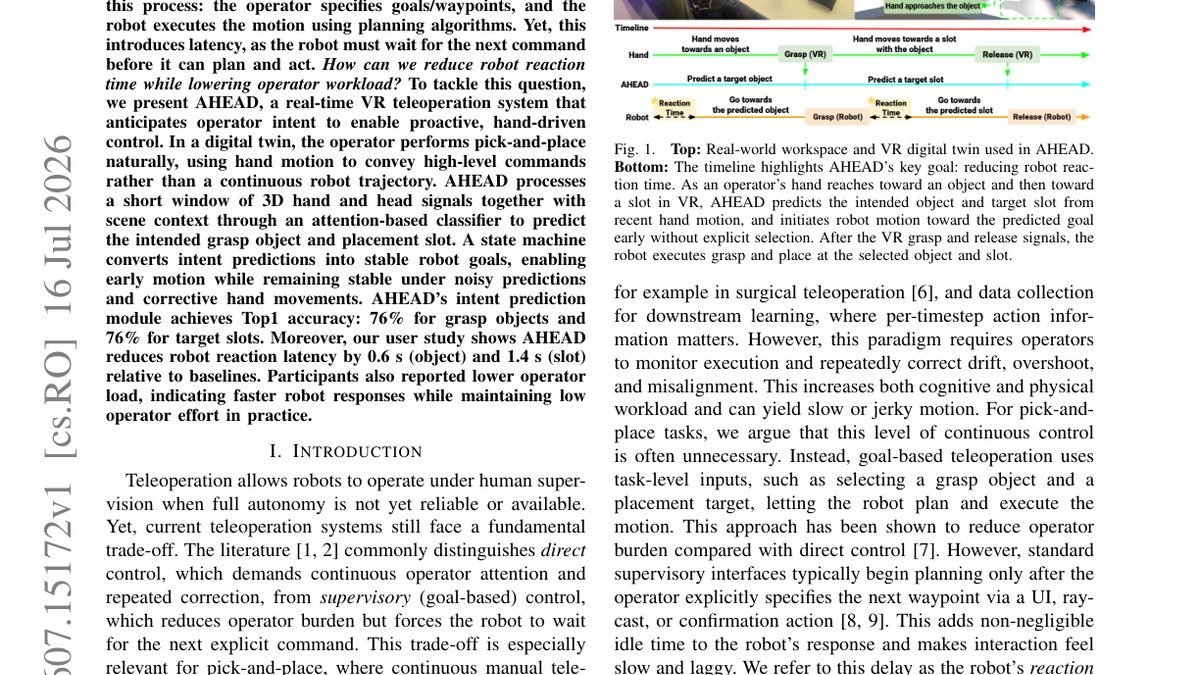
AHEAD: Anticipatory Hand-Driven Teleoperation via Human Intent Prediction
Seok Joon Kim, Junho Lee, Federica Spinola et al. · arXiv preprint · Jul 2026
Direct hand-driven teleoperation maps an operator's hand motion to robot end-effector commands at every frame, enabling precise control, but it requires constant monitoring and correction during approach, grasp, and placement, which can be slow and fatiguing. For repetitive pick-and-place tasks, ...