
Eureka: Human-Level Reward Design via Coding Large Language Models
Yecheng Jason Ma, William Liang, Guanzhi Wang, De-An Huang, Osbert Bastani, Dinesh Jayaraman, Yuke Zhu, Linxi Fan, Anima Anandkumar · NVIDIA, UT Austin, Caltech · 2024
Framework
PyTorch + IsaacGym
License
Apache-2.0
Stars
3,161
Summary
Eureka uses GPT-4 to write reward functions for RL environments, achieving human-level reward design on 29 tasks and enabling zero-shot sim-to-real transfer on Shadow Hand dexterous manipulation.
Abstract Summary
Key Points
- GPT-4 writes and iteratively refines RL reward functions.
- Outperforms human rewards on 83% of 29 tasks across 10 robot types.
- Zero-shot sim-to-real transfer to Shadow Hand dexterous manipulation.
- Evolutionary selection: generate → train → select → iterate.
- Open-source with IsaacGym integration and 29 benchmark tasks.
Related Papers

Gymnasium: A Standard Interface for Reinforcement Learning Environments
Farama Foundation, Jordan Terry, Mark Towers et al. · JMLR 2023 · Mar 2023
Gymnasium is the maintained successor to OpenAI Gym, providing a standardized API for RL environments with 100+ built-in tasks, vectorized parallel execution, and native support for physics engines like MuJoCo, PyBullet, and IsaacGym.
ManiSkill: A Unified Benchmark for Generalizable Manipulation Skills
Jiayuan Gu, Sean Xiang, Stone Tao et al. · ICLR 2023 (Oral) · Jan 2023
ManiSkill is a GPU-parallelized robotics simulation benchmark with 20+ manipulation tasks, PartNet-Mobility assets, and unified observation/action spaces, supporting RL, IL, and VLA training at millions of steps per hour.
iGibson: Interactive Gibson Benchmark for Real-World Navigation and Manipulation
Bokui Shen, Fei Xia, Chengshu Li et al. · ICRA 2021 · May 2021
iGibson is a photorealistic, physics-based indoor simulation platform with 15 interactive scenes, 500+ object categories, and GPU-accelerated rendering, enabling RL and VLA training for mobile manipulation and embodied AI.
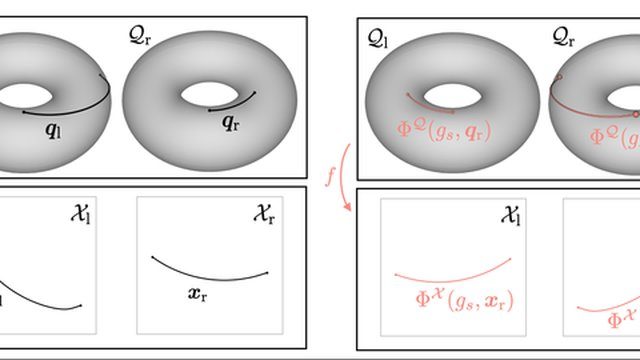
Symmetries Here and There, Combined Everywhere: Cross-space Symmetry Compositions in Robotics
Loizos Hadjiloizou, Rodrigo Pérez-Dattari, Noémie Jaquier · arXiv preprint · May 2026
Formalizes cross-space symmetry compositions in robotics and derives equivariant network architectures that exploit multiple simultaneous symmetries for improved generalization.