
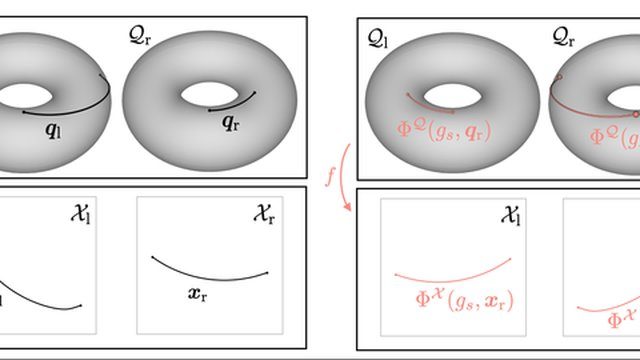
Symmetries Here and There, Combined Everywhere: Cross-space Symmetry Compositions in Robotics
Loizos Hadjiloizou, Rodrigo Pérez-Dattari, Noémie Jaquier · German Aerospace Center (DLR), KTH Royal Institute of Technology · 2026
Summary
Formalizes cross-space symmetry compositions in robotics and derives equivariant network architectures that exploit multiple simultaneous symmetries for improved generalization.
Abstract Summary
Key Points
- Formalizes cross-space symmetry compositions in robotics.
- Derives equivariant architectures respecting multiple simultaneous symmetries.
- Proves improved generalization across robot morphologies and task geometries.
- Evaluated on manipulation and locomotion benchmarks.
- Achieves over 20% better zero-shot transfer on unseen morphologies.
Additional Notes
Overview
- Paper (PDF): 2605.22639
- arXiv: 2605.22639
Related Papers
- E(3)-Equivariant Graph Neural Networks for Data-Efficient Dynamics
- Eureka: Neural Network Synthesis via LLMs
- Geometric Deep Learning: Grids, Groups, Graphs, Geodesics, and Gauges
Related Papers

LeRobot: A Library for Real-World Robot Learning
Remi Cadene, Simon Alibert, Alexander Soare et al. · NeurIPS 2024 Workshop · Jun 2024
Hugging Face's LeRobot is an open-source PyTorch framework providing pretrained models, datasets, and training scripts for imitation and reinforcement learning on real robots, lowering the entry barrier to robot learning.
ManiSkill: A Unified Benchmark for Generalizable Manipulation Skills
Jiayuan Gu, Sean Xiang, Stone Tao et al. · ICLR 2023 (Oral) · Jan 2023
ManiSkill is a GPU-parallelized robotics simulation benchmark with 20+ manipulation tasks, PartNet-Mobility assets, and unified observation/action spaces, supporting RL, IL, and VLA training at millions of steps per hour.
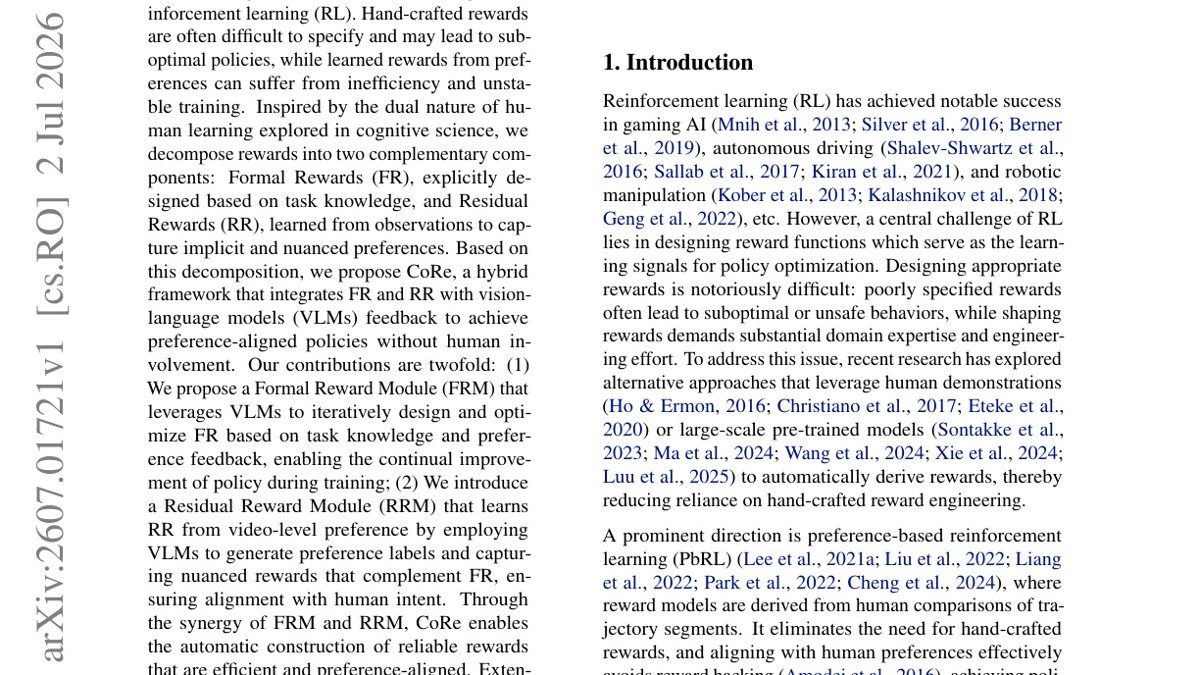
CoRe: Combined Rewards with Vision-Language Model Feedback for Preference-Aligned Reinforcement Learning
Hexian Ni, Tao Lu, Yinghao Cai · ICML 2026 · Jul 2026
Reward design remains a central challenge in reinforcement learning (RL). Hand-crafted rewards are often difficult to specify and may lead to suboptimal policies, while learned rew...
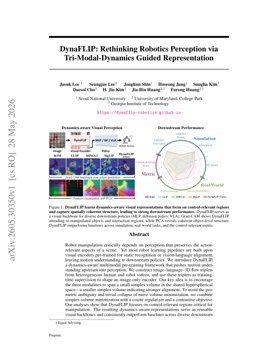
DynaFLIP: Rethinking Robotics Perception via Tri-Modal-Dynamics Guided Representation
Jusuk Lee, Seungjae Lee, Jonghun Shin et al. · arXiv preprint · May 2026
Robot manipulation critically depends on perception that preserves the action-relevant aspects of a scene. Yet most robot learning pipelines are built upon visual encoders pre-trained for static recog