
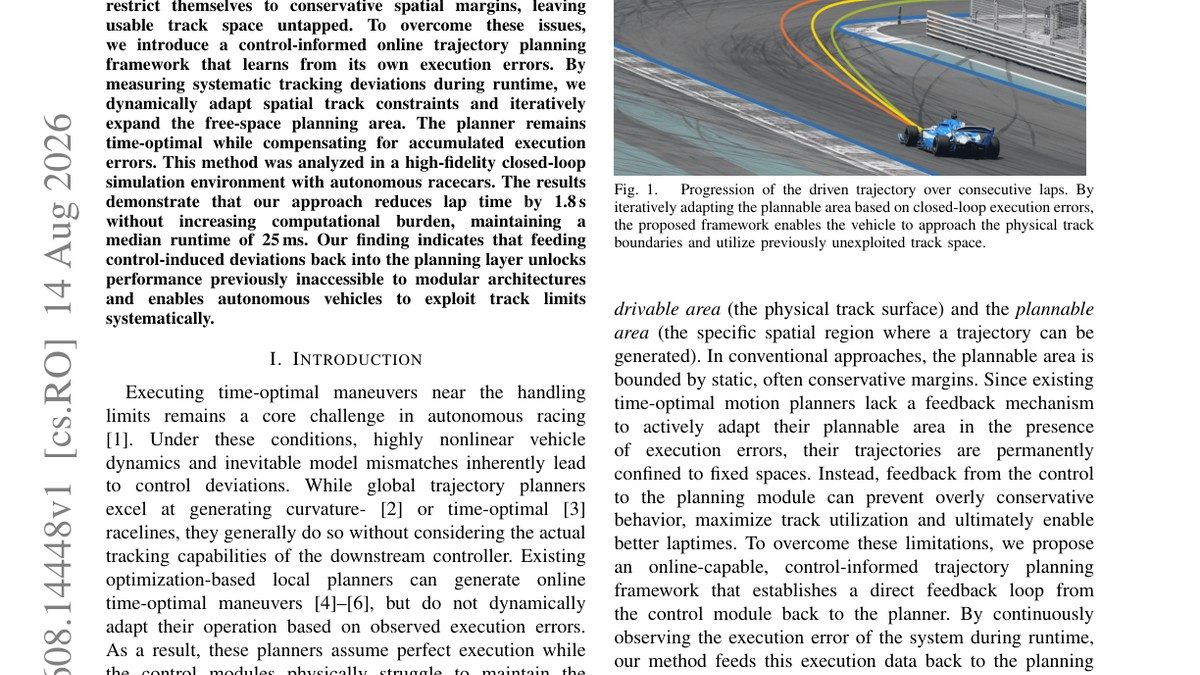
Control-Informed Constraint Adaptation in Minimum-Time Trajectory Planning for Autonomous Racing
Ann-Kathrin Schwehn, Alexander Langmann, Mattia Piccinini, Johannes Betz · N/A · 2026
Framework
N/A
License
N/A
Stars
N/A
Summary
Autonomous racecars operate at the limits of vehicle dynamics, where small control errors translate into safety-critical behavior and lost performance. Trajectory planners assume perfect tracking and remain blind to execution errors. To guarantee safety, trajectory planners therefore restrict the...
Abstract Summary
Key Points
- Autonomous racecars operate at the limits of vehicle dynamics, where small control errors transla...
- Trajectory planners assume perfect tracking and remain blind to execution errors
- To guarantee safety, trajectory planners therefore restrict themselves to conservative spatial ma...
- To overcome these issues, we introduce a control-informed online trajectory planning framework th...
- By measuring systematic tracking deviations during runtime, we dynamically adapt spatial track co...
Control-Informed Constraint Adaptation in Minimum-Time Trajectory Planning for Autonomous Racing
|Authors: Ann-Kathrin Schwehn, Alexander Langmann, Mattia Piccinini, Johannes Betz
|Venue: arXiv preprint | Year: 2026
|arXiv: 2608.14448v1
Abstract
Autonomous racecars operate at the limits of vehicle dynamics, where small control errors translate into safety-critical behavior and lost performance. Trajectory planners assume perfect tracking and remain blind to execution errors. To guarantee safety, trajectory planners therefore restrict themselves to conservative spatial margins, leaving usable track space untapped. To overcome these issues, we introduce a control-informed online trajectory planning framework that learns from its own execution errors. By measuring systematic tracking deviations during runtime, we dynamically adapt spatial track constraints and iteratively expand the free-space planning area. The planner remains time-optimal while compensating for accumulated execution errors. This method was analyzed in a high-fidelity closed-loop simulation environment with autonomous racecars. The results demonstrate that our approach reduces lap time by 1.8,s without increasing computational burden, maintaining a median runtime of 25 ms. Our finding indicates that feeding control-induced deviations back into the planning layer unlocks performance previously inaccessible to modular architectures and enables autonomous vehicles to exploit track limits systematically.
Key Contributions
- Autonomous racecars operate at the limits of vehicle dynamics, where small control errors transla…
- Trajectory planners assume perfect tracking and remain blind to execution errors
- To guarantee safety, trajectory planners therefore restrict themselves to conservative spatial ma…
- To overcome these issues, we introduce a control-informed online trajectory planning framework th…
- By measuring systematic tracking deviations during runtime, we dynamically adapt spatial track co…
Topics
- planning
- control
Code & Data
No code repository linked in paper metadata.
BibTeX
@article{Schwehn2026_260814448v1,
  title     = {Control-Informed Constraint Adaptation in Minimum-Time Trajectory Planning for Autonomous Racing},
  author    = {Ann-Kathrin Schwehn and Alexander Langmann and Mattia Piccinini and Johannes Betz},
  year      = {2026},
  eprint    = {2608.14448v1},
  archivePrefix = {arXiv},
  primaryClass  = {cs.RO},
  url       = {https://arxiv.org/abs/2608.14448v1}
}
Related Papers
A Browser-Native Digital Test Range for Benchmarking 4D Ocean-Glider Planning Algorithms
Edward Holmberg, Elias Ioup, Mahdi Abdelguerfi · arXiv preprint · Aug 2026
Repeated in-situ evaluation of ocean-glider planners requires scarce vehicles, operators, deployment and recovery resources, and ocean conditions that cannot be reset for competing algorithms. We present a guided, installation-free browser-native digital test range that transforms a selected regi...
A Low-Cost, Open Platform for End-to-End Autonomous Driving on a Miniature Ackermann Vehicle
Gustavo Claudio Karl Couto, Eric Aislan Antonelo, Gabriel George Zipperer · arXiv preprint · Sep 2026
This paper presents a low-cost, open experimental platform for research in end-to-end autonomous driving with miniature Ackermann vehicles. The platform combines a physical vehicle, a printed urban track, data collection tools, trajectory registration, and a Webots digital twin, enabling controll...
Adaptation Needs in Robotic Systems: Assessing Behavior Trees and Their Enhancement
Mehran Rostamnia, Gianluca Filippone, Ricardo Caldas et al. · arXiv preprint · Sep 2026
Robotic systems increasingly operate in dynamic, uncertain, and open-ended environments, where design-time assumptions may no longer hold, and adaptation becomes necessary to maintain effective and safe operation. Behavior Trees (BTs) are widely used in robotic control architectures due to their ...
AHEAD: Anticipatory Hand-Driven Teleoperation via Human Intent Prediction
Seok Joon Kim, Junho Lee, Federica Spinola et al. · arXiv preprint · Jul 2026
Direct hand-driven teleoperation maps an operator's hand motion to robot end-effector commands at every frame, enabling precise control, but it requires constant monitoring and correction during approach, grasp, and placement, which can be slow and fatiguing. For repetitive pick-and-place tasks, ...