BORA: Bridging Offline Reinforcement Learning and Online Residual Adaptation for Real-World Dexterous VLA Models

BORA: Bridging Offline Reinforcement Learning and Online Residual Adaptation for Real-World Dexterous VLA Models

Featured

Zhongxi Chen, Yifan Han, Yanming Shao, Huanming Liu, Congsheng Xu, Xiaoyu Chen · · 2026

Framework

N/A

License

N/A

Stars

0

Summary

Vision-Language-Action (VLA) models have emerged as a promising paradigm for grounding visual-language understanding into real-world robotic manipulation. However, dexterous manipulation remains chall

Abstract Summary

Vision-Language-Action (VLA) models have emerged as a promising paradigm for grounding visual-language understanding into real-world robotic manipulation. However, dexterous manipulation remains challenging for VLA policies due to high-dimensional hand control and compounding execution errors, which makes real-world RL post-training essential for bridging the gap between visually grounded action generation and physically reliable dexterous execution. However, high-dimensional dexterous exploration often triggers temporal inconsistency, sample inefficiency and hardware risks in the real world. To address these challenges, we propose BORA, an offline-to-online RL post-training framework designed for real-world dexterous VLA models. In the offline phase, BORA constructs a critic that takes both the VLM's cognition tokens and action chunks as inputs. This design enables action-conditioned value guidance, allowing the critic to evaluate dexterous hand motions beyond visual context alone. During the subsequent online phase, BORA freezes the VLA base and introduces a lightweight, Human-in-the-Loop (HiL) chunk-wise residual adaptation mechanism to mitigate real-world execution errors and further correct the offline-learned intents within the actual physical environment. By inheriting the offline critic and employing intervention-driven rewards, BORA effectively corrects execution discrepancies and adapts to real-world physical variances while preserving the pretrained policy as a stable prior. Extensive evaluations across five complex real-world dexterous tasks demonstrate that BORA significantly outperforms pure imitation learning and traditional decoupled RL baselines, achieving a 33% absolute increase in average success rate under standard settings and up to a 43% improvement in unseen object generalization.

Key Points

  • Offline-to-online RL framework for dexterous VLA models.
  • Critic takes VLM cognition tokens + action chunks for value guidance.
  • Human-in-the-Loop chunk-wise residual adaptation for real-world correction.
  • Achieves 33% absolute increase in success rate on dexterous tasks.
  • 43% improvement in unseen object generalization over decoupled baselines.
Share

Related Papers

3DThinkVLA: Endowing Vision-Language-Action Models with Latent 3D Priors via 3D-Thinking-Guided Co-training

3DThinkVLA: Endowing Vision-Language-Action Models with Latent 3D Priors via 3D-Thinking-Guided Co-training

Jiaxin Shi, Xidong Zhang, Fucai Zhu et al. · arXiv preprint · Jun 2026

We propose a 3D-thinking-guided co-training framework that enables vision-language-action (VLA) models to perform 3D spatial reasoning implicitly during action prediction. Our core insight is that 3D geometry perception and 3D spatial reasoning are distinct capabilities that can be disentangled and ...
sim-to-real reinforcement-learning vision vla manipulation
PDF Advanced
No code repo Jun 2026
Decoding Task Progress from VLA Representations

Decoding Task Progress from VLA Representations

Atiksh Bhardwaj, Edward Weiyi Duan, Prithwish Dan et al. · arXiv preprint · Aug 2026

Vision-language-action models (VLAs) are moving rapidly towards deployment as general-purpose manipulation policies, but we currently lack basic tools for understanding what these models represent internally or for monitoring them at runtime. Leveraging ideas from mechanistic interpretability, we...
manipulation vision vla reinforcement-learning control
PDF Intermediate
No code repo Aug 2026
Development of a Humanoid Robot Prototype for Multimodal Human-Robot Interaction

Development of a Humanoid Robot Prototype for Multimodal Human-Robot Interaction

Thang Tran Viet, Thanh Nguyen Canh, Huy Uong Gia et al. · arXiv preprint · Sep 2026

Human-robot interaction (HRI) enables intuitive and intelligent collaboration between humans and robots in real-world environments. This paper introduces a humanoid robot prototype designed as a flexible testbed for developing and integrating artificial intelligence (AI) modules in HRI tasks. The...
manipulation vision vla reinforcement-learning control human-robot-interaction
Code PDF Intermediate
GitHub ★ — Sep 2026
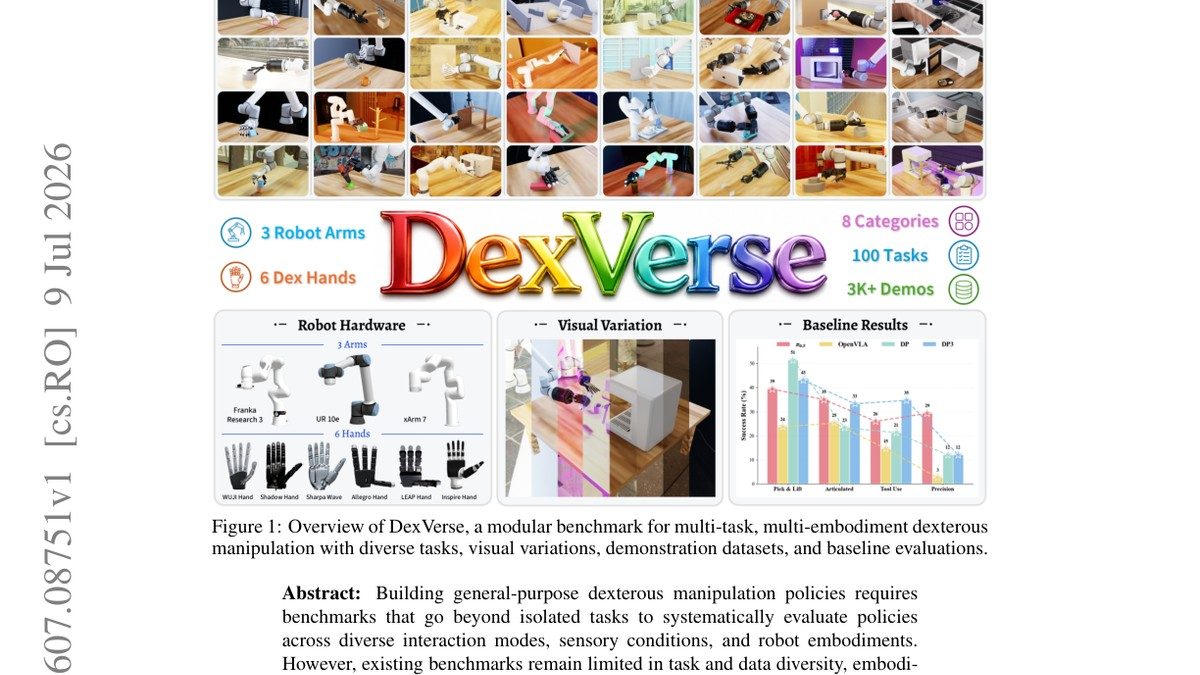
DexVerse: A Modular Benchmark for Multi-Task, Multi-Embodiment Dexterous Manipulation

DexVerse: A Modular Benchmark for Multi-Task, Multi-Embodiment Dexterous Manipulation

Yunchao Yao, Zhuxiu Xu, Tianqi Zhang et al. · arXiv preprint · Jul 2026

Building general-purpose dexterous manipulation policies requires benchmarks that go beyond isolated tasks to systematically evaluate policies across diverse interaction modes, sensory conditions, and robot embodiments. However, existing benchmarks remain limited in task and data diversity, embod...

manipulation vision vla reinforcement-learning control learning-from-demonstration benchmark
PDF Advanced
No code repo Jul 2026