
Aim Short to Reach Far: Your Frozen World Model Can Plan Better Than You Think
Xvyuan Liu, Jianjie Fang, Chen Gao, Yong Li · N/A · 2026
Framework
N/A
License
N/A
Stars
N/A
Summary
Planners built on visual world models commonly score each predicted outcome by its distance to the encoded goal image. We show that this target can limit control even with exact dynamics and globally optimal short-horizon search: reaching a goal may require actions that initially move away from i...
Abstract Summary
Key Points
- Planners built on visual world models commonly score each predicted outcome by its distance to th...
- We show that this target can limit control even with exact dynamics and globally optimal short-ho...
- With frozen LeWM models, intermediate targets substantially improve action synthesis and recorded...
- Learned targets and targets drawn from observed experience both produce these gains
- We introduce Anchored Planning, which retrieves a recorded segment whose start and end resemble t...
Aim Short to Reach Far: Your Frozen World Model Can Plan Better Than You Think
|Authors: Xvyuan Liu, Jianjie Fang, Chen Gao, Yong Li
|Venue: arXiv preprint | Year: 2026
|arXiv: 2609.30036v1
Abstract
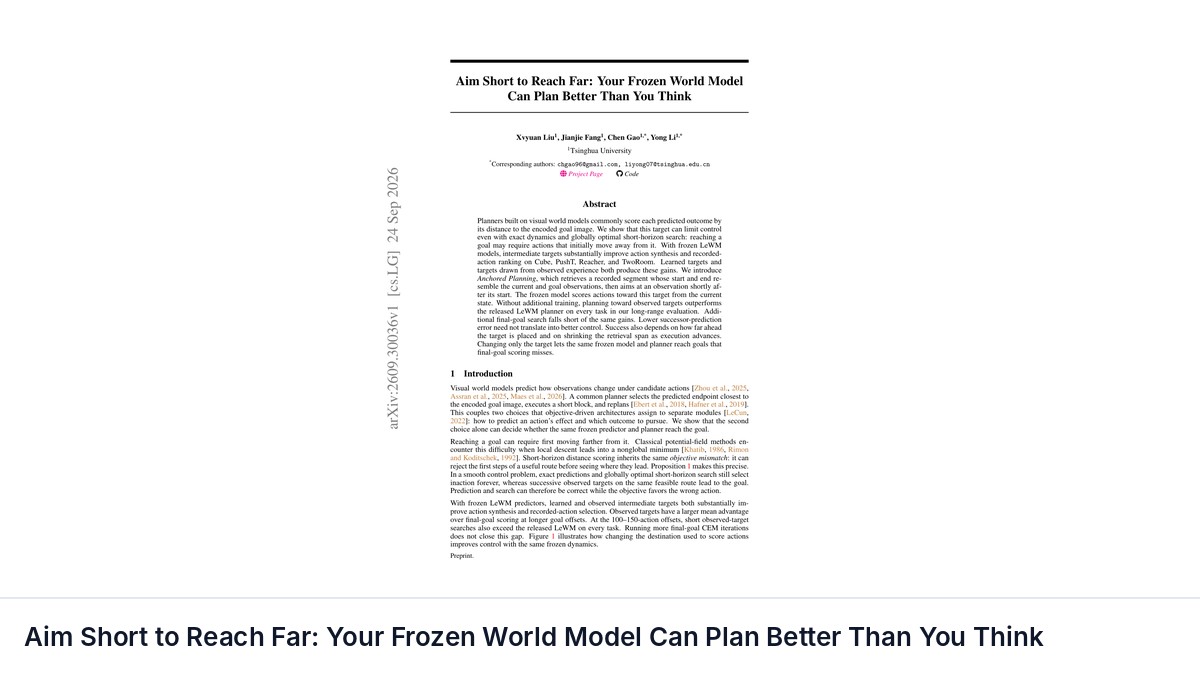
Planners built on visual world models commonly score each predicted outcome by its distance to the encoded goal image. We show that this target can limit control even with exact dynamics and globally optimal short-horizon search: reaching a goal may require actions that initially move away from it. With frozen LeWM models, intermediate targets substantially improve action synthesis and recorded-action ranking on Cube, PushT, Reacher, and TwoRoom. Learned targets and targets drawn from observed experience both produce these gains. We introduce Anchored Planning, which retrieves a recorded segment whose start and end resemble the current and goal observations, then aims at an observation shortly after its start. The frozen model scores actions toward this target from the current state. Without additional training, planning toward observed targets outperforms the released LeWM planner on every task in our long-range evaluation. Additional final-goal search falls short of the same gains. Lower successor-prediction error need not translate into better control. Success also depends on how far ahead the target is placed and on shrinking the retrieval span as execution advances. Changing only the target lets the same frozen model and planner reach goals that final-goal scoring misses.
Key Contributions
- Planners built on visual world models commonly score each predicted outcome by its distance to th…
- We show that this target can limit control even with exact dynamics and globally optimal short-ho…
- With frozen LeWM models, intermediate targets substantially improve action synthesis and recorded…
- Learned targets and targets drawn from observed experience both produce these gains
- We introduce Anchored Planning, which retrieves a recorded segment whose start and end resemble t…
Topics
- vision
- reinforcement-learning
- planning
- control
- human-robot-interaction
- benchmark
Code & Data
No code repository linked in paper metadata.
BibTeX
@article{Liu2026_260930036v1,
  title     = {Aim Short to Reach Far: Your Frozen World Model Can Plan Better Than You Think},
  author    = {Xvyuan Liu and Jianjie Fang and Chen Gao and Yong Li},
  year      = {2026},
  eprint    = {2609.30036v1},
  archivePrefix = {arXiv},
  primaryClass  = {cs.LG},
  url       = {https://arxiv.org/abs/2609.30036v1}
}
Related Papers
Catch, Throw, Repeat: Planning for Human-Robot Partner Juggling
Jonathan Rainer Lippert, Kai Ploeger, Abir Chowdhury et al.
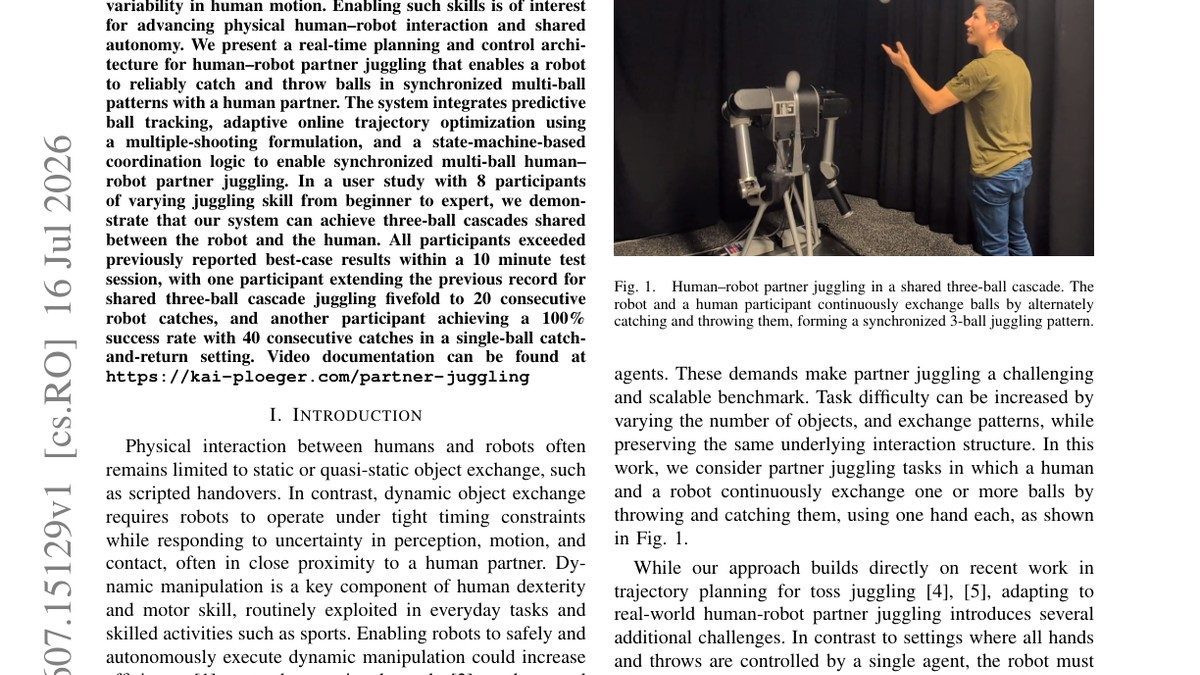
Dynamic object exchange between humans and robots remains a challenging problem due to uncertainty in perception, timing, and contact-rich interaction. Human-robot juggling represents a particularly demanding instance of this problem, requiring precise real-time coordination, predictive motion pl...
Planning-Oriented End-to-End Autonomous Driving: Architectures, Evaluation, and Emerging Paradigms
Yanchen Guan, Xingcheng Liu, Bin Rao et al.
End-to-end autonomous driving has evolved from camera-to-control regression toward planning-oriented systems that use structured representations, trajectory-level outputs, and increasingly realistic evaluation protocols. This survey reviews this transition across behavior cloning, conditional imi...
A Browser-Native Digital Test Range for Benchmarking 4D Ocean-Glider Planning Algorithms
Edward Holmberg, Elias Ioup, Mahdi Abdelguerfi
Repeated in-situ evaluation of ocean-glider planners requires scarce vehicles, operators, deployment and recovery resources, and ocean conditions that cannot be reset for competing algorithms. We present a guided, installation-free browser-native digital test range that transforms a selected regi...
A Low-Cost, Open Platform for End-to-End Autonomous Driving on a Miniature Ackermann Vehicle
Gustavo Claudio Karl Couto, Eric Aislan Antonelo, Gabriel George Zipperer
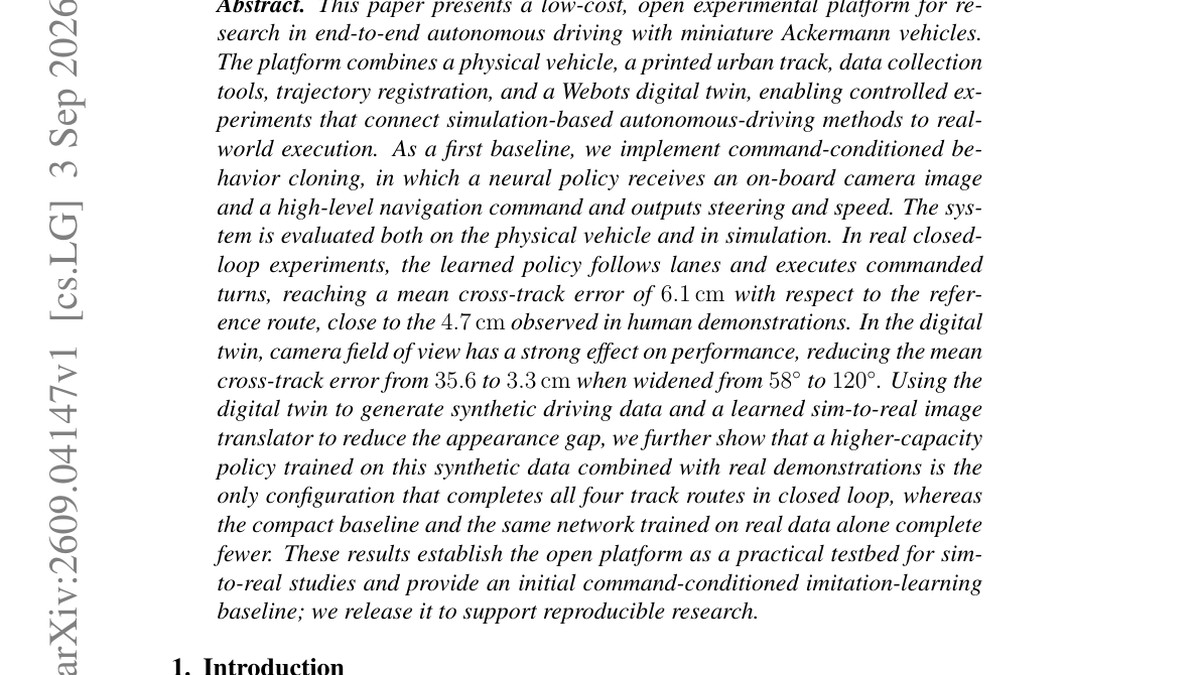
This paper presents a low-cost, open experimental platform for research in end-to-end autonomous driving with miniature Ackermann vehicles. The platform combines a physical vehicle, a printed urban track, data collection tools, trajectory registration, and a Webots digital twin, enabling controll...