
What Matters, When? Diagnosing and Improving Conditional Visual Grounding in Visuomotor Imitation Policies
Vivek Chavan, Pengtao Xie, Yahuan Shi, Oliver Heimann, Kevin Haninger, Jörg Krüger · N/A · 2026
Framework
N/A
License
N/A
Stars
N/A
Summary
Visuomotor imitation policies can achieve high performance under in-distribution visual conditions yet fail when visually similar objects or receptacles are introduced. We study this behavior as a problem of conditional visual grounding: the visual target required for successful control changes w...
Abstract Summary
Key Points
- Visuomotor imitation policies can achieve high performance under in-distribution visual condition...
- We study this behavior as a problem of conditional visual grounding: the visual target required f...
- Using Action Chunking with Transformers (ACT), we systematically introduce distractor objects and...
- We find that distractor sensitivity is specific to both the type of visual similarity and the man...
- Guided by this diagnosis, we evaluate distractor augmentation, phase-dependent attention regulari...
What Matters, When? Diagnosing and Improving Conditional Visual Grounding in Visuomotor Imitation Policies
|Authors: Vivek Chavan, Pengtao Xie, Yahuan Shi, Oliver Heimann, Kevin Haninger, Jörg Krüger
|Venue: arXiv preprint | Year: 2026
|arXiv: 2609.05376v1
Abstract
Visuomotor imitation policies can achieve high performance under in-distribution visual conditions yet fail when visually similar objects or receptacles are introduced. We study this behavior as a problem of conditional visual grounding: the visual target required for successful control changes with the manipulation phase and, in more complex tasks, with the observed task state. Using Action Chunking with Transformers (ACT), we systematically introduce distractor objects and receptacles with controlled color and shape similarity and localize failures to picking and placement. We find that distractor sensitivity is specific to both the type of visual similarity and the manipulation stage. Guided by this diagnosis, we evaluate distractor augmentation, phase-dependent attention regularization, and appearance-based visual prompting as complementary interventions for improving target selection while preserving spatial information required for control. These interventions substantially improve robustness in simulation and on a physical UR3e. We further examine the same failure pattern in a pretrained vision-language-action policy on a state-conditioned instrument-handling task, where the observed state of a medical instrument determines the correct destination. Together, the results show that visual distractors can cause incorrect object or destination selection even when the underlying manipulation skill remains intact, and that explicitly improving target selection can substantially recover performance across distinct visuomotor policy-learning regimes.
Key Contributions
- Visuomotor imitation policies can achieve high performance under in-distribution visual condition…
- We study this behavior as a problem of conditional visual grounding: the visual target required f…
- Using Action Chunking with Transformers (ACT), we systematically introduce distractor objects and…
- We find that distractor sensitivity is specific to both the type of visual similarity and the man…
- Guided by this diagnosis, we evaluate distractor augmentation, phase-dependent attention regulari…
Topics
- manipulation
- vision
- vla
- reinforcement-learning
- control
Code & Data
No code repository linked in paper metadata.
BibTeX
@article{Chavan2026_260905376v1,
  title     = {What Matters, When? Diagnosing and Improving Conditional Visual Grounding in Visuomotor Imitation Policies},
  author    = {Vivek Chavan and Pengtao Xie and Yahuan Shi and Oliver Heimann and Kevin Haninger and Jörg Krüger},
  year      = {2026},
  eprint    = {2609.05376v1},
  archivePrefix = {arXiv},
  primaryClass  = {cs.RO},
  url       = {https://arxiv.org/abs/2609.05376v1}
}
Related Papers
Decoding Task Progress from VLA Representations
Atiksh Bhardwaj, Edward Weiyi Duan, Prithwish Dan et al. · arXiv preprint · Aug 2026
Vision-language-action models (VLAs) are moving rapidly towards deployment as general-purpose manipulation policies, but we currently lack basic tools for understanding what these models represent internally or for monitoring them at runtime. Leveraging ideas from mechanistic interpretability, we...
Development of a Humanoid Robot Prototype for Multimodal Human-Robot Interaction
Thang Tran Viet, Thanh Nguyen Canh, Huy Uong Gia et al. · arXiv preprint · Sep 2026
Human-robot interaction (HRI) enables intuitive and intelligent collaboration between humans and robots in real-world environments. This paper introduces a humanoid robot prototype designed as a flexible testbed for developing and integrating artificial intelligence (AI) modules in HRI tasks. The...
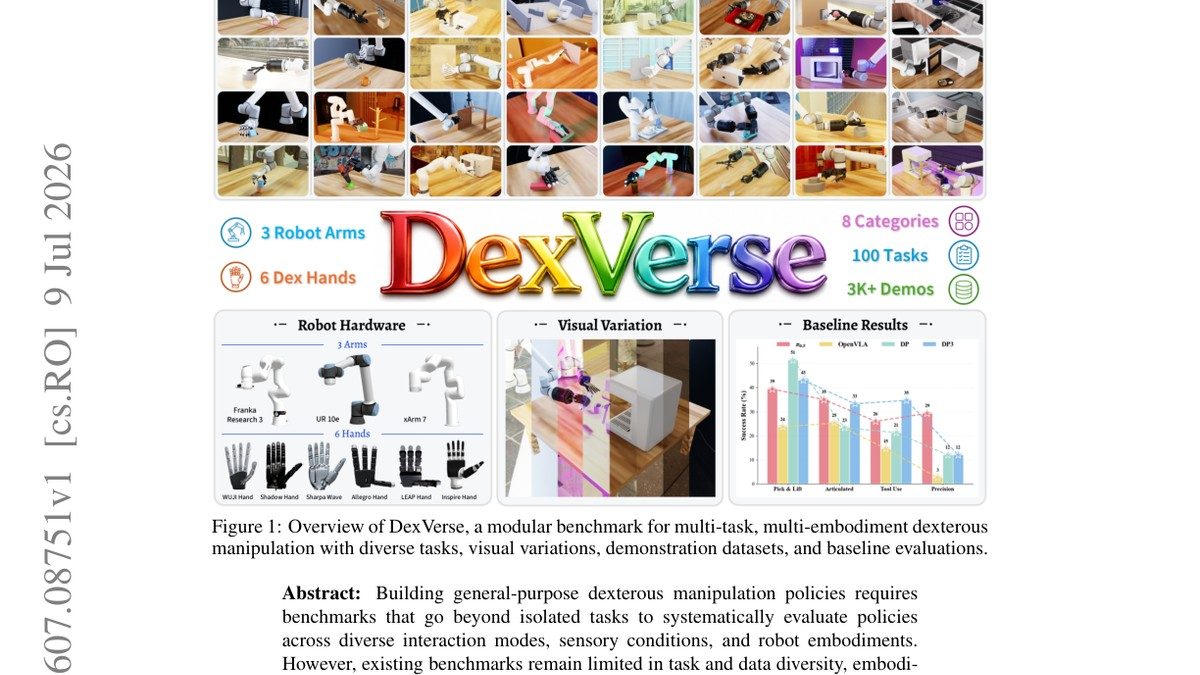
DexVerse: A Modular Benchmark for Multi-Task, Multi-Embodiment Dexterous Manipulation
Yunchao Yao, Zhuxiu Xu, Tianqi Zhang et al. · arXiv preprint · Jul 2026
Building general-purpose dexterous manipulation policies requires benchmarks that go beyond isolated tasks to systematically evaluate policies across diverse interaction modes, sensory conditions, and robot embodiments. However, existing benchmarks remain limited in task and data diversity, embod...
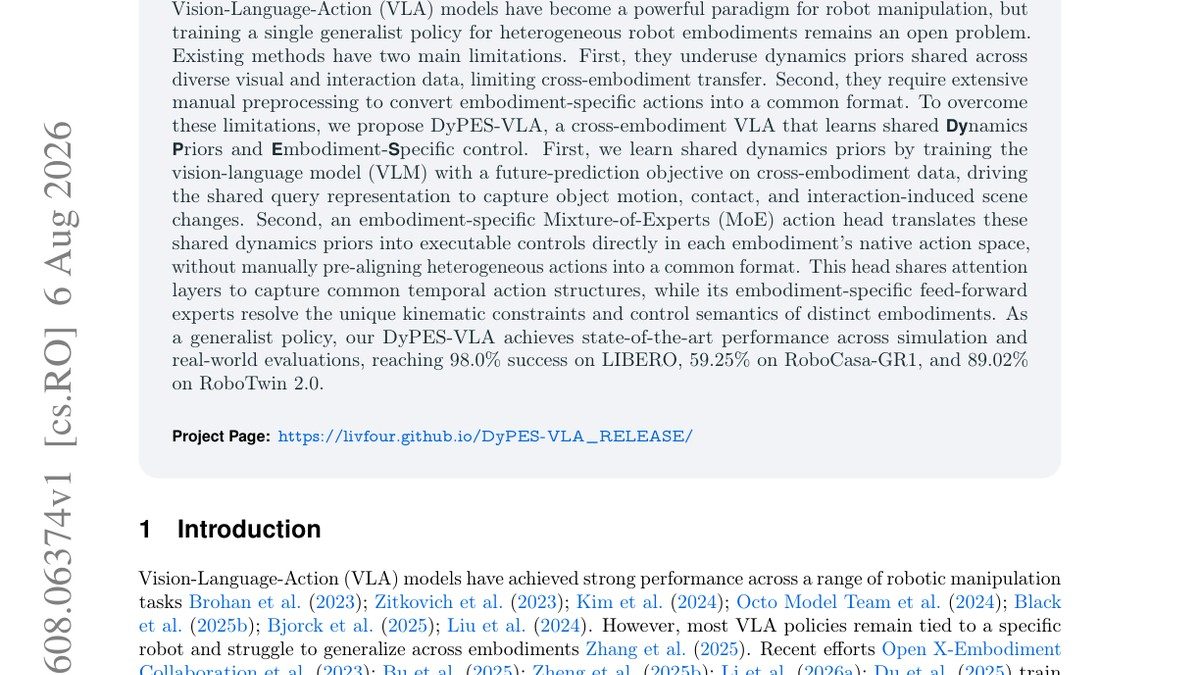
DyPES-VLA: Learning Shared Dynamics Priors and Embodiment-Specific Control for Cross-Embodiment Manipulation
Junfeng Li, Junjie He, Zhide Zhong et al. · arXiv preprint · Aug 2026
Vision-Language-Action (VLA) models have become a powerful paradigm for robot manipulation, but training a single generalist policy for heterogeneous robot embodiments remains an open problem. Existing methods have two main limitations. First, they underuse dynamics priors shared across diverse v...