

What Limits Vision-and-Language Navigation ?
FeaturedYunheng Wang, Yuetong Fang, Taowen Wang, Lusong Li, Kun Liu, Junzhe Xu, Zizhao Yuan, Yixiao Feng, Jiaxi Zhang, Wei Lu, Zecui Zeng, Renjing Xu · · 2026
Framework
N/A
License
N/A
Stars
17
Summary
Vision-and-Language Navigation (VLN) is a cornerstone of embodied intelligence. However, current agents often suffer from significant performance degradation when transitioning from simulation to real-world deployment, primarily due to perceptual instability (e.g., lighting variations and motion blu...
Abstract Summary
Key Points
- Proposes What Limits Vision-and-Language Navigation ?
- Provides open-source code or data
Abstract
Vision-and-Language Navigation (VLN) is a cornerstone of embodied intelligence. However, current agents often suffer from significant performance degradation when transitioning from simulation to real-world deployment, primarily due to perceptual instability (e.g., lighting variations and motion blur) and under-specified instructions. While existing methods attempt to bridge this gap by scaling up model size and training data, we argue that the bottleneck lies in the lack of robust spatial grounding and cross-domain priors. In this paper, we propose StereoNav, a robust Vision-Language-Action framework designed to enhance real-world navigation consistency. To address the inherent gap between synthetic training and physical execution, we introduce Target-Location Priors as a persistent bridge. These priors provide stable visual guidance that remains invariant across domains, effectively grounding the agent even when instructions are vague. Furthermore, to mitigate visual disturbances like motion blur and illumination shifts, StereoNav leverages stereo vision to construct a unified representation of semantics and geometry, enabling precise action prediction through enhanced depth awareness. Extensive experiments on R2R-CE and RxR-CE demonstrate that StereoNav achieves state-of-the-art egocentric RGB performance, with SR and SPL scores of 81.1% and 68.3%, and 67.5% and 52.0%, respectively, while using significantly fewer parameters and less training data than prior scaling-based approaches. More importantly, real-world robotic deployments confirm that StereoNav substantially improves navigation reliability in complex, unstructured environments. Project page: https://yunheng-wang.github.io/stereonav-public.github.io.
Links
- Paper (PDF): 2605.13328v1
- arXiv: 2605.13328v1
Related Papers

Scalable Behavior Cloning with Open Data, Training, and Evaluation
Arthur Allshire, Himanshu Gaurav Singh, Ritvik Singh et al. · arXiv · Jun 2026
We introduce ABC, a fully open-source stack for manipulation with behavior cloning. At its core is ABC-130K: the largest open-source teleoperation dataset to date, featuring 3,500 hours of data spanning over 130K episodes across 195 diverse tasks. Furthermore, we open-source o...

E-TTS: A New Embodied Test-Time Scaling Framework for Robotic Manipulation
Wen Ye, Peiyan Li, Tingyu Yuan et al. · arXiv · Jun 2026
Recently, a few works have made early attempts to study test-time scaling for embodied tasks. However, two major challenges remain unsolved: (1) reasoning can effectively improve the performance of the policy, but its scaling mechanism has seldom been studied; (2) historical i...
Guide, Think, Act: Interactive Embodied Reasoning in Vision-Language-Action Models
Yiran Ling, Qing Lian, Jinghang Li et al. · arXiv · May 2026
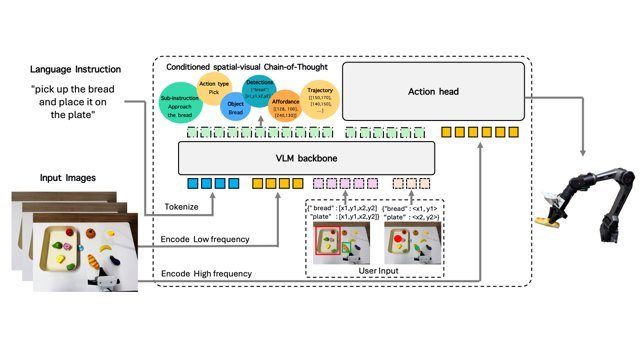
In this paper, we propose GTA-VLA(Guide, Think, Act), an interactive Vision-Language-Action (VLA) framework that enables spatially steerable embodied reasoning by allowing users to guide robot policies with explicit visual cues. Existing VLA models learn a direct "Sense-to-Act" mapping from multimod...

LA4VLA: Learning to Act without Seeing via Language-Action Pretraining
Tao Lin, Yuxin Du, Yiran Mao et al. · arXiv · Jun 2026
Vision-Language-Action (VLA) models are commonly pretrained on robot demonstrations by jointly mapping visual observations and language instructions to actions. However, dense visual-action supervision can dominate the comparatively sparse language-action signal. As a result, ...