
Guide, Think, Act: Interactive Embodied Reasoning in Vision-Language-Action Models
FeaturedYiran Ling, Qing Lian, Jinghang Li, Qing Jiang, Tianming Zhang, Xiaoke Jiang, Chuanxiu Liu, Jie Liu, Lei Zhang · · 2026
Framework
N/A
License
N/A
Stars
1
Summary
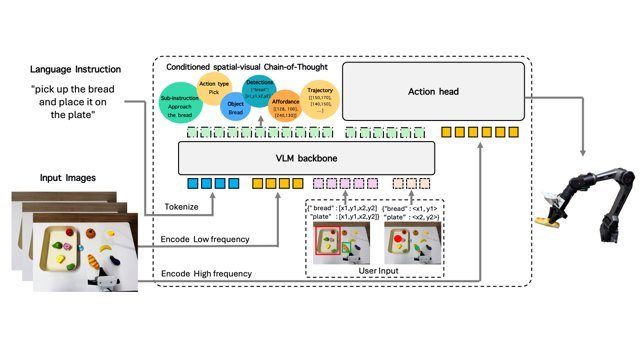
In this paper, we propose GTA-VLA(Guide, Think, Act), an interactive Vision-Language-Action (VLA) framework that enables spatially steerable embodied reasoning by allowing users to guide robot policies with explicit visual cues. Existing VLA models learn a direct "Sense-to-Act" mapping from multimod...
Abstract Summary
Key Points
- Proposes Interactive Embodied Reasoning in Vision-Language-Action Models
- Introduces a new dataset or benchmark
- Provides open-source code or data
Abstract
In this paper, we propose GTA-VLA(Guide, Think, Act), an interactive Vision-Language-Action (VLA) framework that enables spatially steerable embodied reasoning by allowing users to guide robot policies with explicit visual cues. Existing VLA models learn a direct “Sense-to-Act” mapping from multimodal observations to robot actions. While effective within the training distribution, such tightly coupled policies are brittle under out-of-domain (OOD) shifts and difficult to correct when failures occur. Although recent embodied Chain-of-Thought (CoT) approaches expose intermediate reasoning, they still lack a mechanism for incorporating human spatial guidance, limiting their ability to resolve visual ambiguities or recover from mistakes. To address this gap, our framework allows users to optionally guide the policy with spatial priors, such as affordance points, boxes, and traces, which the subsequent reasoning process can directly condition on. Based on these inputs, the model generates a unified spatial-visual Chain-of-Thought that integrates external guidance with internal task planning, aligning human visual intent with autonomous decision-making. For practical deployment, we further couple the reasoning module with a lightweight reactive action head for efficient action execution. Extensive experiments demonstrate the effectiveness of our approach. On the in-domain SimplerEnv WidowX benchmark, our framework achieves a state-of-the-art 81.2% success rate. Under OOD visual shifts and spatial ambiguities, a single visual interaction substantially improves task success over existing methods, highlighting the value of interactive reasoning for failure recovery in embodied control. Details of the project can be found here: https://signalispupupu.github.io/GTA-VLA_ProjPage/
Links
- Paper (PDF): 2605.13632v1
- arXiv: 2605.13632v1
Related Papers

What Limits Vision-and-Language Navigation ?
Yunheng Wang, Yuetong Fang, Taowen Wang et al. · arXiv · May 2026
Vision-and-Language Navigation (VLN) is a cornerstone of embodied intelligence. However, current agents often suffer from significant performance degradation when transitioning from simulation to real-world deployment, primarily due to perceptual instability (e.g., lighting variations and motion blu...

Scalable Behavior Cloning with Open Data, Training, and Evaluation
Arthur Allshire, Himanshu Gaurav Singh, Ritvik Singh et al. · arXiv · Jun 2026
We introduce ABC, a fully open-source stack for manipulation with behavior cloning. At its core is ABC-130K: the largest open-source teleoperation dataset to date, featuring 3,500 hours of data spanning over 130K episodes across 195 diverse tasks. Furthermore, we open-source o...

CUBic: Coordinated Unified Bimanual Perception and Control Framework
Xingyu Wang, Pengxiang Ding, Jingkai Xu et al. · arXiv · May 2026
Recent advances in visuomotor policy learning have enabled robots to perform control directly from visual inputs. Yet, extending such end-to-end learning from single-arm to bimanual manipulation remains challenging due to the need for both independent perception and coordinated interaction between a...

E-TTS: A New Embodied Test-Time Scaling Framework for Robotic Manipulation
Wen Ye, Peiyan Li, Tingyu Yuan et al. · arXiv · Jun 2026
Recently, a few works have made early attempts to study test-time scaling for embodied tasks. However, two major challenges remain unsolved: (1) reasoning can effectively improve the performance of the policy, but its scaling mechanism has seldom been studied; (2) historical i...