

CUBic: Coordinated Unified Bimanual Perception and Control Framework
FeaturedXingyu Wang, Pengxiang Ding, Jingkai Xu, Donglin Wang, Zhaoxin Fan · · 2026
Framework
N/A
License
N/A
Stars
0
Summary
Recent advances in visuomotor policy learning have enabled robots to perform control directly from visual inputs. Yet, extending such end-to-end learning from single-arm to bimanual manipulation remains challenging due to the need for both independent perception and coordinated interaction between a...
Abstract Summary
Key Points
- Proposes Coordinated Unified Bimanual Perception and Control Framework
- Introduces a new dataset or benchmark
- Provides open-source code or data
Abstract
Recent advances in visuomotor policy learning have enabled robots to perform control directly from visual inputs. Yet, extending such end-to-end learning from single-arm to bimanual manipulation remains challenging due to the need for both independent perception and coordinated interaction between arms. Existing methods typically favor one side — either decoupling the two arms to avoid interference or enforcing strong cross-arm coupling for coordination — thus lacking a unified treatment. We propose CUBic, a Coordinated and Unified framework for Bimanual perception and control that reformulates bimanual coordination as a unified perceptual modeling problem. CUBic learns a shared tokenized representation bridging perception and control, where independence and coordination emerge intrinsically from structure rather than from hand-crafted coupling. Our approach integrates three components: unidirectional perception aggregation, bidirectional perception coordination through two codebooks with shared mapping, and a unified perception-to-control diffusion policy. Extensive experiments on the RoboTwin benchmark show that CUBic consistently surpasses standard baselines, achieving marked improvements in coordination accuracy and task success rates over state-of-the-art visuomotor baselines.
Links
- Paper (PDF): 2605.13452v1
- arXiv: 2605.13452v1
Related Papers

Scalable Behavior Cloning with Open Data, Training, and Evaluation
Arthur Allshire, Himanshu Gaurav Singh, Ritvik Singh et al. · arXiv · Jun 2026
We introduce ABC, a fully open-source stack for manipulation with behavior cloning. At its core is ABC-130K: the largest open-source teleoperation dataset to date, featuring 3,500 hours of data spanning over 130K episodes across 195 diverse tasks. Furthermore, we open-source o...

E-TTS: A New Embodied Test-Time Scaling Framework for Robotic Manipulation
Wen Ye, Peiyan Li, Tingyu Yuan et al. · arXiv · Jun 2026
Recently, a few works have made early attempts to study test-time scaling for embodied tasks. However, two major challenges remain unsolved: (1) reasoning can effectively improve the performance of the policy, but its scaling mechanism has seldom been studied; (2) historical i...
Guide, Think, Act: Interactive Embodied Reasoning in Vision-Language-Action Models
Yiran Ling, Qing Lian, Jinghang Li et al. · arXiv · May 2026
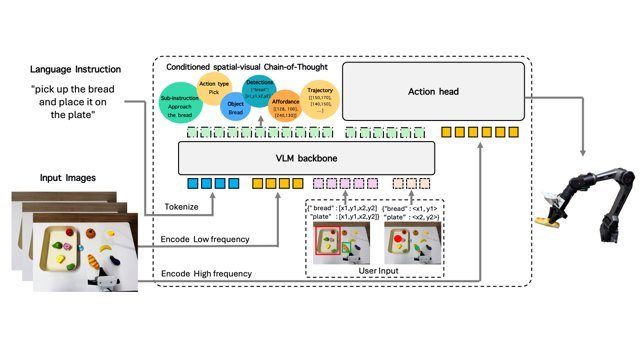
In this paper, we propose GTA-VLA(Guide, Think, Act), an interactive Vision-Language-Action (VLA) framework that enables spatially steerable embodied reasoning by allowing users to guide robot policies with explicit visual cues. Existing VLA models learn a direct "Sense-to-Act" mapping from multimod...

Hand-in-the-Loop: Improving Dexterous VLA via Seamless Interventional Correction
Zhuohang Li, Liqun Huang, Wei Xu et al. · arXiv · May 2026
Vision-Language-Action (VLA) models are prone to compounding errors in dexterous manipulation, where high-dimensional action spaces and contact-rich dynamics amplify small policy deviations over long horizons. While Interactive Imitation Learning (IIL) can refine policies through human takeover data...