

LA4VLA: Learning to Act without Seeing via Language-Action Pretraining
FeaturedTao Lin, Yuxin Du, Yiran Mao, Zewei Ye, Yilei Zhong, Bing Cheng, Yiming Wang, Jiting Liu, Yang Tian, Junchi Yan, Feiran Wu, Zenan Meng, Hu Wei, Yuqian Fu, Gen Li, Bo Zhao · · 2026
Framework
N/A
License
N/A
Stars
0
Summary
Vision-Language-Action (VLA) models are commonly pretrained on robot demonstrations by jointly mapping visual observations and language instructions to actions. However, dense visual-action supervision can dominate the comparatively sparse language-action signal. As a result, ...
Abstract Summary
Key Points
- Vision-Language-Action (VLA) models are commonly pretrained on robot demonstrations by jointly mapping visual observations and language instructions t...
Abstract
Vision-Language-Action (VLA) models are commonly pretrained on robot demonstrations by jointly mapping visual observations and language instructions to actions. However, dense visual-action supervision can dominate the comparatively sparse language-action signal. As a result, policies may rely on visual shortcuts rather than learn how language conditions action execution, making them sensitive to visual variations. To address this limitation, we propose LA4VLA, a language-action pretraining framework that enables policies to acquire language-conditioned action priors without visual observations. These priors capture reusable manipulation skills shared across tasks and scenes, reducing reliance on scene-specific visual cues. Specifically, LA4VLA decomposes expert demonstration trajectories into atomic action segments and pairs each segment with a corresponding low-level action description. This yields LA4-33K, a dataset of 33K Language-Action (LA) episodes derived entirely from existing demonstrations without additional robot data collection. We further develop LA4VLA-1B, a lightweight 1B-parameter VLA model, and investigate three paradigms for incorporating language-action supervision into VLA learning: LA-only pretraining, sequential LA-to-VLA pretraining, and mixed LA-VLA pretraining. Across simulation and real-world tasks, LA-pretrained policies consistently outperform matched VLA-pretrained counterparts, while combining LA and VLA supervision leads to further gains. In particular, mixed LA-VLA pretraining improves the average success rate of LA4VLA-1B over the no-pretraining baseline by up to 17.8 and 45.0 percentage points in simulation and real-world tasks, respectively. These results establish LA4VLA as an effective and complementary pretraining strategy for building stronger and more robust VLA policies.
Links
- Paper (PDF): 2606.27295v1
- arXiv: 2606.27295v1
Related Papers

Scalable Behavior Cloning with Open Data, Training, and Evaluation
Arthur Allshire, Himanshu Gaurav Singh, Ritvik Singh et al. · arXiv · Jun 2026
We introduce ABC, a fully open-source stack for manipulation with behavior cloning. At its core is ABC-130K: the largest open-source teleoperation dataset to date, featuring 3,500 hours of data spanning over 130K episodes across 195 diverse tasks. Furthermore, we open-source o...

E-TTS: A New Embodied Test-Time Scaling Framework for Robotic Manipulation
Wen Ye, Peiyan Li, Tingyu Yuan et al. · arXiv · Jun 2026
Recently, a few works have made early attempts to study test-time scaling for embodied tasks. However, two major challenges remain unsolved: (1) reasoning can effectively improve the performance of the policy, but its scaling mechanism has seldom been studied; (2) historical i...

Hand-in-the-Loop: Improving Dexterous VLA via Seamless Interventional Correction
Zhuohang Li, Liqun Huang, Wei Xu et al. · arXiv · May 2026
Vision-Language-Action (VLA) models are prone to compounding errors in dexterous manipulation, where high-dimensional action spaces and contact-rich dynamics amplify small policy deviations over long horizons. While Interactive Imitation Learning (IIL) can refine policies through human takeover data...
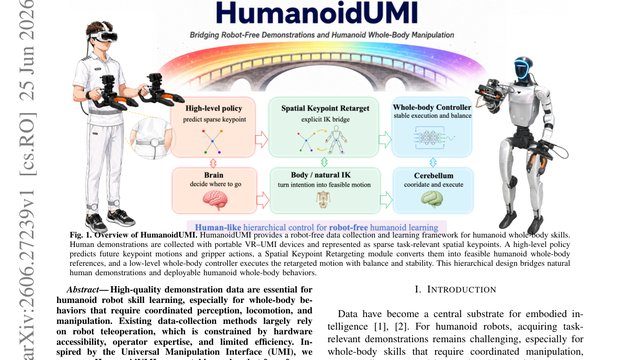
HumanoidUMI: Bridging Robot-Free Demonstrations and Humanoid Whole-Body Manipulation
Hongwu Wang, Chenhao Yu, Youhao Hu et al. · arXiv · Jun 2026
High-quality demonstration data are essential for humanoid robot skill learning, especially for whole-body behaviors that require coordinated perception, locomotion, and manipulation. Existing data-collection methods largely rely on robot teleoperation, which is constrained by...