

VLA-Corrector: Stage-Aware Observable State Understanding for Prompt-Based Closed-Loop Recovery of Vision-Language-Action Policies
Chang Song, Bin Qian, Yan Feng, Zhijie Song · N/A · 2026
Framework
N/A
License
N/A
Stars
N/A
Summary
Long-horizon robot manipulation with Vision-Language-Action (VLA) policies remains vulnerable to execution-time deviations, as final task success provides little information for diagnosing and correcting failures caused by action noise, object displacement, or goal misalignment. We introduce a st...
Abstract Summary
Key Points
- Long-horizon robot manipulation with Vision-Language-Action (VLA) policies remains vulnerable to ...
- We introduce a stage-aware failure verification and Prompt Recovery framework that enables closed...
- The framework introduces an observable-history-based Learned Verifier that jointly estimates mani...
- To provide interpretable task understanding, we represent manipulation execution through semantic...
- Upon detecting abnormal execution, the framework preserves the original instruction and generates...
VLA-Corrector: Stage-Aware Observable State Understanding for Prompt-Based Closed-Loop Recovery of Vision-Language-Action Policies
|Authors: Chang Song, Bin Qian, Yan Feng, Zhijie Song
|Venue: arXiv preprint | Year: 2026
|arXiv: 2609.06508v1
Abstract
Long-horizon robot manipulation with Vision-Language-Action (VLA) policies remains vulnerable to execution-time deviations, as final task success provides little information for diagnosing and correcting failures caused by action noise, object displacement, or goal misalignment. We introduce a stage-aware failure verification and Prompt Recovery framework that enables closed-loop correction of a fixed VLA policy without parameter updates or privileged simulator states. The framework introduces an observable-history-based Learned Verifier that jointly estimates manipulation progress and execution risk by temporally modeling multi-view visual observations, proprioceptive states, and executed actions. To provide interpretable task understanding, we represent manipulation execution through semantic progress stages, including approach, alignment, grasp, transport, and placement, and identify stage-specific failure patterns. Upon detecting abnormal execution, the framework preserves the original instruction and generates a stage-conditioned recovery prompt, allowing the same frozen VLA policy to produce corrective actions. Extensive multi-round evaluations on LIBERO and LIBERO Plus demonstrate that the proposed approach substantially improves closed-loop reliability under diverse perturbations. Without access to privileged object or goal coordinates, the Learned Verifier achieves recovery performance close to that of the privileged rule-based verifier in the evaluated settings. These results show that observable visual-proprioceptive-action history is sufficient to infer latent task states and enable practical failure recovery for existing VLA policies.
Key Contributions
- Long-horizon robot manipulation with Vision-Language-Action (VLA) policies remains vulnerable to …
- We introduce a stage-aware failure verification and Prompt Recovery framework that enables closed…
- The framework introduces an observable-history-based Learned Verifier that jointly estimates mani…
- To provide interpretable task understanding, we represent manipulation execution through semantic…
- Upon detecting abnormal execution, the framework preserves the original instruction and generates…
Topics
- manipulation
- vision
- vla
- reinforcement-learning
- benchmark
Code & Data
No code repository linked in paper metadata.
BibTeX
@article{Song2026_260906508v1,
  title     = {VLA-Corrector: Stage-Aware Observable State Understanding for Prompt-Based Closed-Loop Recovery of Vision-Language-Action Policies},
  author    = {Chang Song and Bin Qian and Yan Feng and Zhijie Song},
  year      = {2026},
  eprint    = {2609.06508v1},
  archivePrefix = {arXiv},
  primaryClass  = {cs.RO},
  url       = {https://arxiv.org/abs/2609.06508v1}
}
Related Papers
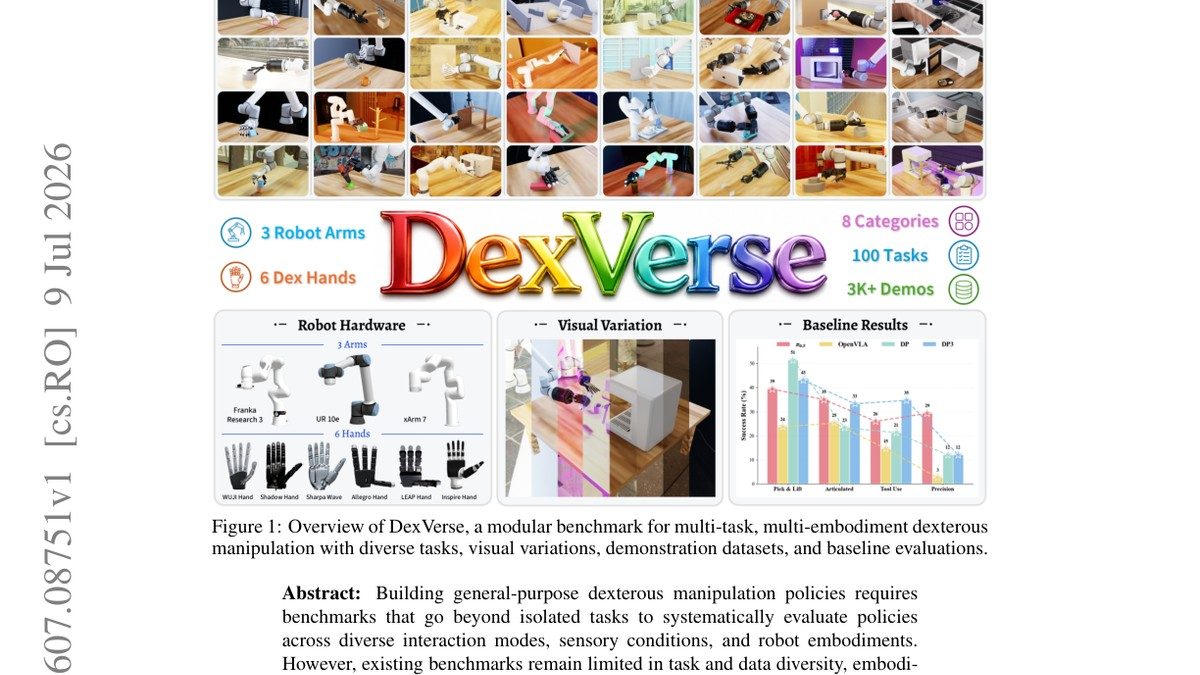
DexVerse: A Modular Benchmark for Multi-Task, Multi-Embodiment Dexterous Manipulation
Yunchao Yao, Zhuxiu Xu, Tianqi Zhang et al. · arXiv preprint · Jul 2026
Building general-purpose dexterous manipulation policies requires benchmarks that go beyond isolated tasks to systematically evaluate policies across diverse interaction modes, sensory conditions, and robot embodiments. However, existing benchmarks remain limited in task and data diversity, embod...
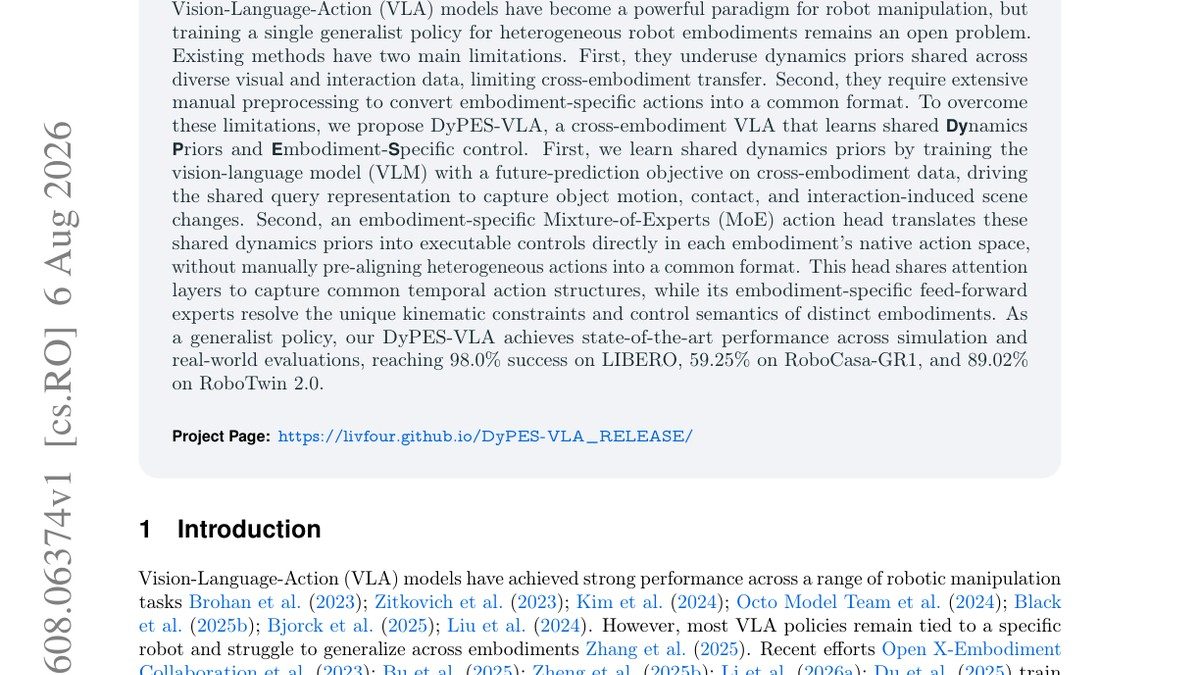
DyPES-VLA: Learning Shared Dynamics Priors and Embodiment-Specific Control for Cross-Embodiment Manipulation
Junfeng Li, Junjie He, Zhide Zhong et al. · arXiv preprint · Aug 2026
Vision-Language-Action (VLA) models have become a powerful paradigm for robot manipulation, but training a single generalist policy for heterogeneous robot embodiments remains an open problem. Existing methods have two main limitations. First, they underuse dynamics priors shared across diverse v...

FabriVLA: A Lightweight Vision-Language-Action Model for Precise Multi-Task Manipulation
Shiyuan Yang, Borong Zhang, Jizheng Zhang et al. · arXiv preprint · Jul 2026
We present FabriVLA, a lightweight Vision-Language-Action model for Precise Multi-Task Manipulation. FabriVLA combines an InternVL3.5 vision-language backbone with a flow-matching action head featuring gated self-attention across action tokens and shallow VLM layer fusion for enriched spatial con...

FolDeX: A Physical-World Benchmark for Long-Horizon Robotic Manipulation of Deformable Objects
Chenhuan Liu, Yi Xu, Feng Wu et al. · arXiv preprint · Sep 2026
Embodied AI, including vision-language-action and world-action models, must operate reliably in the physical world. Yet methods that perform well in simulation can degrade substantially on real robots, especially in long-horizon deformable-object manipulation, where policies must track changing s...