

FolDeX: A Physical-World Benchmark for Long-Horizon Robotic Manipulation of Deformable Objects
Chenhuan Liu, Yi Xu, Feng Wu, Hanyang Wang, Wenxiao Kuai, Weihao Ding, Shan Wang, Yang Liu, Shuyong Gao, Wenqiang Zhang · N/A · 2026
Framework
N/A
License
N/A
Stars
N/A
Summary
Embodied AI, including vision-language-action and world-action models, must operate reliably in the physical world. Yet methods that perform well in simulation can degrade substantially on real robots, especially in long-horizon deformable-object manipulation, where policies must track changing s...
Abstract Summary
Key Points
- Embodied AI, including vision-language-action and world-action models, must operate reliably in t...
- Yet methods that perform well in simulation can degrade substantially on real robots, especially ...
- Existing real-robot benchmarks mainly focus on short-horizon rigid-object tasks and offer limited...
- We introduce FolDeX, a physical-world benchmark built entirely from real-robot data, with garment...
- Since real-robot data collection is costly, FolDeX studies how heterogeneous physical experience ...
FolDeX: A Physical-World Benchmark for Long-Horizon Robotic Manipulation of Deformable Objects
|Authors: Chenhuan Liu, Yi Xu, Feng Wu, Hanyang Wang, Wenxiao Kuai, Weihao Ding, Shan Wang, Yang Liu, Shuyong Gao, Wenqiang Zhang
|Venue: arXiv preprint | Year: 2026
|arXiv: 2609.10243v1
Abstract
Embodied AI, including vision-language-action and world-action models, must operate reliably in the physical world. Yet methods that perform well in simulation can degrade substantially on real robots, especially in long-horizon deformable-object manipulation, where policies must track changing states and execute reliable multi-stage bimanual interactions. Existing real-robot benchmarks mainly focus on short-horizon rigid-object tasks and offer limited coverage of long-horizon deformable manipulation. We introduce FolDeX, a physical-world benchmark built entirely from real-robot data, with garment folding as its primary task. Since real-robot data collection is costly, FolDeX studies how heterogeneous physical experience can be reused efficiently. The benchmark is organized around four research axes: leveraging human intervention and recovery data collected during deployment; transferring data across tasks, including across garment categories and from rigid to deformable-object manipulation; reusing data across scenes with changes in lighting, background, and layout; and transferring data across robotic embodiments. FolDeX provides 2,000+ hours of real-robot data spanning 20+ tasks and 10+ embodiments. We also establish a fair real-robot evaluation platform for externally submitted policies, with standardized tasks, held-out physical objects, controlled initializations, and a unified execution protocol. The platform is publicly accessible at https://ai.midea.com/#/fold-challenge. We hope FolDeX will serve as a unified testbed for heterogeneous real-robot data reuse and reliable long-horizon deformable manipulation.
Key Contributions
- Embodied AI, including vision-language-action and world-action models, must operate reliably in t…
- Yet methods that perform well in simulation can degrade substantially on real robots, especially …
- Existing real-robot benchmarks mainly focus on short-horizon rigid-object tasks and offer limited…
- We introduce FolDeX, a physical-world benchmark built entirely from real-robot data, with garment…
- Since real-robot data collection is costly, FolDeX studies how heterogeneous physical experience …
Topics
- manipulation
- vision
- vla
- reinforcement-learning
- control
- benchmark
Code & Data
No code repository linked in paper metadata.
BibTeX
@article{Liu2026_260910243v1,
  title     = {FolDeX: A Physical-World Benchmark for Long-Horizon Robotic Manipulation of Deformable Objects},
  author    = {Chenhuan Liu and Yi Xu and Feng Wu and Hanyang Wang and Wenxiao Kuai and Weihao Ding and Shan Wang and Yang Liu and Shuyong Gao and Wenqiang Zhang},
  year      = {2026},
  eprint    = {2609.10243v1},
  archivePrefix = {arXiv},
  primaryClass  = {cs.RO},
  url       = {https://arxiv.org/abs/2609.10243v1}
}
Related Papers
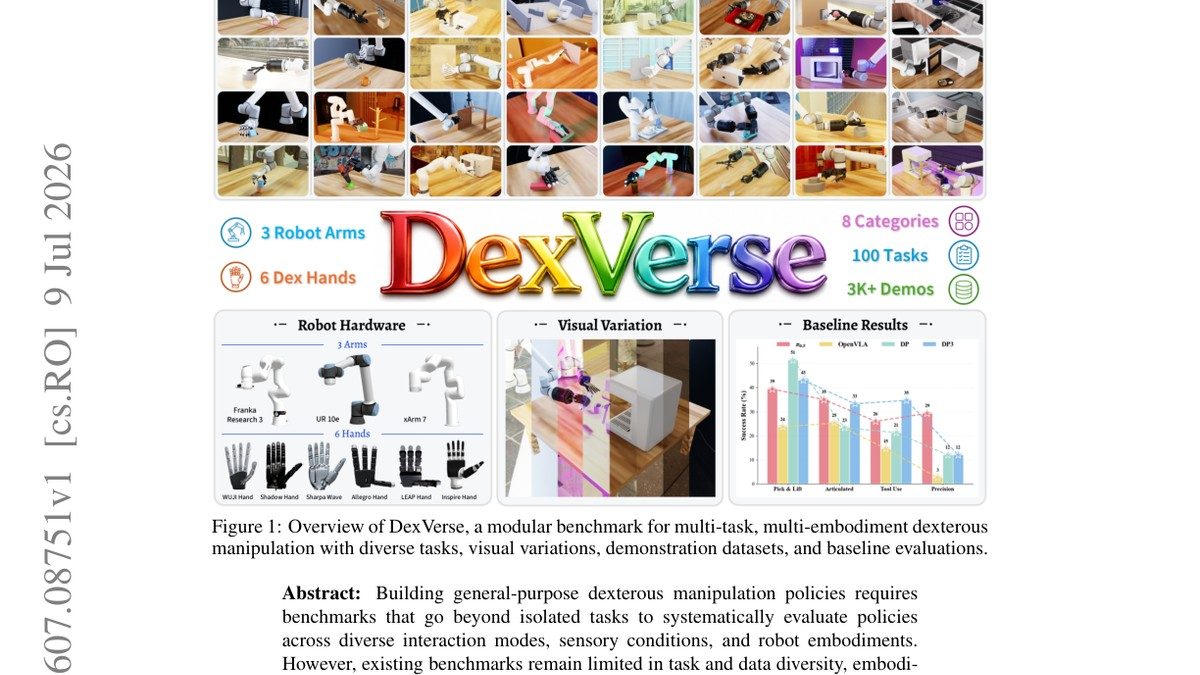
DexVerse: A Modular Benchmark for Multi-Task, Multi-Embodiment Dexterous Manipulation
Yunchao Yao, Zhuxiu Xu, Tianqi Zhang et al. · arXiv preprint · Jul 2026
Building general-purpose dexterous manipulation policies requires benchmarks that go beyond isolated tasks to systematically evaluate policies across diverse interaction modes, sensory conditions, and robot embodiments. However, existing benchmarks remain limited in task and data diversity, embod...
DyPES-VLA: Learning Shared Dynamics Priors and Embodiment-Specific Control for Cross-Embodiment Manipulation
Junfeng Li, Junjie He, Zhide Zhong et al. · arXiv preprint · Aug 2026
Vision-Language-Action (VLA) models have become a powerful paradigm for robot manipulation, but training a single generalist policy for heterogeneous robot embodiments remains an open problem. Existing methods have two main limitations. First, they underuse dynamics priors shared across diverse v...
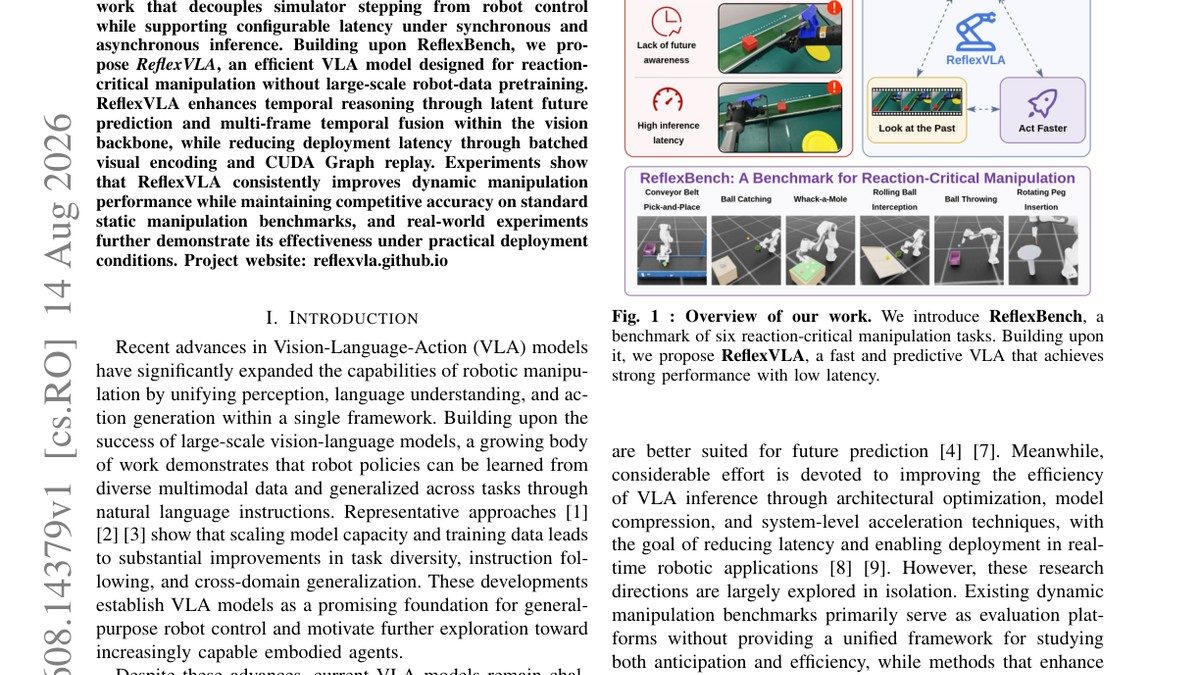
Reflex: Enabling Fast and Predictive Vision-Language-Action Models for Reaction-Critical Manipulation
Yuxuan Chen, Wanruo Zhang, Xiao Li · arXiv preprint · Aug 2026
Vision-Language-Action (VLA) models have recently achieved promising performance in robotic manipulation. However, existing benchmarks mainly evaluate generalization on static manipulation tasks and largely overlook dynamic interaction scenarios. To address this gap, we present ReflexBench, a ben...
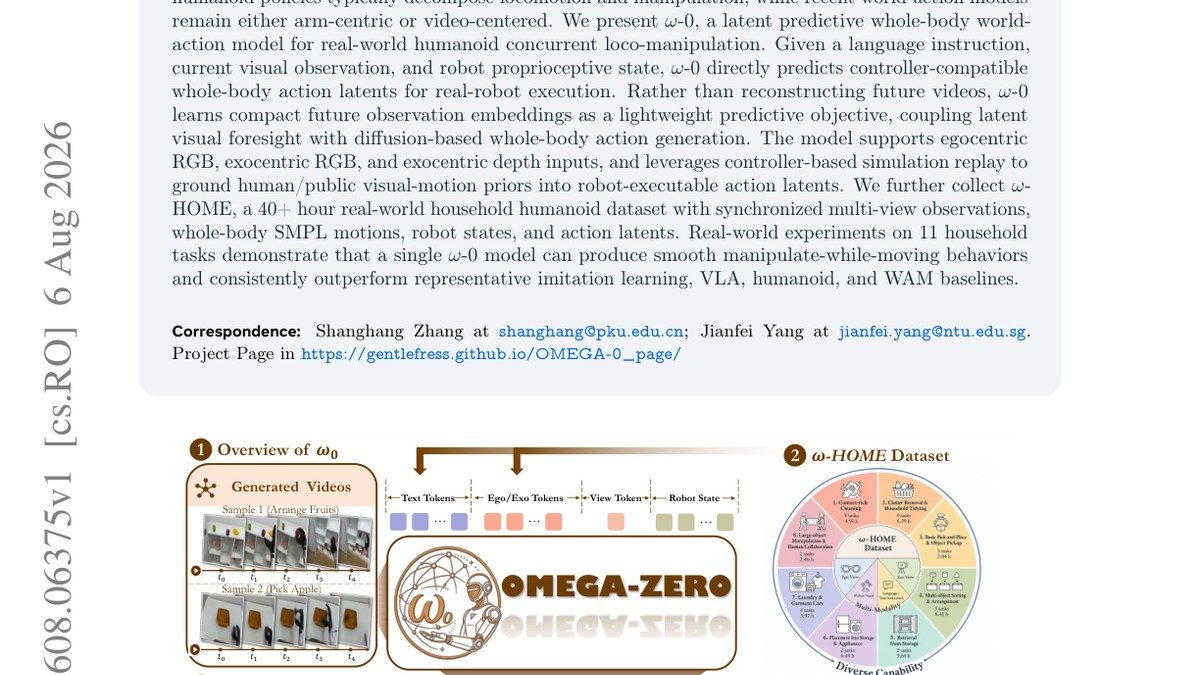
$ω$-0: A Latent Predictive World Action Model for Concurrent Humanoid Loco-Manipulation
Zhe Li, Zhenzhe Zhang, Yangyang Wei et al. · arXiv preprint · Aug 2026
Humanoid household tasks often require concurrent loco-manipulation, where the robot must move, adjust posture, maintain balance, and manipulate objects as a single coordinated behavior. Yet existing humanoid policies typically decompose locomotion and manipulation, while recent world-action mode...