
Stigmergic Graph Memory: An Environment-Aware Approach for Many-to-Many Multi-Agent Pickup and Delivery
Aditya Dutta, Joon-Seok Kim · N/A · 2026
Framework
N/A
License
N/A
Stars
N/A
Summary
Automated fulfillment warehouses must continuously assign and execute pickup-and-delivery work while avoiding congestion. In many-to-many Multi-Agent Pickup and Delivery (MAPD), a request specifies a stock-keeping unit rather than fixed endpoints, requiring the controller to select an agent, sour...
Abstract Summary
Key Points
- Automated fulfillment warehouses must continuously assign and execute pickup-and-delivery work wh...
- In many-to-many Multi-Agent Pickup and Delivery (MAPD), a request specifies a stock-keeping unit ...
- Existing graph-guidance methods primarily influence routing after goals are fixed, leaving endpoi...
- We introduce Stigmergic Graph Memory (SGM), a bounded, decaying memory layer that records recent ...
- Across paired request streams on five layouts, three load levels, and 25 seeds per condition, SGM...
Stigmergic Graph Memory: An Environment-Aware Approach for Many-to-Many Multi-Agent Pickup and Delivery
|Authors: Aditya Dutta, Joon-Seok Kim
|Venue: arXiv preprint | Year: 2026
|arXiv: 2607.15182v1
Abstract
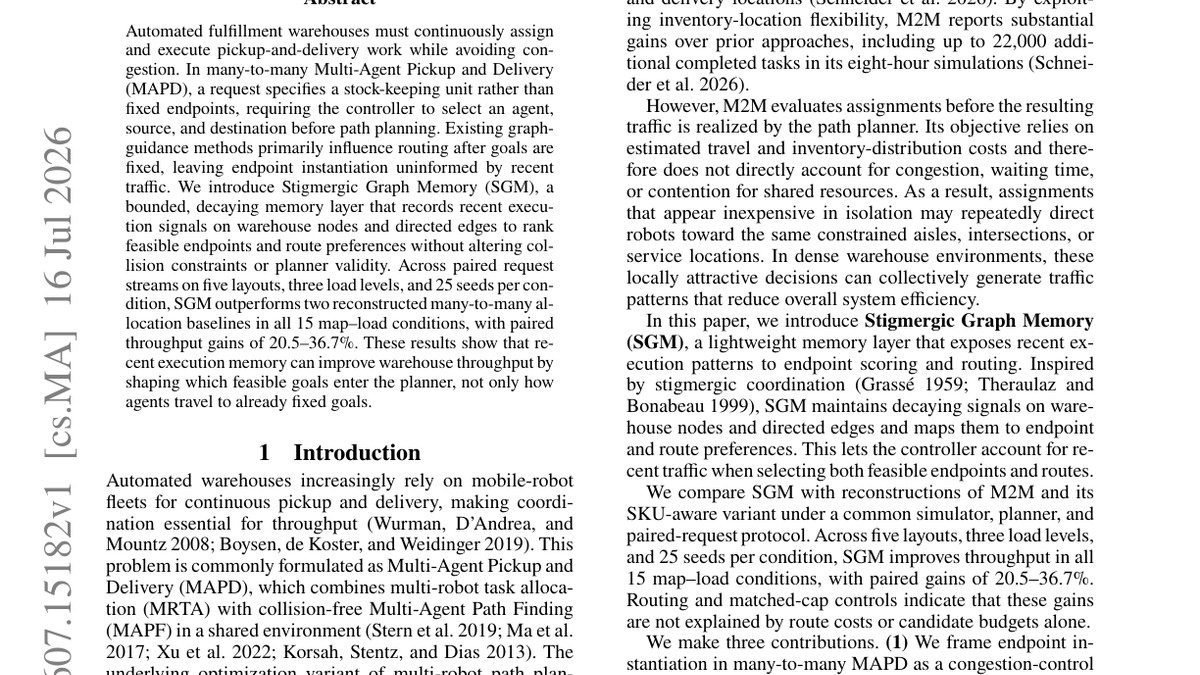
Automated fulfillment warehouses must continuously assign and execute pickup-and-delivery work while avoiding congestion. In many-to-many Multi-Agent Pickup and Delivery (MAPD), a request specifies a stock-keeping unit rather than fixed endpoints, requiring the controller to select an agent, source, and destination before path planning. Existing graph-guidance methods primarily influence routing after goals are fixed, leaving endpoint instantiation uninformed by recent traffic. We introduce Stigmergic Graph Memory (SGM), a bounded, decaying memory layer that records recent execution signals on warehouse nodes and directed edges to rank feasible endpoints and route preferences without altering collision constraints or planner validity. Across paired request streams on five layouts, three load levels, and 25 seeds per condition, SGM outperforms two reconstructed many-to-many allocation baselines in all 15 map-load conditions, with paired throughput gains of 20.5-36.7%. These results show that recent execution memory can improve warehouse throughput by shaping which feasible goals enter the planner, not only how agents travel to already fixed goals.
Key Contributions
- Automated fulfillment warehouses must continuously assign and execute pickup-and-delivery work wh…
- In many-to-many Multi-Agent Pickup and Delivery (MAPD), a request specifies a stock-keeping unit …
- Existing graph-guidance methods primarily influence routing after goals are fixed, leaving endpoi…
- We introduce Stigmergic Graph Memory (SGM), a bounded, decaying memory layer that records recent …
- Across paired request streams on five layouts, three load levels, and 25 seeds per condition, SGM…
Topics
- vla
- planning
- control
Code & Data
No code repository linked in paper metadata.
BibTeX
@article{Dutta2026_260715182v1,
  title     = {Stigmergic Graph Memory: An Environment-Aware Approach for Many-to-Many Multi-Agent Pickup and Delivery},
  author    = {Aditya Dutta and Joon-Seok Kim},
  year      = {2026},
  eprint    = {2607.15182v1},
  archivePrefix = {arXiv},
  primaryClass  = {cs.MA},
  url       = {https://arxiv.org/abs/2607.15182v1}
}
Related Papers
Planning-Oriented End-to-End Autonomous Driving: Architectures, Evaluation, and Emerging Paradigms
Yanchen Guan, Xingcheng Liu, Bin Rao et al. · arXiv preprint · Aug 2026
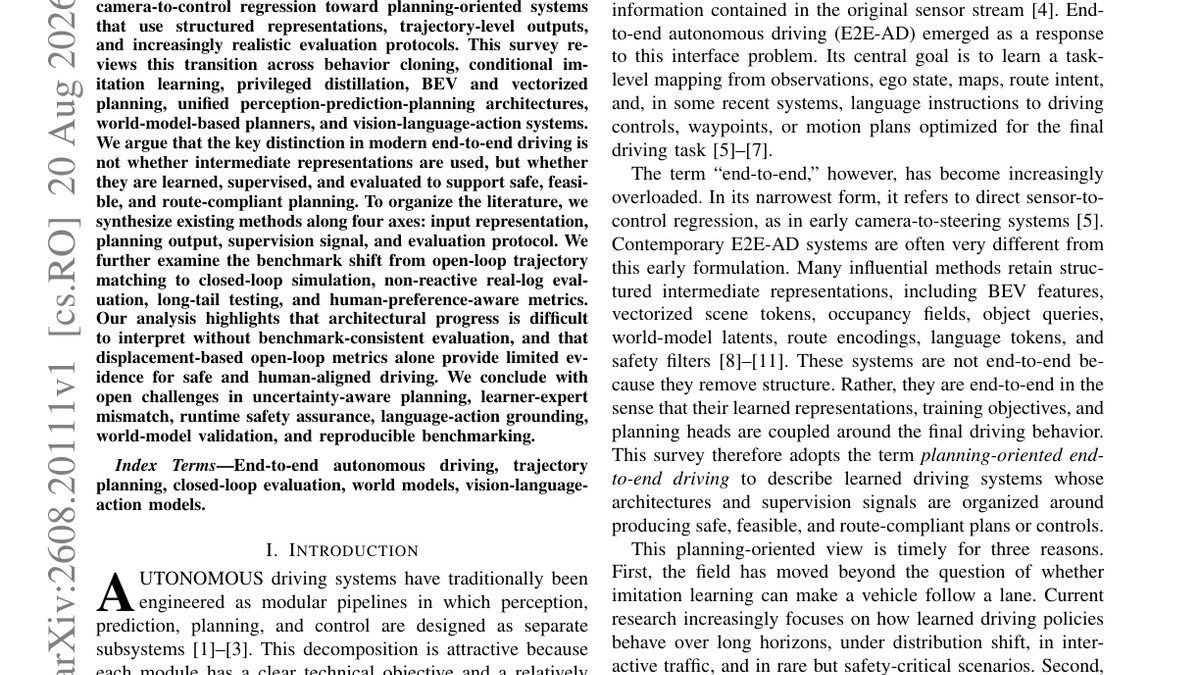
End-to-end autonomous driving has evolved from camera-to-control regression toward planning-oriented systems that use structured representations, trajectory-level outputs, and increasingly realistic evaluation protocols. This survey reviews this transition across behavior cloning, conditional imi...
A Browser-Native Digital Test Range for Benchmarking 4D Ocean-Glider Planning Algorithms
Edward Holmberg, Elias Ioup, Mahdi Abdelguerfi · arXiv preprint · Aug 2026
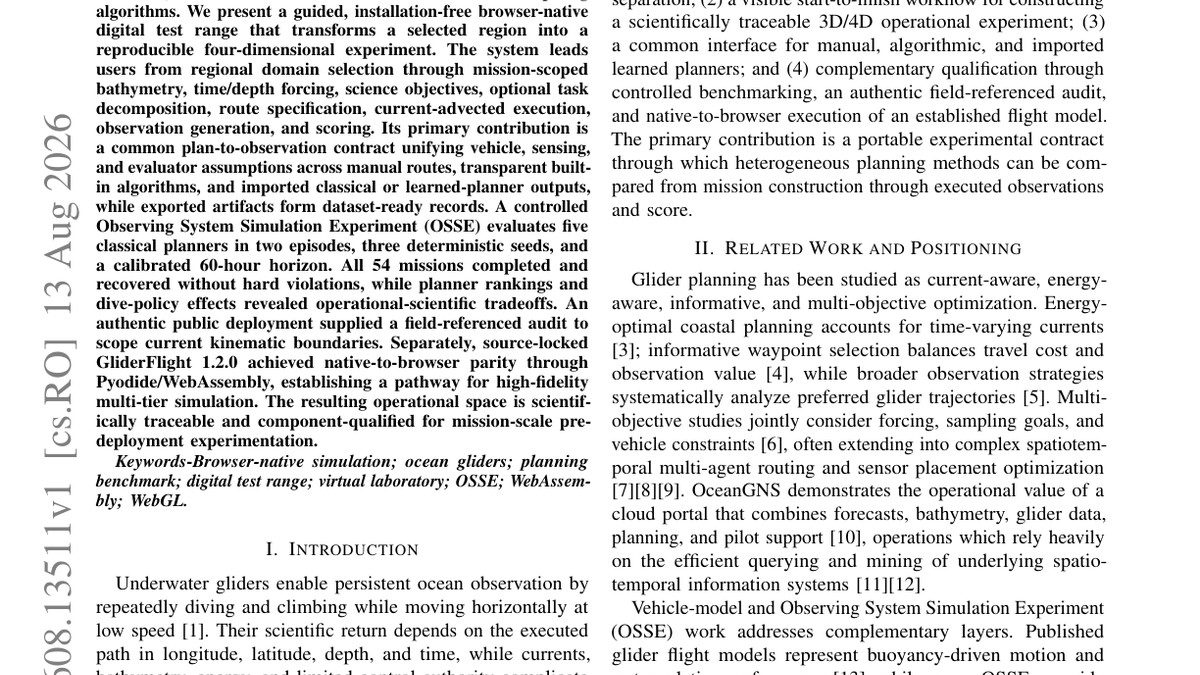
Repeated in-situ evaluation of ocean-glider planners requires scarce vehicles, operators, deployment and recovery resources, and ocean conditions that cannot be reset for competing algorithms. We present a guided, installation-free browser-native digital test range that transforms a selected regi...
A Low-Cost, Open Platform for End-to-End Autonomous Driving on a Miniature Ackermann Vehicle
Gustavo Claudio Karl Couto, Eric Aislan Antonelo, Gabriel George Zipperer · arXiv preprint · Sep 2026
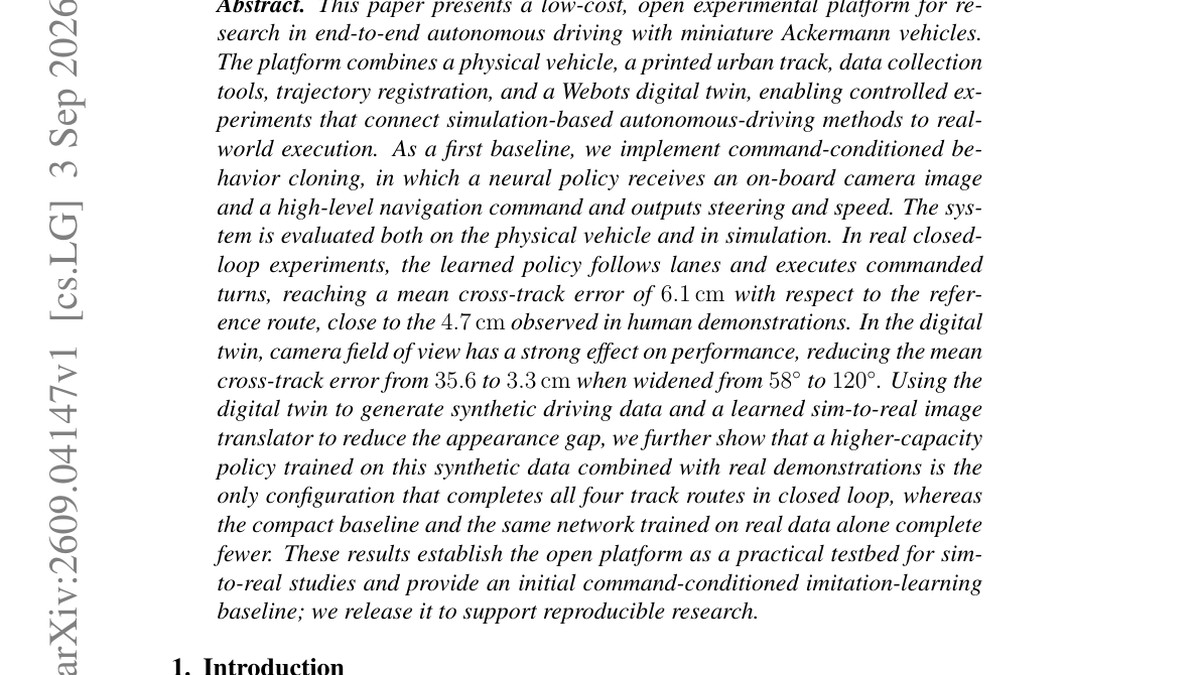
This paper presents a low-cost, open experimental platform for research in end-to-end autonomous driving with miniature Ackermann vehicles. The platform combines a physical vehicle, a printed urban track, data collection tools, trajectory registration, and a Webots digital twin, enabling controll...
Adaptation Needs in Robotic Systems: Assessing Behavior Trees and Their Enhancement
Mehran Rostamnia, Gianluca Filippone, Ricardo Caldas et al. · arXiv preprint · Sep 2026
Robotic systems increasingly operate in dynamic, uncertain, and open-ended environments, where design-time assumptions may no longer hold, and adaptation becomes necessary to maintain effective and safe operation. Behavior Trees (BTs) are widely used in robotic control architectures due to their ...