
SEED-UMI: Sharing the Exoskeleton between human and robot for onE-to-one Dexterous demonstration
Tengbo Yu, Jiahao Wu, Daohan Li, Bingxu Chen, Hao Liu, Xiaojian Ma, Hangxin Liu · N/A · 2026
Framework
N/A
License
N/A
Stars
N/A
Summary
Imitation learning for dexterous hands is bottlenecked by the difficulty of collecting contact-rich demonstrations that transfer faithfully to the robot. Prior wearable-exoskeleton systems record only on the human side and retarget via open-loop mappings calibrated in free space, which degrade un...
Abstract Summary
Key Points
- Imitation learning for dexterous hands is bottlenecked by the difficulty of collecting contact-ri...
- Prior wearable-exoskeleton systems record only on the human side and retarget via open-loop mappi...
- We present SEED-UMI, a framework in which both the human and the robot wear the same exoskeleton:...
- This turns retargeting into paired cross-embodiment supervision and lets policies train directly ...
- On five contact-rich tasks, SEED-UMI achieves 3.0x greater data collection efficiency than exoske...
SEED-UMI: Sharing the Exoskeleton between human and robot for onE-to-one Dexterous demonstration
|Authors: Tengbo Yu, Jiahao Wu, Daohan Li, Bingxu Chen, Hao Liu, Xiaojian Ma, Hangxin Liu
|Venue: arXiv preprint | Year: 2026
|arXiv: 2609.11753v1
Abstract
Imitation learning for dexterous hands is bottlenecked by the difficulty of collecting contact-rich demonstrations that transfer faithfully to the robot. Prior wearable-exoskeleton systems record only on the human side and retarget via open-loop mappings calibrated in free space, which degrade under contact. We present SEED-UMI, a framework in which both the human and the robot wear the same exoskeleton: joint encoders become a physically shared measurement, and wrist cameras mounted to the exoskeleton observe the same outer mechanism during both human data collection and robot policy rollouts. This turns retargeting into paired cross-embodiment supervision and lets policies train directly on raw exoskeleton-centric wrist images, without segmentation or inpainting. On five contact-rich tasks, SEED-UMI achieves 3.0x greater data collection efficiency than exoskeleton-based teleoperation and a 70.0% average rollout success rate.
Key Contributions
- Imitation learning for dexterous hands is bottlenecked by the difficulty of collecting contact-ri…
- Prior wearable-exoskeleton systems record only on the human side and retarget via open-loop mappi…
- We present SEED-UMI, a framework in which both the human and the robot wear the same exoskeleton:…
- This turns retargeting into paired cross-embodiment supervision and lets policies train directly …
- On five contact-rich tasks, SEED-UMI achieves 3.0x greater data collection efficiency than exoske…
Topics
- manipulation
- vision
- reinforcement-learning
- learning-from-demonstration
Code & Data
- GitHub repository: https://github.com/Tengbo-Yu/SEED-UMI
BibTeX
@article{Yu2026_260911753v1,
  title     = {SEED-UMI: Sharing the Exoskeleton between human and robot for onE-to-one Dexterous demonstration},
  author    = {Tengbo Yu and Jiahao Wu and Daohan Li and Bingxu Chen and Hao Liu and Xiaojian Ma and Hangxin Liu},
  year      = {2026},
  eprint    = {2609.11753v1},
  archivePrefix = {arXiv},
  primaryClass  = {cs.RO},
  url       = {https://arxiv.org/abs/2609.11753v1}
}
Related Papers
Design and Evaluation of a Touchscreen-Based Teleoperation Interface for Robotic Manipulators
Juan José García Cárdenas, Alperen Kenan, Hamidreza Raei et al. · arXiv preprint · Aug 2026
Intuitive teleoperation interfaces are crucial for the safe and effective operation of robotic manipulators in challenging environments. In the nuclear industry, surface contact tasks such as swab sampling require precise path and force tracking, obstacle avoidance, and sustained operator attenti...
DexVerse: A Modular Benchmark for Multi-Task, Multi-Embodiment Dexterous Manipulation
Yunchao Yao, Zhuxiu Xu, Tianqi Zhang et al. · arXiv preprint · Jul 2026
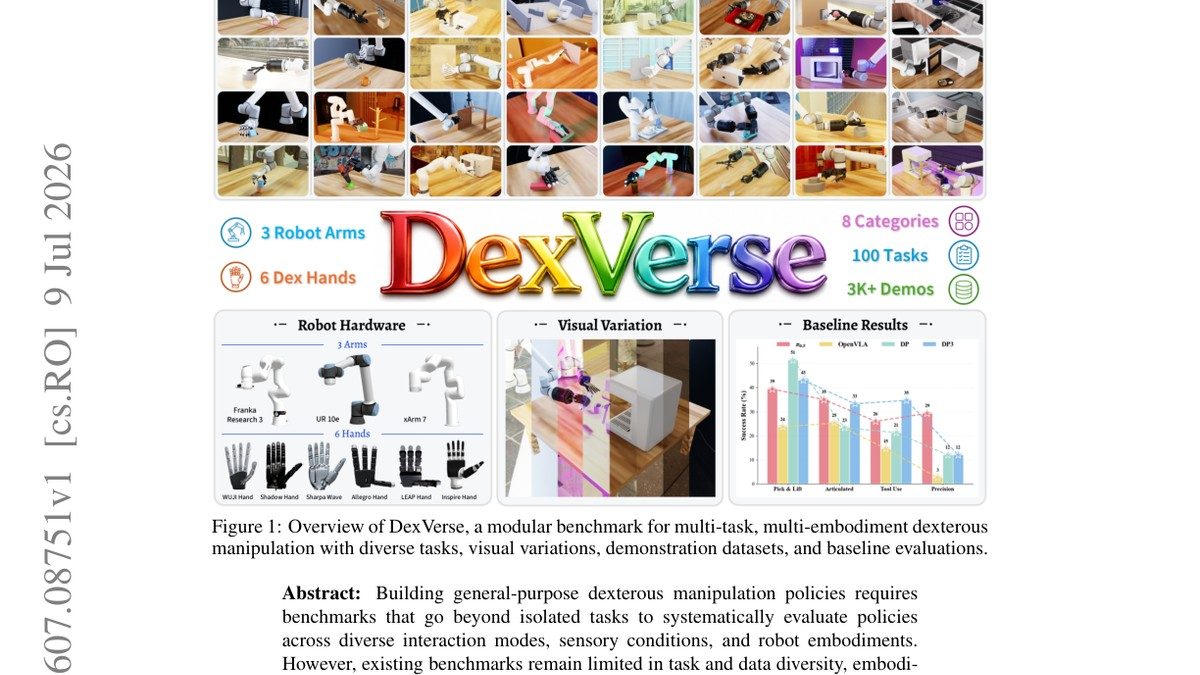
Building general-purpose dexterous manipulation policies requires benchmarks that go beyond isolated tasks to systematically evaluate policies across diverse interaction modes, sensory conditions, and robot embodiments. However, existing benchmarks remain limited in task and data diversity, embod...
GeniWorld: A Generalizable Interactive World Model for Robotic Manipulation via Visual Actions
Chenghao Gu, Hanyang Yu, Jingbo Zhang et al. · arXiv preprint · Aug 2026
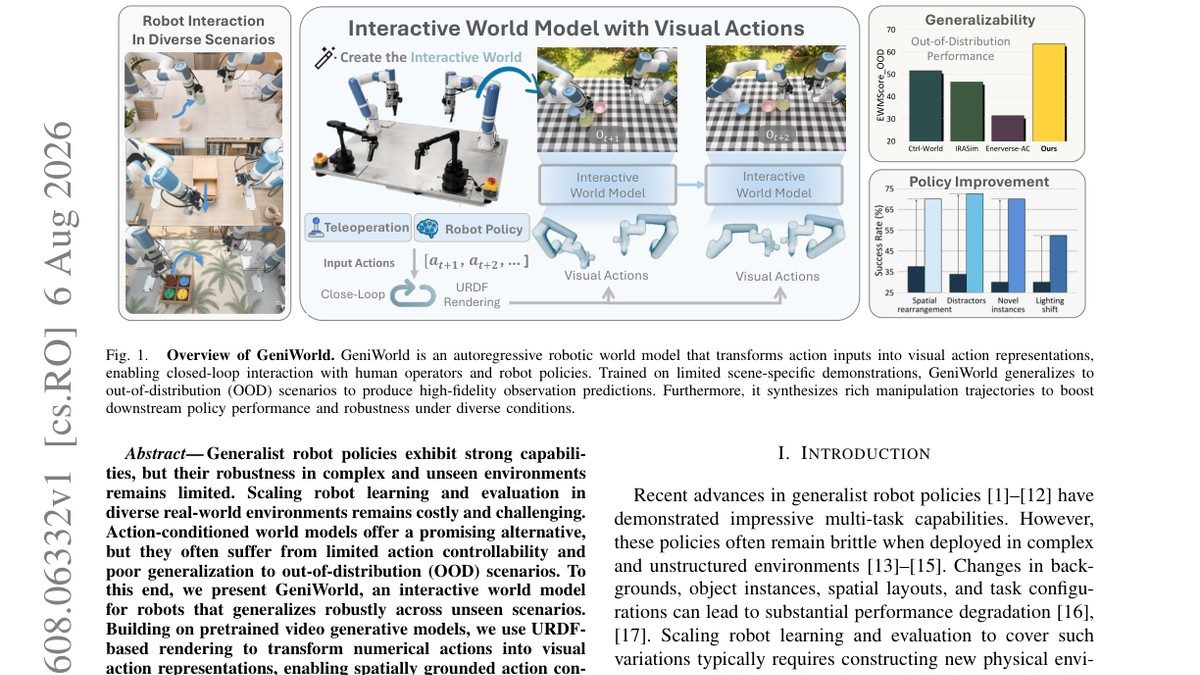
Generalist robot policies exhibit strong capabilities, but their robustness in complex and unseen environments remains limited. Scaling robot learning and evaluation in diverse real-world environments remains costly and challenging. Action-conditioned world models offer a promising alternative, b...
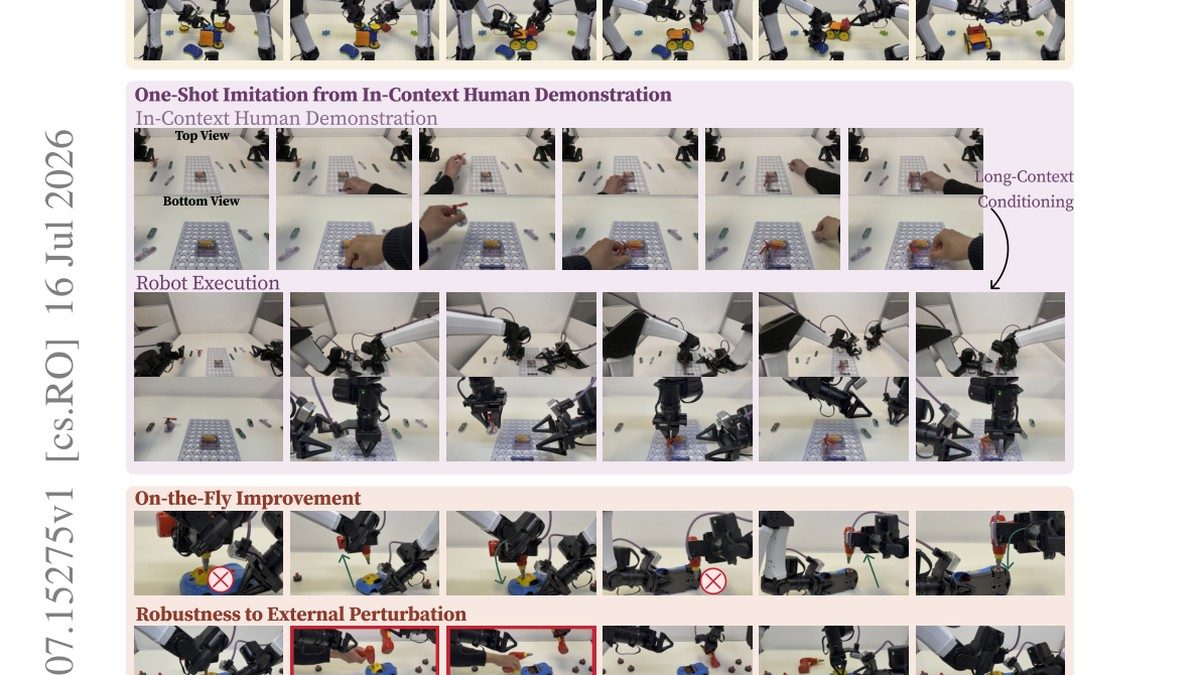
RoboTTT: Context Scaling for Robot Policies
Yunfan Jiang, Yevgen Chebotar, Ruijie Zheng et al. · arXiv preprint · Jul 2026
Recent robot foundation models operate with single-step or short-history visuomotor context. We introduce Test-Time-Training Robot Policies (RoboTTT), a robot model and training recipe that scale visuomotor context to 8K timesteps, three orders of magnitude beyond state-of-the-art policies, witho...